
Affiliate disclosure: This guide contains partner links. FoxyEco may earn a commission if you buy through them. Check the exact product, US availability and purchase terms before ordering.
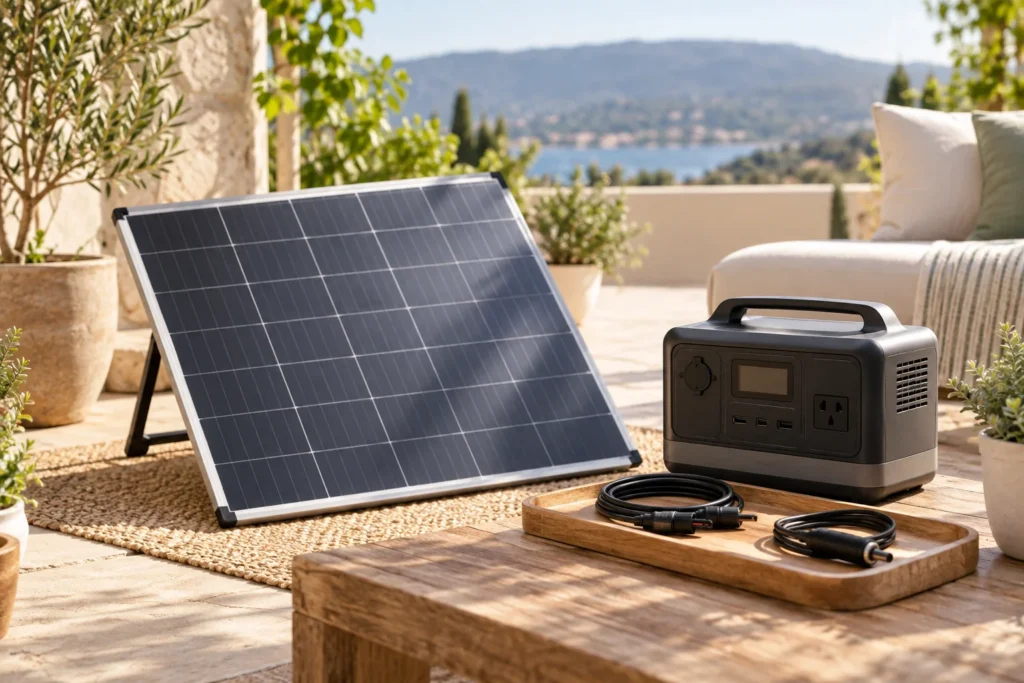
AI-generated editorial illustration. The scene is illustrative; it does not depict a FoxyEco product test or the exact appearance of a recommended model.
A panel’s watt rating is only one part of portable solar charging. Put the power station manual beside the panel specification and ask whether that exact combination stays within voltage, current, connector, and placement limits. A bigger printed number is not compatibility.
Start with the station’s solar input
Record permitted input-voltage range, current limit, power limit, and connection requirements for the precise regional variant. Keep maximums separate from recommended arrangements. Incomplete docs mean ask the manufacturer—do not infer from a lookalike model.
Read the panel’s electrical values
Open-circuit voltage, operating voltage, and current describe different conditions. Watts are test-condition ratings; real daylight, shade, and temperature change output. Keep the label with the kit.
Series and parallel are design choices
Series raises voltage; parallel raises current. Both must stay inside documented limits under relevant conditions. Do not assemble strings from generic internet diagrams or undocumented adapters. A smaller documented setup beats an improvised larger one.
Physical route matters
Measure cable distance from useful sun to a suitable battery location. Protect connectors, avoid trip hazards, and never pinch cables in doors. A panel may be outdoor-rated while the battery is not—plan to move equipment rather than inventing weather covers.
Honest replenishment math
Illustrative: 150 W average for 4 useful hours is about 600 Wh before other losses—about $0.12 of grid energy at $0.20/kWh. That is a planning sketch, not a forecast for a “200 W” panel in your yard.
Manufacturer examples: US BLUETTI AC200L lists up to 1,200 W solar input; FOSSiBOT F2400 lists 500 W—controller limits, not your weather. When comparing BLUETTI’s US solar-ready equipment with FOSSiBOT’s current configurations, keep exact model and cable details. Do not borrow EU configs for a US purchase.
Portability and checklist
If you will not carry or store the panel, it will not charge anything. Confirm packing list contents rather than trusting promo photos. Keep a grid or other charging option in the outage plan.
Questions people ask
Will any MC4 panel work? Connector shape is not electrical approval.
Clouds? Expect large drops; size plans with margin and alternatives.
Balcony rules? Check building and safety rules before mounting.
More scenarios that break the default plan
Guest weekends: brief visitors on the one rule that matters—bags by the door, fan after showers, no stacking on spray arms, no blocking vents on a battery.
Move-in or renovation dust: filters, seals, and sensors fail early; schedule an extra cleaning pass rather than blaming the product on day thirty.
Shared laundry or kitchen: post the two programs you actually use and the dose mark on the detergent bottle. Mystery settings create rewash waste.
Storm weeks: drafts, moisture, and outage prep collide. Check weatherstripping, dehumidifier drains, and battery charge the day before the forecast, not during the outage.
End-of-season sports or school gear: suddenly you have mud, extra loads, and forgotten bottles in bags. Retire damaged gear to the correct stream instead of stuffing another closet.
If two people disagree about “eco” settings, write a default and a temporary override. Unspoken rules do not survive Thursday night fatigue.
Document assumptions on a sticky note attached to the manual: rate used, hours assumed, and which housemate agreed to the trial window.
Failure modes worth logging
Write down the last three times power, water, or packaging problems cost you time or money. Specific dates beat vague frustration. Size purchases against that log.
After any setup change, schedule a verify date. Many backup and water “solutions” look fine until the next outage, windy night, or guest weekend.
Brief everyone who shares the space. One person can follow a careful charge routine while another drains the station for a nonessential load.
Seasonal and occupancy notes
Peak-occupancy days stress circuits and water differently from empty weekdays. Weather extremes change panel output, draft paths, and battery behavior. Inspect at season changes.
Travel weeks are when charge states drift, sensors go quiet, and packaging accumulates. Leave a short checklist for whoever remains home.
Decision checklist
- Name the failure in one sentence.
- Find the exact manual, label, or local rule that applies.
- Do only the checks you are allowed and equipped to do.
- Photograph serials, labels, and before/after conditions when useful.
- Decide: keep, repair, resize, replace, or stop buying.
- Calendar a verify date and keep cables next to the equipment they serve.
If a product page and your manual disagree, trust the manual for the unit you own, then ask the manufacturer in writing before forcing a connection.
Shade, angle, and cable discipline
Even a compatible panel underperforms with noon shade from a railing. Walk the sun path for the hours you actually expect to charge. Note trip hazards where cables cross doorways.
Do not leave connectors in standing water. Coil slack without sharp bends. Bring panels inside when wind advisories arrive if the stand is light.
Record a few days of observed wattage if the station displays input—compare to the panel’s nameplate so expectations stay honest.
Review the plan when you add a new appliance or change who lives in the home. Yesterday’s worksheet can understate today’s surge.
Keep a non-solar charging path in the plan. Multi-day cloud cover is normal in many climates; solar-only optimism creates dark evenings.
Rehearse once in daylight so nighttime fumbling is reduced.
Write down open-circuit voltage and connector type on a tape label attached to the panel cable.
Measured solar example
Illustrative: 150 W average for 4 useful hours delivers about 600 Wh before other losses—about $0.12 of grid energy at $0.20/kWh. Log your station’s input watts for three sunny noon hours to replace that illustration with your site’s numbers.
Measure cable run length before buying; a 25 ft need with only a 10 ft included cable is a $20–$40 adapter surprise, not a footnote.
Sources
Related guides
- Measure Your Essential Loads Before Buying Backup Power
- Where to Store a Portable Power Station at Home
Verified Eco Recommendation: Eco-Worthy
Off-grid monocrystalline solar panels, LiFePO4 battery banks, and hybrid inverter kits.
Explore Eco-Worthy Official Store →