
Affiliate disclosure: This guide contains partner links. FoxyEco may earn a commission if you buy through them. Check the exact product, US availability and purchase terms before ordering.
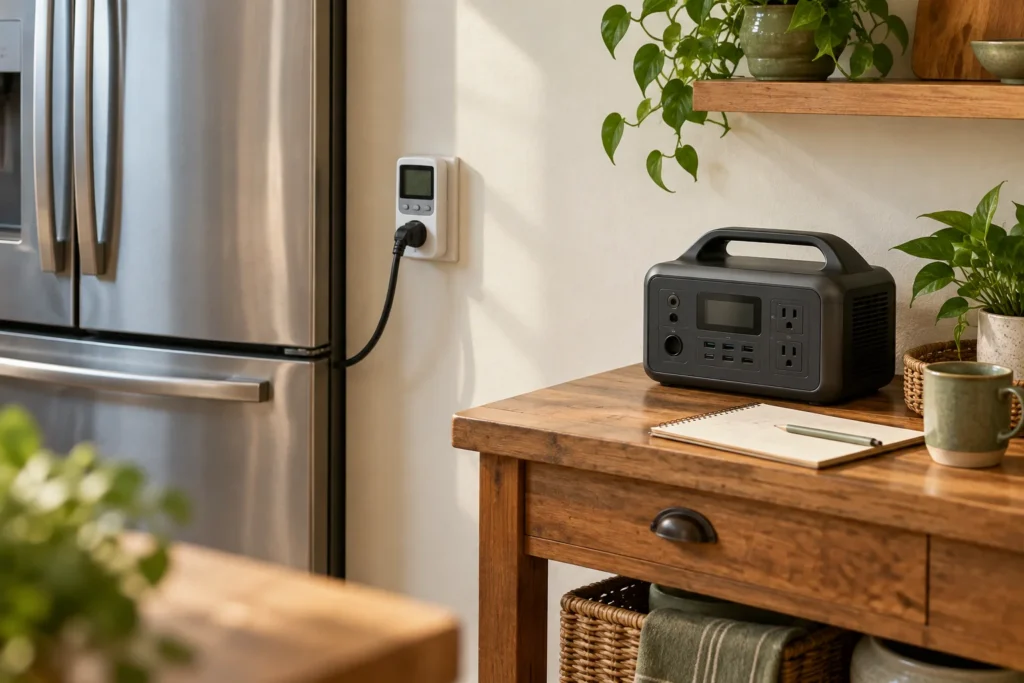
AI-generated editorial illustration. The scene is illustrative; it does not depict a FoxyEco product test or the exact appearance of a recommended model.
A backup battery should follow a load worksheet, not lead it. List devices that make an interruption manageable—lighting, communication, medical needs you are qualified to plan for, and any appliance you truly intend to run. Separate must-run from nice-to-have. The worksheet helps even if you decide not to buy.
Record a job, not just a name
Write a purpose beside each device: router for messages, lamp for a usable room, fridge as a cycling load that cannot be estimated by multiplying the largest label number by every hour. Note intended duration, shared use, and when you would change the plan. Include cables needed to make each job possible.
Watts vs watt-hours
Watts are instantaneous; watt-hours accumulate. Hypothetical 10 W lamp for 6 hours is 60 Wh; 12 W router for 8 hours is 96 Wh. Combined 156 Wh is arithmetic, not your measurement. At $0.20/kWh that energy is about $0.03 from the grid before charging losses—bill trivia does not equal resilience value.
Meter within ratings
Use a plug-in meter only on loads that fit its voltage, current, and load-type ratings. Max label ≠ average use; many meters miss short starting peaks. No unsuitable adapters, no wet locations, no measuring fixed circuits with consumer gadgets. Whole-house measurement needs proper equipment and qualified help.
Cycling appliances need representative intervals
For a fridge, accumulate energy over a period that includes normal cycling. Note room temperature, door openings, and restocking. Keep raw observations beside planning estimates.
Output and connection checks
Energy budgets do not prove a battery can start a load. Check continuous output, surge, regional waveform/voltage, and connection method. Never backfeed the house through a wall outlet. Fixed-circuit backup needs transfer equipment and pros.
Planning margin and brand comparison
If loads total 800 Wh and you allow 80% of a hypothetical 1,200 Wh pack, usable allowance is 960 Wh—160 Wh arithmetic headroom, not a guarantee of runtime, cold performance, or inverter efficiency.
Compare BLUETTI’s US range, FOSSiBOT’s available equipment, and Nature’s Generator’s documented systems against the same worksheet: exact battery, output limits, recharge sources, cables, storage, and service—not a single product-page halo for a whole brand.
Household routine
Save the worksheet offline. Mark which loads run together. Decide who checks charge, where cables live, and when to shed load. Review when appliances or people change.
Questions people ask
Can I run the whole house? Usually not from a portable station without proper transfer gear—and often not at all. Prioritize.
Medical devices? Follow clinician and manufacturer guidance; this article is not a medical plan.
Generator instead? Different fuel, noise, and safety story—compare with a dedicated backup guide.
More scenarios that break the default plan
Guest weekends: brief visitors on the one rule that matters for outage prep—priority loads only.
Storm weeks: check charge state the day before the forecast, not during the outage.
Document assumptions on a sticky note attached to the manual: rate used, hours assumed, and which housemate agreed to the trial window.
Failure modes worth logging
Write down the last three times power problems cost you time or money. Specific dates beat vague frustration. Size purchases against that log.
After any setup change, schedule a verify date. Many backup “solutions” look fine until the next outage.
Prioritize loads with a red-yellow-green list
Green: lights, phones, router. Yellow: fridge on a cycling plan. Red: space heaters, hair dryers, and whole-kitchen wish lists that blow past portable inverter limits.
Measure or estimate each green and yellow item. Add them in the combinations you would actually run together—not every nameplate at once.
Rehearse once: plug the priority strip into the station, confirm startup surges, and note what you turn off when the display drops faster than planned.
Review the plan when you add a new appliance or change who lives in the home. Yesterday’s worksheet can understate today’s surge.
Measured load example
Illustrative: a 10 W lamp for 6 hours is 60 Wh; a 12 W router for 8 hours is 96 Wh; together 156 Wh before inverter losses. At $0.20/kWh that energy is about $0.03 on-grid—resilience value is separate.
If essential loads total 800 Wh and you plan to use only 80% of a 1,200 Wh pack, usable allowance is 960 Wh—160 Wh arithmetic headroom. Revise after one measured outage drill.
Sources
- ENERGY STAR appliance buying guidance
- BLUETTI AC200L US documentation
- FOSSiBOT F2400 US documentation
- Nature’s Generator Standard 1800 documentation
Related guides
- BLUETTI AC200L vs Nature’s Generator 1800: Home Backup Compared
- Home Battery vs Dual-Fuel Generator: Plan Your Household Backup
Verified Eco Recommendation: Nature's Generator
Expandable solar and wind home backup power systems built for sustainable off-grid resilience.
Explore Nature's Generator Official Store →