
Affiliate disclosure: This guide contains partner links. FoxyEco may earn a commission if you buy through them. Check the exact product, US availability and purchase terms before ordering.
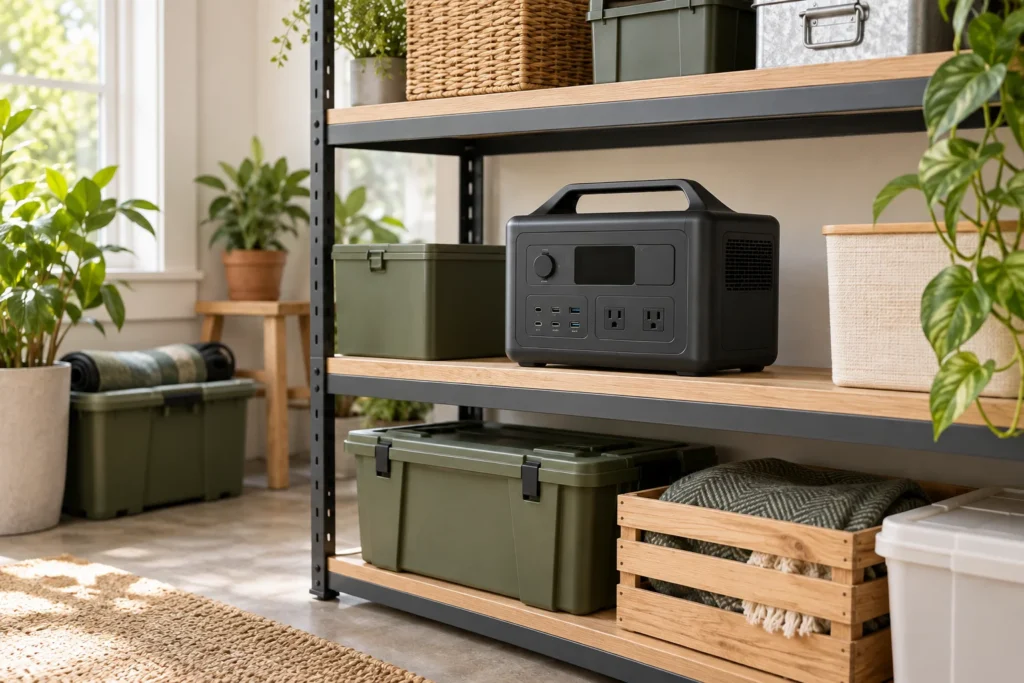
AI-generated editorial illustration. The scene is illustrative; it does not depict a FoxyEco product test or the exact appearance of a recommended model.
A portable power station is useful only if you can find it, move it, ventilate it, and charge it the way the manual allows. Pick a dry storage place, a suitable charging location, and a clear route between them before you shop by watt-hours alone.
Read storage and operating limits separately
Record temperature, moisture, ventilation, and charging conditions for the exact model. Do not borrow numbers from a similar-looking unit. If the manual is silent on your proposed cupboard, ask the manufacturer before treating that cupboard as approved.
Indoor-rated equipment in a garage can still see condensation, temperature swings, and vehicle exhaust dust. An awning does not make outdoor storage automatically safe.
Accessibility beats tidy hiding
A shelf must support the weight and allow a safe lift—no heroic overhead moves during an outage. Leave clearance for handles, vents, and cable uncoiling. Avoid locations that require moving furniture first.
Agree who is allowed to move the unit and where it returns after use. A battery left in a hallway becomes a trip hazard; one buried behind holiday decorations becomes a paperweight.
Air, cables, and what not to invent
Keep vents clear. Do not pack soft goods against cooling openings. Route supported cables without pinching them in doors. Supplying fixed household circuits needs transfer equipment and qualified installation—never backfeed through a wall outlet.
Waterproof boxes can create unsuitable operating enclosures. Follow the manual rather than improvising “protection.”
Charge and inspection routine
Keep the manual, model ID, and support contact together. Log charge state on a schedule taken from the manufacturer, not from a viral percentage rule. Some chemistries have specific long-term storage guidance—those win over forum folklore.
Illustrative: a 1,000 Wh display dropping from 60% to 50% is 100 Wh of nominal arithmetic, not proof of a fault. Compare with the manual and time elapsed.
Accessories are part of capacity
Store the approved charger and cables labeled. Incompatible cables in the same bin create dangerous guesses at 2 a.m. A forgotten charger turns stored energy into a short evening of light.
When comparing BLUETTI’s US portable range or FOSSiBOT’s available stations, match dimensions, weight, handling, and service arrangements to the storage plan—not capacity alone.
Questions people ask
Garage OK? Only if the manual’s environment limits are met year-round.
Charge to 100% always? Follow the exact product guidance for standby storage.
Kids and pets? Place out of reach; treat cables as chew hazards.
More scenarios that break the default plan
Guest weekends: brief visitors on the one rule that matters—bags by the door, fan after showers, no stacking on spray arms, no blocking vents on a battery.
Move-in or renovation dust: filters, seals, and sensors fail early; schedule an extra cleaning pass rather than blaming the product on day thirty.
Shared laundry or kitchen: post the two programs you actually use and the dose mark on the detergent bottle. Mystery settings create rewash waste.
Storm weeks: drafts, moisture, and outage prep collide. Check weatherstripping, dehumidifier drains, and battery charge the day before the forecast, not during the outage.
End-of-season sports or school gear: suddenly you have mud, extra loads, and forgotten bottles in bags. Retire damaged gear to the correct stream instead of stuffing another closet.
If two people disagree about “eco” settings, write a default and a temporary override. Unspoken rules do not survive Thursday night fatigue.
Document assumptions on a sticky note attached to the manual: rate used, hours assumed, and which housemate agreed to the trial window.
Failure modes worth logging
Write down the last three times power, water, or packaging problems cost you time or money. Specific dates beat vague frustration. Size purchases against that log.
After any setup change, schedule a verify date. Many backup and water “solutions” look fine until the next outage, windy night, or guest weekend.
Brief everyone who shares the space. One person can follow a careful charge routine while another drains the station for a nonessential load.
Seasonal and occupancy notes
Peak-occupancy days stress circuits and water differently from empty weekdays. Weather extremes change panel output, draft paths, and battery behavior. Inspect at season changes.
Travel weeks are when charge states drift, sensors go quiet, and packaging accumulates. Leave a short checklist for whoever remains home.
Decision checklist
- Name the failure in one sentence.
- Find the exact manual, label, or local rule that applies.
- Do only the checks you are allowed and equipped to do.
- Photograph serials, labels, and before/after conditions when useful.
- Decide: keep, repair, resize, replace, or stop buying.
- Calendar a verify date and keep cables next to the equipment they serve.
If a product page and your manual disagree, trust the manual for the unit you own, then ask the manufacturer in writing before forcing a connection.
Garage, closet, and hallway tradeoffs
Garages swing from freezing to hot; closets may lack airflow; hallways create trip hazards. Score each candidate spot for temperature stability, dryness, lifting height, and cable reach to an approved charging outlet.
During a drill, time how long it takes to move the station to the intended load. If the drill takes five minutes of furniture moving, the storage spot fails the outage test.
Label the approved charger and bag spare fuses or tips the manual lists. A station without its charger is a heavy paperweight.
Review the plan when you add a new appliance or change who lives in the home. Yesterday’s worksheet can understate today’s surge.
Store a printed one-page outage card with the station: priority loads, shutoff locations, and who to call. Phones die; paper does not need a charger.
Rehearse once in daylight so nighttime fumbling is reduced.
Measured storage example
Illustrative: a 1,000 Wh station showing 60% then 50% between weekly checks is 100 Wh of nominal arithmetic—not automatic proof of a fault. Compare against the manual’s storage guidance and the days elapsed.
Time a drill: if moving the unit from storage to the fridge outlet takes more than 3 minutes of furniture shifting, the storage spot fails the outage usability test.