
Affiliate disclosure: This guide contains partner links. FoxyEco may earn a commission if you buy through them at no additional cost to you. Verify rough-in dimensions, supply line compatibility, and local plumbing codes before purchasing.
Toilets represent the single largest indoor water consumer in residential properties, accounting for approximately 27% to 30% of total municipal water usage in average households. Across North America, millions of pre-1994 homes continue to operate legacy fixtures consuming 3.5 to 5.0 gallons per flush (GPF). Retrofitting to an EPA WaterSense certified dual-flush toilet (or converting existing tanks with modern dual-actuator valve assemblies) dramatically reduces per-capita water demand. This engineering guide examines gallons-per-flush math, fluid dynamics of siphonic jet bowl clearing, Maximum Performance (MaP) test thresholds, and silent flapper leak diagnostics.
Water conservation is not merely an environmental stewardship priority; it is an immediate operational cost reduction. Because municipal utility bills meter both water supply inflow and sewer discharge outflow (often assessing sewer charges at 120% to 150% of clean water rates), reducing toilet flush volume delivers compounding financial returns on municipal utility bills.
Gallons-Per-Flush Math: The Volumetric Savings Model
Under the federal Energy Policy Act of 1992 (EPAct), residential toilets sold after 1994 were capped at a maximum of 1.6 GPF (6.0 liters per flush). The EPA WaterSense program advanced this threshold by requiring certified fixtures to achieve at least 20% greater efficiency than the federal standard, setting a ceiling of 1.28 GPF (4.8 LPF) for single-flush models.
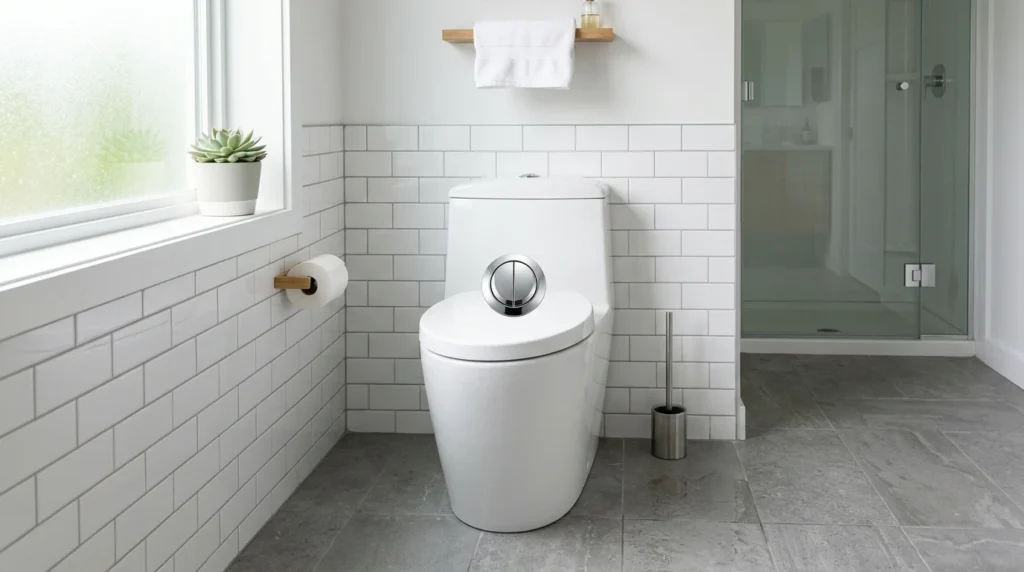
Dual-flush systems provide two discrete volumetric settings operated via split top-mounted push buttons:
- Reduced Flush (Liquid / Light Waste): Discharges 0.8 GPF (3.0 LPF), utilizing rapid gravitational dump velocity to clear liquid contents.
- Full Flush (Solid Waste): Discharges 1.28 to 1.6 GPF (4.8 to 6.0 LPF), activating a full siphonic action to evacuate high-density solids.
In real-world residential use patterns, demographic data indicates an average individual flushes five times per day: four liquid flushes and one solid flush (a 4:1 operational ratio). The weighted average volumetric consumption is calculated as:
Weighted Average GPF = (4 × 0.8 GPF + 1 × 1.6 GPF) / 5 = 0.96 GPF
For a four-person household generating 20 daily flushes, replacing an aging 3.5 GPF toilet with a 0.96 weighted GPF dual-flush fixture saves 50.8 gallons daily. Over a full year, this simple upgrade saves 18,542 gallons of treated municipal water.
Precision Flow Control & Water Fixtures: Cangyu
High-efficiency ceramic sanitaryware, advanced dual-flush valves, and water-conserving bathroom hardware engineered for maximum flow reduction and durability.
Visit Shenzhen Cangyu Technology Co., Ltd. Official Portal →Fluid Dynamics: Siphonic Jet vs European Washdown Mechanics
A frequent homeowner hesitation regarding low-flow toilets is the fear of clogging or requiring multiple flushes. Overcoming this requires understanding bowl evacuation fluid mechanics:
1. Siphonic Jet Systems (Predominant in North America): When the flush valve lifts, water enters both the rim wash perforations and a dedicated lower jet opening aimed directly into the trapway. The high-velocity jet primes the trapway instantly, creating a negative pressure differential (siphon vacuum) that pulls water and waste out of the bowl. Siphonic bowls maintain a larger water surface area (preventing bowl skid marks) and operate with minimal splashing.
2. Direct Washdown Systems (Common in Europe): Washdown bowls utilize steep bowl slopes and a direct gravitational torrent of water from the rim to push waste through an enlarged 3-inch trapway. While highly clog-resistant with very low water volumes (0.8 GPF), washdown bowls have smaller standing water spots, occasionally requiring manual brush cleaning.
To verify solid waste clearance reliability, consumers should consult independent Maximum Performance (MaP) Testing scores. MaP ratings measure the grams of soybean paste and toilet paper successfully evacuated in a single flush without clogging. The WaterSense program requires a minimum score of 350 grams, while premium dual-flush units regularly achieve 800 to 1,000 grams (MaP 1000)—far exceeding human physiological demands.
Financial Payback and Household Water Audit
The table below summarizes annual volumetric water consumption and utility costs across a four-person household under different toilet fixture generations, assuming a combined water and sewer rate of $9.50 per 1,000 gallons.
| Fixture Generation | Rated Flush Volume | Annual Water Used (20 flushes/day) | Annual Utility Cost | Annual Savings vs Pre-1994 Baseline |
|---|---|---|---|---|
| Pre-1994 Legacy Toilet | 3.50 GPF | 25,550 gallons | $242.73 | $0.00 (Baseline) |
| Standard EPAct 1994 Fixture | 1.60 GPF | 11,680 gallons | $110.96 | $131.77 |
| Standard WaterSense Fixture | 1.28 GPF | 9,344 gallons | $88.77 | $153.96 |
| Modern Dual-Flush System | 0.96 GPF (Weighted) | 7,008 gallons | $66.58 | $176.15 |
With high-quality dual-flush toilet retrofit kits priced around $40 to $70, and complete replacement WaterSense ceramic commodes ranging from $180 to $280, the return on investment (ROI) is realized within 12 to 20 months. Homeowners can model broader household plumbing efficiency and leak rates using our Home Water Leak Waste & Low-Flow Calculator.
Silent Flapper Leak Prevention and Dye Testing Protocol
Even a 0.8 GPF toilet can become a major water waster if the internal tank seal degrades. A warped flapper or misaligned flush tower valve can leak a continuous, silent stream of 30 to 250 gallons per day directly down the overflow tube and into the bowl, adding $50 to $100 per month to utility bills without making an audible dripping sound.
To detect and prevent silent tank leaks, follow this standard plumbing diagnostic protocol:
- The Food Coloring Dye Test: Remove the tank lid and deposit 10 to 15 drops of dark blue or red food coloring into the tank water. Do not flush. Wait 25 minutes. If colored water appears in the toilet bowl, the flapper or seal gasket is leaking and requires immediate replacement.
- Upgrade from Rubber to Silicone: Municipal tap water treated with chlorine and chloramines rapidly hardens traditional black rubber flappers, causing micro-fissures within 18 months. Always install chlorine-resistant silicone or polyurethane seal gaskets.
- Verify Water Fill Level: Ensure the tank water level sits exactly 1/2-inch to 1-inch below the top of the overflow tube. If the fill valve float is adjusted too high, water will constantly trickle down the overflow tube.
Upgrade Your Bath with High-Efficiency Plumbing
Durable water-saving plumbing fittings, dual-flush ceramic fixtures, and precision flow cartridges designed to eliminate silent leaks and lower utility costs.
Visit Shenzhen Cangyu Technology Co., Ltd. Official Portal →Frequently Asked Questions
Can I convert an existing standard toilet into a dual-flush toilet?
Yes. Universal dual-flush conversion kits replace the traditional flapper and trip lever with a drop-in flush tower and split-button mechanism. Installation takes roughly 30 minutes without requiring tank removal or complex plumbing tools.
Do low-flow toilets cause sewer line blockages (“dry pipe syndrome”)?
In standard residential homes with standard slope plumbing (1/4-inch pitch per foot), modern dual-flush toilets provide sufficient kinetic velocity to carry solids through 3-inch and 4-inch drain lines. Blockages only occur if building drain slopes are flatter than plumbing code minimums or if non-flushable wipes are introduced.
Do local water utilities offer rebates for WaterSense toilet upgrades?
Yes. Hundreds of municipal water districts and city utilities offer cash rebates ranging from $50 to $150 per qualifying WaterSense certified fixture to mitigate peak municipal water treatment demands.