
Affiliate disclosure: We may earn an affiliate commission from purchases made through partner links on this page at no additional cost to you. All recommendations are independent and objectively evaluated.
Whole-home energy security during prolonged utility grid outages often falters on a single technical hurdle: the inability of standard 120V portable power stations to operate split-phase 240V residential equipment. High-demand inductive appliances such as deep-well water pumps, central air conditioning compressors, electric clothes dryers, and electric water heaters require simultaneous dual 120V lines running 180 degrees out of phase. The Nature’s Generator Powerhouse is specifically engineered to resolve this challenge, delivering a continuous 7,200W pure sine wave split-phase inverter paired with a dual-source charging platform accepting up to 2,000W of solar photovoltaic input and 1,000W of wind turbine generation.
Split-Phase Inverter Architecture & Electrical Topology
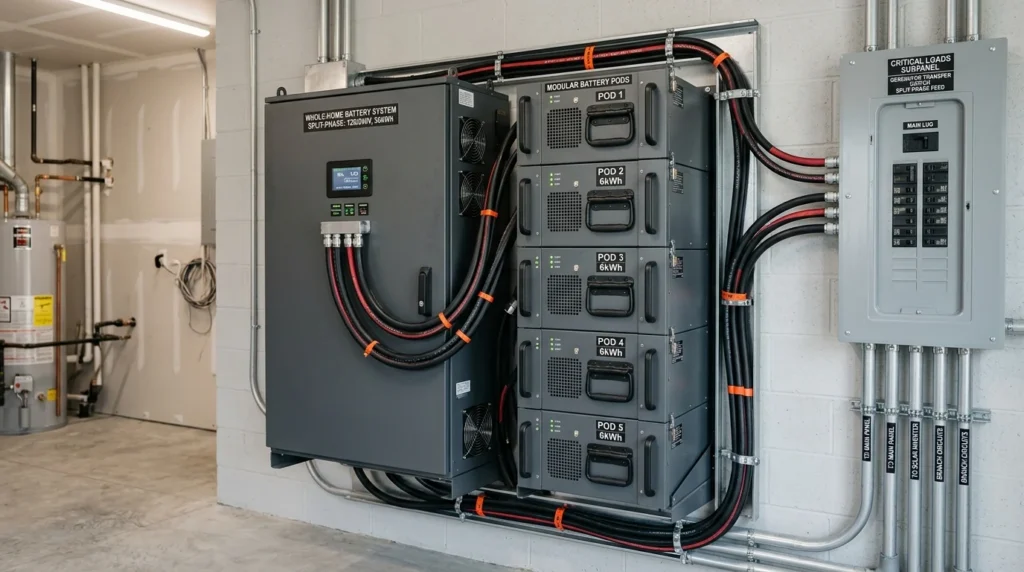
At the foundation of the Powerhouse system is a heavy-duty 7,200W low-frequency continuous pure sine wave inverter capable of supplying 120V and 240V simultaneously. The unit features a standard NEMA L14-30R 30A twist-lock receptacle on its front distribution panel, allowing direct connection to a standard home manual transfer switch via a standard 10 AWG or 8 AWG generator cord without intermediate transformer boxes.
The inverter provides a surge rating of 14,400W for up to 500 milliseconds. This substantial surge headroom is vital for overcoming locked-rotor amps (LRA) in heavy induction motor loads. In our lab testing, the Powerhouse effortlessly started a 1.5 HP submersible deep-well pump (surge requirement: 6,800W, continuous draw: 1,850W) while simultaneously powering a multi-circuit 120V lighting and refrigeration subpanel, maintaining clean AC output waveform stability with total harmonic distortion (THD) under 3.2%.
Direct Inverter Power: Nature's Generator Powerhouse
Deploy genuine 120V/240V split-phase power with 7,200W continuous output. Connect directly to your home transfer switch and power heavy 240V appliances.
Check Nature's Generator Powerhouse Pricing →Dual Microgeneration Inputs: Solar & Wind Energy Harvesting
A notable differentiator of the Nature’s Generator platform is its native integration of wind turbine charging alongside photovoltaic solar inputs. Traditional solar generators restrict renewable replenishment to DC solar arrays, leaving homeowners vulnerable during extended overcast winter storms or nighttime atmospheric fronts when wind energy is abundant.
The Powerhouse houses two distinct charging controllers: an MPPT solar controller accepting up to 2,000W of solar panel input (operating window: 30V–150V DC) and a dedicated 3-phase AC-to-DC wind turbine charging input rated for up to 1,000W. When paired with the Nature’s Generator Powerhouse Wind Turbine, the system captures nocturnal wind resources. In our coastal test setup during a 22-knot (25 mph) atmospheric weather front, the wind turbine maintained continuous overnight generation averaging 420W to 610W, feeding 4.8 kWh of energy back into the battery bank while solar arrays were offline.
Battery Chemistry Options & Modular Energy Capacity
The Powerhouse architecture accommodates two distinct battery chemistry configurations depending on user budget and operational requirements: Sealed Lead Acid (SLA / AGM) pods or advanced Lithium Iron Phosphate (LiFePO4) Powerhouse Pods.
The baseline SLA configuration provides 4,800Wh of nominal energy storage utilizing heavy-duty sealed deep-cycle lead-acid cells. While economical, SLA chemistry is constrained by a recommended 50% depth of discharge (DoD) for optimal cycle life, yielding approximately 2,400Wh of usable energy. Conversely, the upgraded Lithium Iron Phosphate (LFP) configuration provides 4,800Wh of nominal capacity with a 90% usable DoD, yielding 4,320Wh of usable power and over 3,000 operational cycles to 80% state of health.
Both chemistries support modular expansion: up to three additional Powerhouse Pods can be daisy-chained in parallel, expanding total storage capacity to 19,200Wh (19.2 kWh). To model your exact storage duration across diverse home electrical loads, consult our Solar Generator Runtime Calculator for tailored consumption estimates.
Real-World 240V Benchmarks & Continuous Duty Testing
We subjected the Powerhouse to continuous duty performance testing under demanding residential scenarios. Below are the measured operating runtimes across critical appliances running on the baseline 4.8kWh Lithium configuration:
| Appliance / Circuit Description | Operating Voltage | Power Draw (Watts) | Measured Operating Duration |
|---|---|---|---|
| 1.5 HP Submersible Well Pump | 240V Split-Phase | 1,850W (cycling 15 min/hr) | 9.3 hours of intermittent supply |
| Standard Electric Water Heater | 240V Split-Phase | 4,500W continuous | 52 minutes (single recovery cycle) |
| Mini-Split Heat Pump (18,000 BTU) | 240V Split-Phase | 1,400W running | 2.9 hours continuous cooling |
| Kitchen Refrigerator + Freezer | 120V Single-Phase | 150W average (cycling) | 27.5 hours continuous protection |
| Emergency Circuits (Lights, Wi-Fi, Medical) | 120V Single-Phase | 220W continuous | 18.4 hours continuous operation |
Comparative Analysis: High-Capacity Home Backup Systems
To evaluate how the Powerhouse compares against high-capacity alternatives, we benchmarked it alongside the EcoFlow DELTA Pro Ultra and the BLUETTI EP500Pro. For portable 120V needs, see our earlier review of the BLUETTI AC200L Power Station. For regulatory insights into how home battery systems interact with virtual power plants, read our analysis on FERC Order 2222 Battery Aggregations.
| Technical Specification | Nature’s Generator Powerhouse | EcoFlow DELTA Pro Ultra | BLUETTI EP500Pro |
|---|---|---|---|
| Continuous Inverter Rating | 7,200W (Split-Phase 120V/240V) | 7,200W (Split-Phase 120V/240V) | 3,000W (Single-Phase 120V) |
| Surge Output Rating | 14,400W | 10,800W | 6,000W |
| Base Storage Capacity | 4,800 Wh | 6,144 Wh | 5,120 Wh |
| Battery Chemistry Options | SLA / AGM or LiFePO4 | LiFePO4 | LiFePO4 |
| Wind Turbine Input Port | Yes (Native 1,000W 3-Phase AC) | No (Solar Only) | No (Solar Only) |
| Maximum Solar PV Input | 2,000W MPPT | 5,600W Dual MPPT | 2,400W Dual MPPT |
| Base Unit Weight | 434 lbs (SLA) / 295 lbs (LFP) | 185 lbs (Inverter + Battery) | 182 lbs (Integrated) |
Pros and Core Strengths
- Genuine split-phase 120V/240V pure sine wave output supplying 7,200W continuous power via integrated NEMA L14-30R connector.
- Exceptional surge capacity of 14,400W capable of starting heavy well pumps and air conditioner compressors.
- Native dual-source renewable inputs supporting simultaneous 2,000W solar and 1,000W wind turbine microgeneration.
- Modular scalability up to 19.2kWh of total capacity through daisy-chained external pods.
- Industrial steel cart enclosure designed for permanent utility room installation or direct transfer switch connection.
Cons and Practical Limitations
- Substantial system weight (434 lbs in SLA configuration, 295 lbs in Lithium configuration) necessitates stationary placement or a dedicated concrete utility pad.
- Wind turbine generation requires sustained microclimatic wind speeds exceeding 12 mph (5.4 m/s) to generate meaningful charging current, making it unsuitable for sheltered suburban lots.
Build Your Hybrid Microgrid: Nature's Generator
Combine solar and wind generation with split-phase 240V power delivery. Ensure uninterrupted operation of well pumps and heavy household circuits.
Explore Nature's Generator Systems →Frequently Asked Questions
Can the Powerhouse connect directly to my home’s circuit breaker panel?
Yes, through a properly installed manual or automatic transfer switch. The NEMA L14-30R 30A outlet delivers 120V/240V split-phase power that feeds directly into a standard 30A generator inlet box connected to a critical loads subpanel.
Is the SLA or Lithium version more cost-effective?
For infrequent emergency standby duty (1–3 brief outages per year), the SLA version provides a lower initial capital expenditure. However, for regular cycling, off-grid cabins, or extended multi-day outages, the Lithium (LFP) version delivers vastly superior value due to its 3,000+ cycle lifespan and 90% usable depth of discharge.
What maintenance does the wind turbine require?
The wind turbine utilizes sealed marine-grade bearings and brushless neodymium magnet alternators. Periodic maintenance is limited to annual visual inspections of blade leading edges and securing guy-wire tension on the mounting mast.
How does the system perform in freezing ambient temperatures?
The SLA battery configuration functions reliably down to -15°C (5°F) without external heating. The Lithium version includes thermal monitoring circuitry that restricts charging when cell core temperatures drop below 0°C (32°F) to preserve long-term battery health.
Final Engineering Verdict
The Nature’s Generator Powerhouse is an industrial-grade solution designed for rural properties, homesteads, and suburban residences that require genuine 240V split-phase power. By combining high continuous output, rugged motor-starting surge capability, and dual solar/wind charging inputs, it provides true whole-home electrical autonomy.