
Disclosure: this guide contains partner links to BLUETTI and Nature’s Generator, marked as sponsored. FoxyEco may earn a commission if you buy through them, at no extra cost to you.
Short answer: choose a battery when your outages are usually shorter than about 24 to 48 hours, when you need quiet power indoors (apartments, medical devices, night use), or when you cannot store fuel or place a generator safely. Choose a generator when outages regularly run for several days, when you need to run large loads such as a 240 V well pump or central air, and when you have a safe outdoor location at least 20 feet from the house. Many households end up with both: a battery for the first day and for night-time, and a generator to recharge it or carry heavy loads during long events.
This guide compares technologies. To size whichever you choose, start with How to measure your essential loads and How to size a home backup battery.
The four options
- Portable power station (roughly 1 to 5 kWh, often expandable): plug-in loads directly, or selected circuits through a manufacturer transfer panel or inlet and transfer switch.
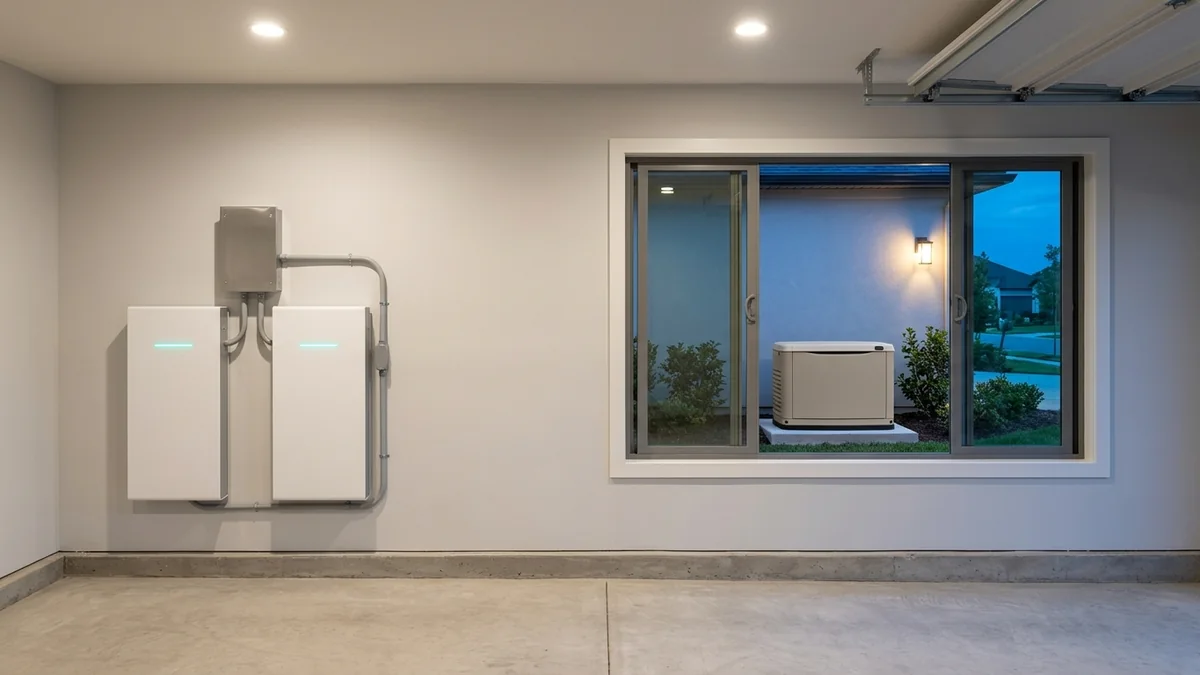
- Installed home battery (typically 10 to 15 kWh per unit, stackable): wired by an electrician, switches over automatically, often paired with rooftop solar. Tesla’s Powerwall 3, for example, is specified at 13.5 kWh of energy and 11.5 kW of continuous output.
- Portable dual-fuel generator (gasoline and propane, a few kW): manual start and connection, outdoors only.
- Standby generator (natural gas or propane, larger outputs): permanently installed outside with an automatic transfer switch.
Side-by-side
| Question | Portable station | Installed battery | Portable dual-fuel generator | Standby generator |
|---|---|---|---|---|
| How long can it run? | Until the stored energy is used; hours to about 2 days for essentials | About 1 to 3 days for essentials per unit, longer with solar | As long as fuel lasts and you refuel safely | As long as the gas supply lasts |
| Can it run indoors? | Yes, per the manual’s placement rules | Installed per code, often in garage or outdoors | Never | Never; fixed outdoor location with clearances |
| Noise | Fan noise only | Fan noise only | Engine noise; check local ordinances | Engine noise; weekly self-test cycles |
| Fuel or recharge | Grid, solar, car or generator | Grid or solar | Gasoline (degrades in storage) or propane (stores well) | Utility gas or propane tank |
| Large 240 V loads | Only on larger 120/240 V models | Yes, within the inverter rating | Larger models only | Yes |
| Upkeep | Periodic charge checks | Software updates, little else | Oil, fuel stabilizer, regular test runs | Annual service, oil, filters |
| Installation | None for plug-in use | Electrician, permit, often utility notification | Transfer switch or interlock for house circuits | Electrician, gas fitter, permit |
Runtime: the honest comparison
A battery’s runtime is fixed by its energy. Using the example household in the sizing guide, a refrigerator, CPAP, router and lights draw about 3,050 Wh per day from the battery once inverter losses and idle draw are counted. A 2 kWh station, keeping a 15% reserve, runs that list for roughly 13 hours; a 13.5 kWh installed battery for about 4 days, before solar.
A generator’s runtime is fixed by its fuel tank and your willingness to refuel. Fuel use is listed in each generator’s manual as hours per tank at a given load, and propane output is usually rated lower than gasoline output on dual-fuel models. Read both figures for the fuel you will actually store. Generators are also inefficient at very light loads: running a large engine to power a router overnight wastes fuel, which is one reason the battery-plus-generator hybrid works well.
Safety: carbon monoxide is the deciding factor
Portable generators kill people every year through carbon monoxide poisoning. The US Consumer Product Safety Commission’s 2011 to 2021 data put the average at about 85 consumer deaths per year from portable generators, most of them at home. CPSC guidance is to operate a generator only outdoors, at least 20 feet from the house, with exhaust pointed away from windows, doors and vents. Opening a garage door does not make a garage safe. Look for models with an automatic CO shut-off certified to ANSI/PGMA G300-2018 or UL 2201, and install battery-powered CO alarms on every level of the home.
If your property has no safe location that meets that distance, for example an apartment, a narrow townhouse lot or a home where the only outdoor space is next to bedroom windows, a portable generator is not a suitable option, and a battery is the answer by default.
Batteries have their own safety rules. Choose equipment listed to the relevant safety standards: UL 9540 for installed energy storage systems, with UL 9540A fire testing behind the installation rules, and the product listing on the manufacturer’s documentation for portable stations. In the US, the International Residential Code section R328 and NFPA 855 limit how much stored energy can be installed in different parts of a home. The 2021 IRC, for example, limits individual units to 20 kWh and sets aggregate limits for utility rooms, garages and outdoor walls. Your building department applies the edition it has adopted. The battery safety standards update explains how these fit together.
Connecting to the house
Neither a battery nor a generator should ever be connected to house wiring through a wall outlet with a double-ended cord. Backfeeding energizes your panel and can energize the utility line outside, endangering line workers and neighbours. House circuits need a listed transfer switch, a breaker interlock, a utility-approved meter collar where offered, or a manufacturer’s home panel, installed by a licensed electrician under NEC Article 702 (optional standby systems) and, for batteries, Article 706. In the UK and EU the equivalent is a changeover switch installed to BS 7671 or the national wiring rules, with notification to the network operator where required.
Cost and effort, without invented numbers
Equipment prices move constantly, so compare quotes for the same task rather than headline figures. Line up: the equipment, any expansion batteries or fuel tanks, the transfer equipment, installation and permits, and the yearly effort. For generators, add stored fuel that you rotate, oil changes, test runs every few weeks and the time someone spends outdoors refuelling during a storm. For batteries, add the solar panels or charger you need for recharging and the gradual capacity fade over the years. The home battery lifecycle cost worksheet shows how to put a battery’s cost per delivered kWh on paper.
Two financial points are easy to get wrong in 2026. The US federal Residential Clean Energy Credit (IRC 25D) no longer applies to expenditures made after 31 December 2025, so do not count a 30% federal credit in a new quote (see the 25D update). And state or utility programs, such as PG&E’s rebate for customers on certain fire-risk circuits, have their own product lists and eligibility rules (see the PSPS planning guide).
Which households fit which option
- Apartment or condo, short outages: a 1 to 2 kWh portable station. A generator is usually impossible to place safely.
- House, outages of a day or two, refrigerator and medical device: a 2 to 4 kWh expandable station with solar panels, or an installed battery if you also want daily solar self-consumption.
- Rural house, multi-day storms, 240 V well pump: a standby or large portable generator with a transfer switch, ideally with a battery to cover nights and short outages quietly.
- Comparing current battery specifications: see BLUETTI's portable and expandable LiFePO4 stations for 1–4 kWh indoor backup, or Nature's Generator 120/240 V split-phase systems for transfer-switch and well-pump setups.
- Household with a bidirectional-capable EV: consider vehicle-to-home before buying a large stationary battery; see vehicle-to-home vs a home battery.
Limits of this comparison
- Runtime figures above are arithmetic from stated example loads, not tests of named products.
- Noise, emissions and placement rules vary by city, county, HOA and country; check local ordinances and, in California, CARB requirements for small engines.
- Battery equipment does not burn fuel, but it still needs correct placement, ventilation per the manual and protection from heat and flooding.