
Disclosure: this article contains sponsored links to AlorAir’s crawl space store and to Argendon, a dehumidifier brand certified with ENERGY STAR under the same partner company as AlorAir. FoxyEco may earn a commission if you buy through them, at no extra cost to you.
Short answer: do the work in this order: stop liquid water, install and seal the ground vapor retarder, choose how the space will be dried, plan a code-compliant GFCI receptacle, route the condensate somewhere it cannot come back, then commission the system and log readings. Most failed crawl space installs skip a step or do them out of order, such as a dehumidifier draining onto the barrier or running from an extension cord through the hatch.
This article covers installation. For deciding whether you need a dehumidifier, start with the moisture triage guide; for capacity, the sizing method; and for the drain choice in any space, our drainage checklist.
Safety: crawl spaces combine damp conditions, grounded surfaces and tight access. Follow the National Electrical Code (NEC) edition and local amendments in force where you live, pull permits where required, and use a licensed electrician for any new circuit, receptacle or wiring change wherever local rules require one. This article explains what to plan for; it is not a substitute for an inspector.
Step 1: Stop liquid water first
DOE’s Building America Solution Center says standing water, mold and rot should be dealt with before a crawl space is air sealed and insulated, and that below-grade foundation walls should be damp-proofed or waterproofed. Start outside: gutters, downspout extensions and grading. Inside, look for seepage at the wall-footing joint and wet soil after storms. Where groundwater rises into the space, a perimeter drain and sump may be needed. A dehumidifier removes vapor; it cannot keep up with liquid water.
Step 2: Install the vapor retarder to specification
DOE’s weatherization job aid for crawl space vapor retarders sets these minimums:
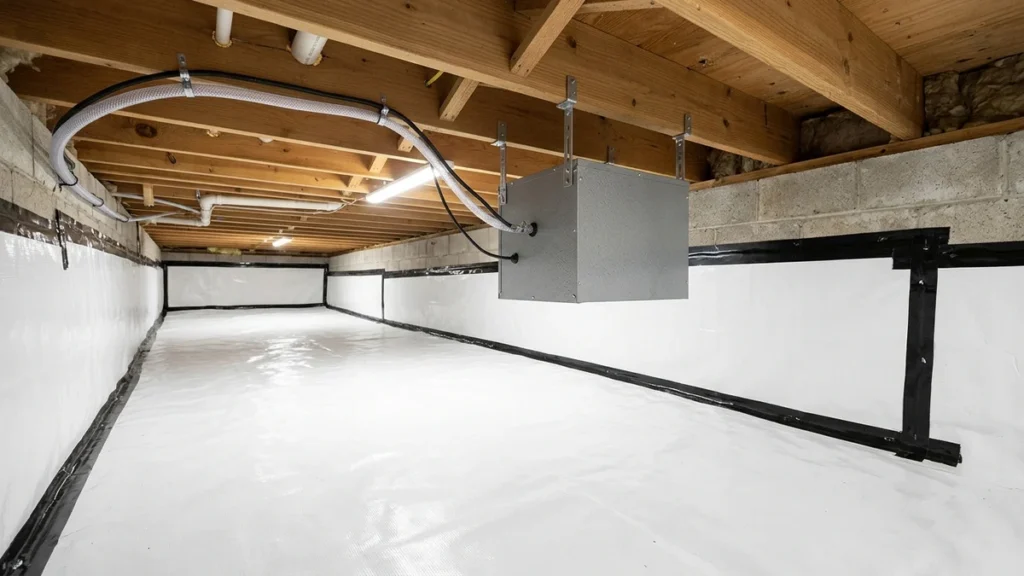
- Ground vapor retarder at least 6 mil thick with a permeance of 0.1 perm or less.
- Extended at least 6 inches up walls, piers and columns and attached securely.
- Seams overlapped at least 12 inches, lapped shingle-fashion, and taped.
- Mechanical fasteners sealed; edges sealed to the foundation and around supports with mastic or acoustical sealant.
The IRC’s unvented crawl space provisions (section R408.3) call for a continuous Class I vapor retarder with joints overlapped 6 inches and sealed or taped, extending at least 6 inches up the stem wall. Building America’s detailed guide goes further, recommending the sheet run up the wall to within a few inches of the top of the foundation and radon venting beneath it where needed. Meeting the DOE detail satisfies the code minimum. Many installers use 10 to 20 mil reinforced liner because it survives foot traffic better than 6 mil sheet.
Step 3: Choose how the space will be dried
A sealed crawl space still needs a way to remove moisture. The IRC lists continuous mechanical exhaust or a conditioned air supply at 1 cfm per 50 sq ft of floor area, among other options, and recent editions add dehumidification. Summaries of the 2018 IRC describe that option as 70 pints per day per 1,000 sq ft, with a designed condensate drain; later text refers to manufacturer sizing. Check your adopted edition. Supply air from an existing system is often cheapest to run but depends on HVAC run time; a dehumidifier controls humidity directly regardless of weather.
Step 4: Read the spec sheet for electrical and drain data
Three spec-sheet figures drive the installation: rated current (for the circuit plan), low-temperature limit (for a cool space), and drain method (gravity or pump). Figures below are from manufacturer listings and ENERGY STAR records we could access; production revisions differ, so confirm against the sheet for the unit you buy.
| Model | Supply | Rated current | Capacity (AHAM / saturation) | Drain | Stated coverage |
|---|---|---|---|---|---|
| AlorAir Sentinel HD55 family | 115 V / 60 Hz | about 3.1 to 4.1 A by variant | 55 / 120 PPD (HD55S: 36.33 PPD on the DOE 65°F test) | Gravity; HD55P adds an internal pump | about 1,300 sq ft |
| AlorAir Sentinel HDi90 | 115 V / 60 Hz | 5.56 A | 90 / 198 PPD | Built-in condensate pump | about 2,600 sq ft |
| Argendon Shield 35P | 115 V / 60 Hz | 2.9 A | 35 / 70 PPD | Pump or gravity | up to 1,000 sq ft |
Rated current multiplied by 115 V gives a rough running load: roughly 350 to 470 W for the HD55 family, about 640 W for the HDi90 and about 330 W for the Shield 35P. These are planning approximations, not measured wattages. Your electrician sizes the circuit from the nameplate and whatever else shares it.
Step 5: Plan the power supply
- GFCI protection. NEC 210.8(A) requires GFCI protection for 125 V, 15 A and 20 A receptacles in dwelling-unit crawl spaces at or below grade. Later editions widened GFCI coverage; confirm the rule in your adopted edition.
- Service receptacle. Where heating, air-conditioning or refrigeration equipment is in the crawl space, NEC 210.63 requires a 125 V, 15 A or 20 A receptacle within 25 ft of it.
- No extension cords as permanent wiring. A cord through the hatch gets pinched, chewed or soaked.
- Placement. Mount the receptacle above the vapor retarder, clear of condensate lines, and strap cords off the ground.
- Outages. If you want the dehumidifier or a sump pump to keep running during outages, plan that load now; our home battery vs generator guide compares the options.
Step 6: Route the condensate
Gravity drainage is simplest when there is continuous fall to a floor drain, sump basin or exterior outlet. When the outlet is higher than the unit, use a built-in or external condensate pump. Keep hose runs short and supported, avoid places where the line can freeze or be crushed, include a backflow-preventing check valve where the pump design calls for one, and confirm the discharge point is allowed locally. Never discharge onto the vapor retarder. AlorAir sells a hanging kit for compatible units that suspends them from the joists; the company says this reduces vibration and adds height for gravity drainage.
AlorAir crawl space dehumidifiers
Gravity and pump-equipped Sentinel units, with optional hanging kits. Confirm rated amps, low-temperature limit and drain type against the steps above before ordering.
See AlorAir crawl space unitsStep 7: Commission and log
- Set the humidistat to the target in our humidity targets guide, typically 50% to 55%.
- Pour water into the unit’s reservoir or pan to confirm the pump starts, water reaches the outlet and the high-water safety switch stops the compressor if the line is blocked.
- Check the filter is installed and accessible, and note the cleaning interval in the manual.
- Place a logging hygrometer away from the unit’s outlet and record readings daily for two weeks, then weekly.
- Recheck wood moisture readings after a month. Falling numbers confirm the system works; flat or rising numbers mean water or air is still getting in.
Pump or gravity: the trade-off
- Pump advantage: lifts water to an outlet above the unit, so no floor drain is needed.
- Pump drawback: a moving part that can fail or clog; check periodically that water reaches the outlet.
- Gravity advantage: nothing to wear out except the hose.
- Gravity drawback: needs continuous fall to the drain point, often impractical in a low crawl space.
For smaller crawl spaces, Argendon’s compact pump-equipped units are another documented option, sold through their own store. Compare the Shield 35P’s capacity and rated current against your worksheet; at about 35 pints AHAM it suits spaces up to roughly 1,000 sq ft under good conditions.
Argendon compact crawl space dehumidifiers
Compact pump or gravity units for small crawl spaces. Check capacity, rated current and drain hose length against your plan.
View Argendon modelsFAQ
Does a crawl space receptacle need GFCI protection?
For 125 V, 15 A and 20 A receptacles in dwelling-unit crawl spaces at or below grade, yes, under NEC 210.8(A). Check your adopted edition and amendments.
What vapor retarder thickness do I need?
DOE’s job aid specifies at least 6 mil with 0.1 perm or less; the IRC specifies a Class I retarder. Thicker reinforced liner is common for durability.
Will a dehumidifier fix a wet crawl space?
Not if water arrives as liquid. Fix bulk water first, then seal, then dry.
Sources
- US DOE Building America Solution Center, crawl space air sealing, insulation and vapor retarder guides.
- US DOE Weatherization Assistance Program, Standard Work Specifications and job aids.
- International Code Council, International Residential Code, section R408.
- NFPA, NFPA 70, National Electrical Code.
- ENERGY STAR, certified dehumidifier dataset (AlorAir and Argendon records, checked 2026-11-06).