
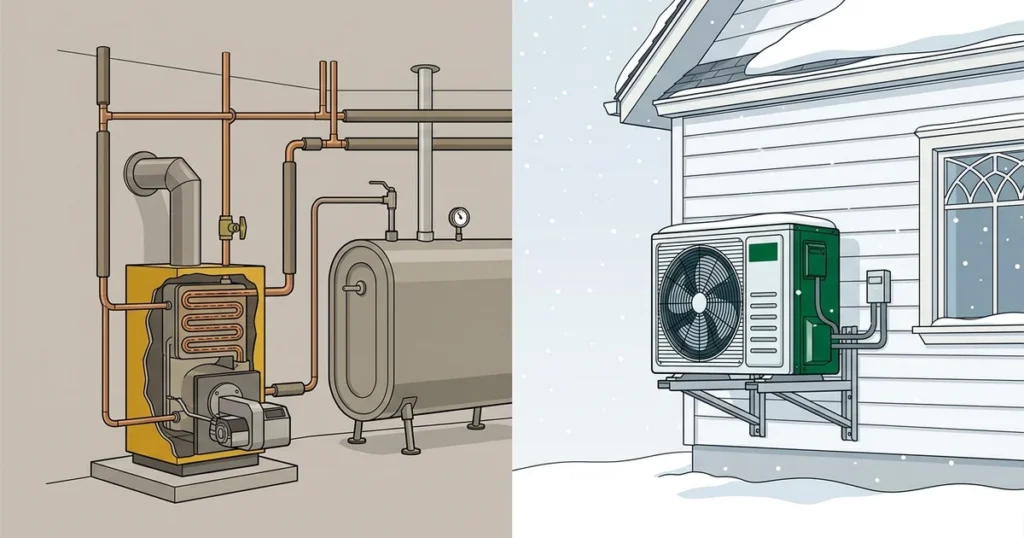
Short answer: without the $2,000 federal Section 25C tax credit that ended on December 31, 2025, replacing a working oil furnace with a cold-climate heat pump rarely pays back quickly on fuel savings alone unless heating oil stays near late-2026 highs (around $5.92 per gallon) or a state or utility rebate cuts the upfront price. The arithmetic flips when your oil furnace already needs replacing: comparing only the extra cost over a new oil unit ($6,000 to $10,000) against a heat pump ($12,000 to $20,000+ before rebates) cuts payback to roughly 5 years at $5.92 oil and $0.18/kWh electricity, versus nearly 14 years if oil returns to last November’s $3.72 average.
This guide is for households heating with No. 2 fuel oil—roughly 82% of which are in the U.S. Northeast, alongside pockets of the Mid-Atlantic such as Virginia—weighing a cold-climate air-source heat pump now that federal tax credits and fuel-switching HEAR rebates are off the table. Every price below comes from U.S. Energy Information Administration (EIA) releases checked on November 18, 2026, and every assumption is labelled so you can plug in your own utility bill and contractor quotes.
Where federal incentives for oil-to-heat-pump swaps stand in late 2026
Two separate federal changes affect anyone budgeting an oil furnace replacement right now:
- Section 25C ended for 2026 installations. Under Public Law 119-21, the 30% Energy Efficient Home Improvement Credit (up to $2,000 a year for heat pumps) does not apply to property placed in service after December 31, 2025. Paying a deposit in 2025 for a 2026 installation does not preserve it. See our 2026 rules table for what remains after the federal credits ended.
- DOE Program Notice 26-2 removed HEEHR/HEAR fuel-switching support. In May 2026, the U.S. Department of Energy revised its Home Electrification and Appliance Rebates (HEEHR, often called HEAR) guidance to bar rebates for switching from fossil fuels—including heating oil, propane and natural gas—to electric heat pumps, restricting HVAC appliance rebates to electric-to-electric upgrades and new construction. State-funded and utility-funded rebates still operate under their own rules.
Before assuming any incentive in a contractor quote, run your state through our 2026 solar, battery and heat pump incentive checker and get programme approval in writing.
Running cost math: heating oil vs a cold-climate heat pump
To compare a gallon of heating oil with a kilowatt-hour of electricity fairly, convert both to the cost of delivering one million British thermal units (MMBtu) of heat into your living space. EIA standard heat contents are 138,500 Btu per gallon of heating oil and 3,412 Btu per kWh of electricity.
Delivered cost per MMBtu (oil) = price per gallon ÷ (0.1385 × furnace AFUE)
Delivered cost per MMBtu (heat pump) = price per kWh ÷ (0.003412 × seasonal COP)
Take an example household burning 500 gallons of heating oil over a winter in an 82% AFUE mid-efficiency oil furnace (consistent with DOE’s 80%–83% mid-efficiency range). That house needs 500 × 0.1385 × 0.82 = 56.8 MMBtu of delivered heat. At a seasonal Coefficient of Performance (COP) of 2.5—a conservative cold-climate average—a heat pump uses 56.8 ÷ (0.003412 × 2.5) ≈ 6,657 kWh to deliver that same heat.
| Scenario (56.8 MMBtu delivered) | Heating oil price | Oil cost per MMBtu (82% AFUE) | Electricity price | Heat pump cost per MMBtu (COP 2.5) | Annual heating bill difference |
|---|---|---|---|---|---|
| U.S. average, November 2026 prices | $5.92/gal (EIA Nov 9, 2026: $5.915) | $52.13 | $0.18/kWh (EIA Aug 2026: 18.16¢) | $21.10 | Heat pump saves about $1,760/yr |
| Virginia, November 2026 prices | $5.88/gal (EIA Nov 9, 2026: $5.882; Nov 2 was $6.039) | $51.77 | $0.176/kWh (EIA Aug 2026: 17.64¢) | $20.63 | Heat pump saves about $1,770/yr |
| New England, November 2026 oil + high electric rate | $5.85/gal (EIA Nov 9, 2026: $5.845) | $51.51 | $0.283/kWh (EIA Aug 2026: 28.31¢) | $33.18 | Heat pump saves about $1,040/yr |
| U.S. average if oil reverts to Nov 2025 price | $3.72/gal (EIA Nov 10, 2025: $3.721) | $32.76 | $0.18/kWh | $21.10 | Heat pump saves about $660/yr |
| New England if oil reverts to $3.72/gal | $3.72/gal | $32.76 | $0.283/kWh | $33.18 | Roughly break-even (−$24/yr at COP 2.5) |
The last row is the warning every homeowner in Maine, Massachusetts or Connecticut needs to see before signing a contract. When heating oil spikes near $6 a gallon—as EIA recorded in Virginia and the Central Atlantic ($6.002/gal) in early November 2026—a heat pump wins handily even at 28-cent electricity. When distillate prices drop back into the mid-$3 range while New England electric rates sit near 28 cents, the two systems cost almost the same per Btu at seasonal COP 2.5. You can test your own delivery slips and electric tariff in our heating fuel cost comparison calculator.
The break-even formula for your utility bill
You can calculate your exact break-even electricity price or seasonal COP in two lines before requesting quotes:
- Break-even electricity price ($/kWh):
Oil cost per MMBtu × 0.003412 × Heat Pump COP. At $5.92/gal oil (82% AFUE = $52.13/MMBtu) and COP 2.5, electricity would have to reach $0.445/kWh before the heat pump costs more to run. At $3.72/gal oil ($32.76/MMBtu), break-even electricity drops to $0.279/kWh. - Break-even seasonal COP:
(Electricity $/kWh ÷ 0.003412) ÷ Oil cost per MMBtu. At $0.283/kWh and $3.72/gal oil, your heat pump must average a seasonal COP above 2.53 just to break even on fuel.
Because seasonal COP varies with outdoor temperature and ductwork, check certified cold-climate capacity and COP at 5°F on ENERGY STAR or AHRI records rather than trusting headline SEER2 numbers. Our guide to reading SEER2, HSPF2 and COP ratings explains how to convert HSPF2 into an approximate seasonal COP.
Upfront costs people overlook when leaving heating oil
A straightforward oil furnace or oil boiler swap typically runs $6,000 to $10,000 because the tank, fuel line, flue and ducts or hydronic pipes are already in place. By contrast, typical pre-rebate installed costs for a whole-home cold-climate heat pump system range from $12,000 to $20,000+ (and up to $28,000 in high-cost markets or multi-zone ductless retrofits). Four add-ons frequently push real quotes higher:
- Electrical service and panel upgrade ($2,000 to $5,000): Many oil-heated homes still run on 100-amp service because an oil burner and blower pull only a few hundred watts. A whole-home heat pump with electric resistance backup strips often requires a 200-amp panel upgrade after a licensed electrician completes an NEC load calculation.
- Oil tank decommissioning ($600 to $1,500): Removing an above-ground basement tank or pumping and inert-filling an abandoned oil tank adds a dedicated line item—and local fire-code sign-off—if you eliminate oil entirely.
- Ductwork or hydronic mismatch: Old steam or high-temperature hydronic baseboards (160°F–180°F water) cannot be fed directly by a standard air-to-air heat pump; those homes either switch to multi-zone ductless heads or higher-cost air-to-water systems. Warm-air ducts sized for an oil furnace may also need sealing or return modifications to handle the higher airflow of a heat pump.
- Cold-snap backup heat: Unless your cold-climate system holds full heating capacity down to your local 99% design temperature (for example, −5°F to 5°F), you either add electric resistance heat strips (which raise panel size and winter kWh spikes) or keep the existing oil furnace in a dual-fuel setup. Keeping a working oil furnace as cold-snap backup avoids panel upgrades and tank removal, though it also keeps you maintaining two systems and may disqualify you from “whole-home” state rebates.
Payback math without the federal credit: three realistic scenarios
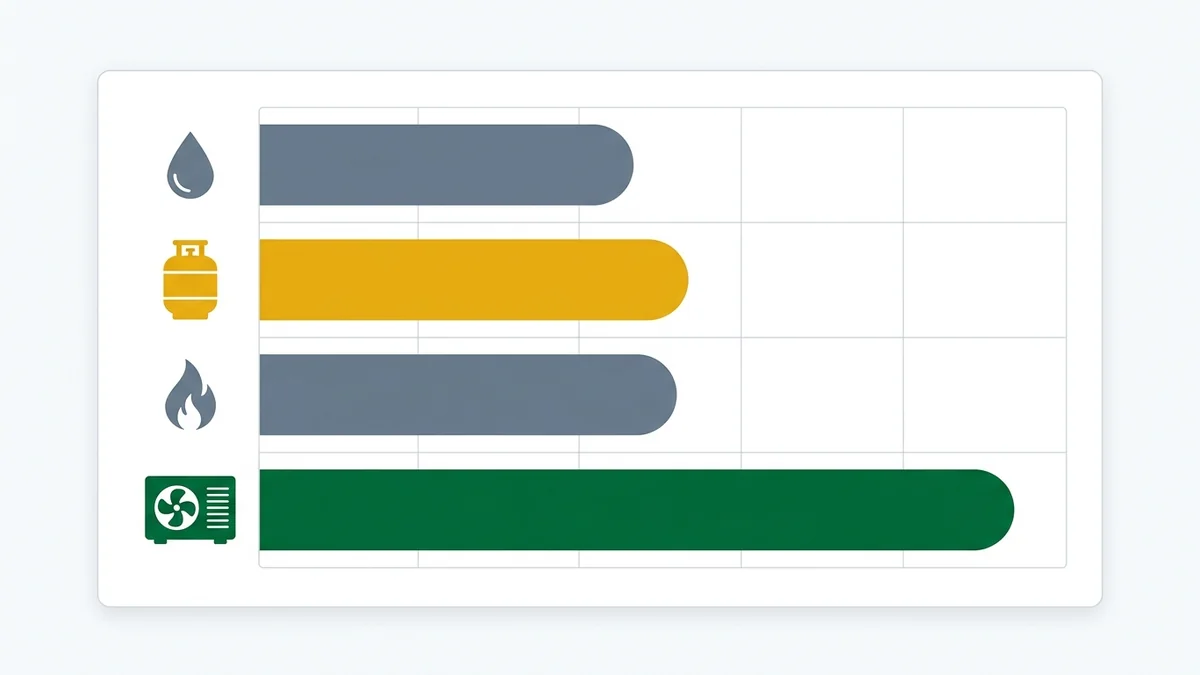
Simple payback equals net upfront cost divided by annual operating savings. The illustrative table below uses a representative 500-gallon household ($2,960/yr at $5.92 oil vs $1,860/yr at $3.72 oil) and typical equipment costs ($16,000 heat pump + $1,000 tank removal = $17,000 full swap, or $9,000 incremental over an $8,000 replacement oil furnace; zero panel upgrade assumed):
| Buying situation | Net upfront gap | Payback at $5.92 oil & $0.18/kWh ($1,760/yr saved) | Payback at $3.72 oil & $0.18/kWh ($660/yr saved) | Payback in New England ($5.85 oil, 28.3¢/kWh; $1,040/yr saved) |
|---|---|---|---|---|
| A. Dead oil furnace (incremental cost vs new $8,000 oil unit, no rebates) | $9,000 | ~5.1 years | ~13.6 years | ~8.7 years |
| B. Working oil furnace replaced early (full $17,000 cost, no rebates) | $17,000 | ~9.7 years | ~25.8 years | ~16.3 years |
| C. Dead oil furnace + $6,000 state/utility rebate (e.g., Mass Save or Efficiency Maine tier) | $3,000 | ~1.7 years | ~4.5 years | ~2.9 years |
| D. Early replacement + $6,000 state/utility rebate | $11,000 | ~6.3 years | ~16.7 years | ~10.6 years |
Notice what the numbers say clearly: if you also need a $3,500 electrical panel upgrade and receive no state rebate, add 2 to 5 years to every figure above. Conversely, if your house currently has no central air conditioning and you were already pricing a $5,000–$7,000 central AC install, a heat pump delivers heating and cooling in one system, which improves the economics substantially.
What state and utility programmes still change the math
Even with federal 25C credits and HEEHR fuel-switching rebates unavailable, state and utility programmes in heating-oil states still bridge a large share of the gap—often exceeding what the old $2,000 federal credit offered:
- Massachusetts (Mass Save): Checked November 18, 2026, sponsor utilities offer $2,650 per ton up to $8,500 for 2026 whole-home heat pump installations (requiring weatherization standards and fossil-fuel disconnection; dropping to $2,350/ton up to $7,500 from January 1, 2027) and $1,125 per ton up to $8,500 for partial-home installations, plus 0% HEAT Loan financing up to $25,000.
- Maine (Efficiency Maine): Checked November 18, 2026, rebates per eligible outdoor unit are $1,000 (any income, $3,000 lifetime cap), $2,000 (moderate income, $6,000 cap) or $3,000 (low income, $9,000 cap), with whole-home ducted systems at $3,000, $6,000 or $9,000 per housing unit through Registered Vendors.
- Weatherization first: NREL modeling of U.S. households found that 62% to 95% save on energy bills when switching to heat pumps (rising to 92%–100% among homes already using fuel oil, propane or electricity with AC), and pairing the swap with air sealing and insulation lifts overall bill-savings odds to 82%–97% while shrinking the required heat pump tonnage.
Outage backup and solar pairing considerations
An oil furnace does not run without electricity either—its burner motor, primary control and blower or circulator pump usually draw 300 W to 700 W on 120 V, which a mid-size backup battery or transfer switch can carry for hours. A central 240 V heat pump draws several kilowatts and requires a much larger 120/240 V home battery or generator during winter storms. If winter outage resilience matters in your area, price the backup plan alongside the HVAC quote or compare a cold-climate mini-split zone that can run on modest backup power. See how to size a home backup battery and our installed heat pump quote checklist before committing.
Decision checklist before signing a quote
- Collect your past 12 months of oil delivery slips and divide total gallons by a realistic 0.75–0.85 furnace AFUE (or check your burner tune-up tag).
- Check your marginal residential electricity rate on your winter utility bill—exclude fixed monthly customer charges and check for winter heat-pump or time-of-use rates.
- Insist on an ACCA Manual J load calculation and a written breakdown of panel upgrades, ductwork, oil-tank removal and backup heat.
- Verify cold-climate output at your design temperature (capacity and COP at 5°F) on the AHRI or ENERGY STAR record, and review current 2026 DOE heat pump rules and state rebate status.
- Keep a working oil furnace as dual-fuel backup only if the math favours it: compare partial-home rebate loss against avoiding a $3,000+ panel upgrade and tank removal.
Sources
- U.S. Energy Information Administration (EIA), Heating Oil and Propane Update and Weekly Residential Heating Oil Prices (week of November 9, 2026, released November 12, 2026; November 2025 comparison series; checked November 18, 2026).
- U.S. EIA, Electric Power Monthly, Table 5.6.A (August 2026 residential retail electricity prices, released October 23, 2026) and Energy Units and Calculators (Btu conversion factors).
- U.S. EIA, Winter Fuels Outlook: Mixed outlook for energy expenditures this winter (October 2026; Northeast share of U.S. heating oil households ~82%).
- Internal Revenue Service (IRS), Energy Efficient Home Improvement Credit (Section 25C) and FS-2025-05 FAQs under Public Law 119-21 (checked November 18, 2026).
- U.S. Department of Energy (DOE), Home Energy Rebates Program Notice 26-2 (May 2026) and Home Heating Systems AFUE Guide.
- National Renewable Energy Laboratory (NREL), Benefits of Heat Pumps Detailed in New NREL Report (62%–95% baseline household savings; 82%–97% with weatherization; 92%–100% for fuel oil/propane/electric-with-AC homes).
- Mass Save Air-Source Heat Pump Rebates & HEAT Loan; Efficiency Maine Residential Heat Pump Rebates (checked November 18, 2026).
This guide contains no affiliate links. It is general informational arithmetic, not tax, financial or engineering advice. Always verify equipment sizing (ACCA Manual J/S), electrical service capacity and tank-decommissioning rules with licensed local professionals and confirm programme budgets in writing before signing a contract.