
Affiliate disclosure: This guide contains partner links. FoxyEco may earn a commission if you buy through them. Check the exact product, US availability and purchase terms before ordering.
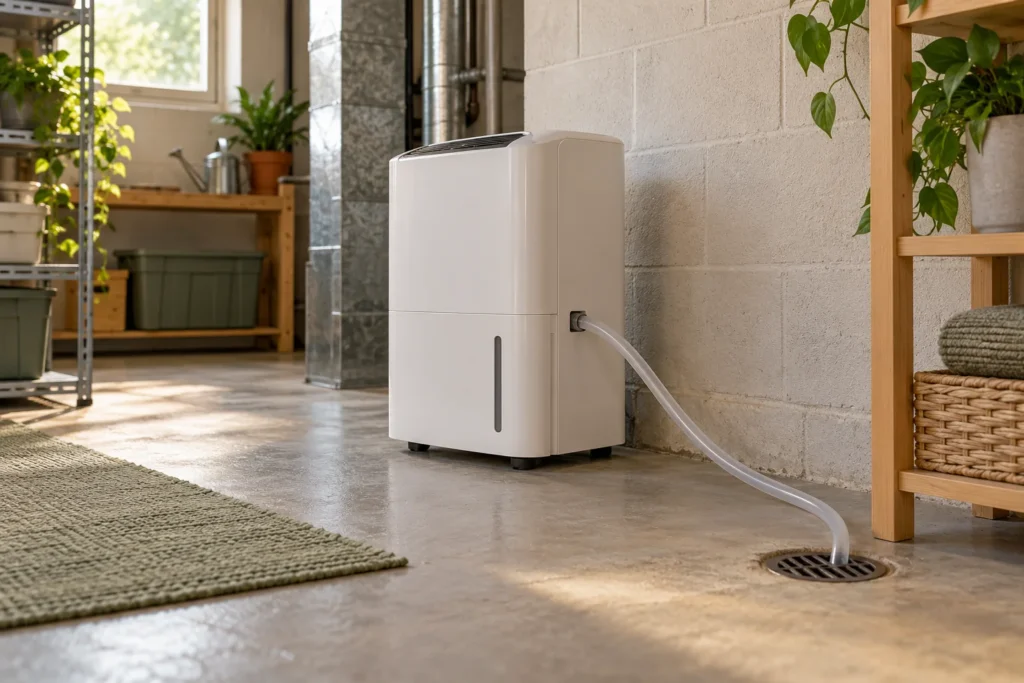
AI-generated editorial illustration. The scene is illustrative; it does not depict a FoxyEco product test or the exact appearance of a recommended model.
If you have been dumping a dehumidifier bucket by hand for months—and waking up to a full tank that shut the machine off overnight—you already know the real product decision is not “how many pints.” It is where the water goes when you are asleep, at work, or away for a weekend. Capacity marketing does not tell you whether gravity drainage reaches your floor drain, whether a pump can lift to a utility sink, or whether a crawlspace hose will kink behind a joist.
Plan the drainage route before you buy the unit. Fix obvious water entry first. A machine that pulls moisture from the air does not repair a leaking pipe, a wet foundation crack, or a crawlspace that stays damp because grade and vapor barriers were never sorted out.
Map the moisture before you shop
Walk the space with a notepad. Where do you see damp spots, musty smell, condensation on ducts, or soft wood? When does it show up—after rain, in summer humidity, only when the shower runs upstairs? The EPA’s moisture guidance is blunt: control the source; do not treat a dehumidifier as proof that the building problem is solved.
Decide what kind of space you are dealing with. A finished basement with a nearby floor drain is a different install from a dirt crawlspace you only enter on your elbows. Temperature matters too: many consumer units struggle in cold rooms. If the area has standing water, mold you cannot assess safely, or wiring you do not understand, get a qualified look before you drag a compressor into a hazard.
Put a cheap hygrometer in the space for a few days. Note morning and evening readings to see whether humidity stays elevated for long stretches—the usual trigger for shopping.
Read the exact model’s drain options—not a lookalike listing
Consumer units typically offer a removable tank, a gravity drain port, a built-in pump, or some combination. The AlorAir Galaxy 85P manual, for example, distinguishes gravity and pump arrangements; that text belongs to that model. Do not copy hose sizes or lift heights from a similar-looking chassis.
Before you click “buy,” write down: hose diameter, maximum recommended hose length, whether the outlet is threaded or barbed, pump lift height (if any), and what the unit does when discharge fails. An included hose in the box does not mean it reaches your approved destination. Measure from the planned unit location to the drain with a tape—around corners, not as a straight-line fantasy.
Gravity drainage only works if the hose really runs downhill
Place the unit so the drain port sits higher than the discharge point. Route the hose with a continuous fall, no loops that trap water, and no sharp kinks behind storage bins. If any section has to climb, gravity will not save you; you need the pump option (or a different placement).
Discharge only to a destination that is allowed for your building—floor drain, utility sink, or condensate line that plumbing rules accept. Stuffing a hose into a random opening is not a connection. Leave enough of the run visible that you can inspect it monthly. Protect it from being crushed by boxes or stepped on by kids.
A common homeowner story: years of emptying the bucket, then discovering the side port and a cheap hose that finally lets the unit run overnight. If that is you, still check the manual for hose type and trap requirements before improvising with garden hose that collapses under suction or heat.
If you need a pump, test fault behavior on day one
Pumped models advertise lift and distance for a reason. Read those limits. After install, run water through the system the way the manufacturer describes—some units let you pour into the tank to trigger the pump. Watch the discharge end. Confirm the hose stays seated.
Then ask: what happens when the sink is blocked or the hose pops off? Does the unit shut down, throw an error, or overflow onto the floor? Keep the error code and the circumstances. Do not defeat a full-tank switch or tape over a sensor so the machine “keeps running.” A silent flood behind a closed basement door is worse than emptying a bucket.
Compare equipment only after the route is real
When you genuinely need a machine, Review AlorAir options for the intended space, Compare crawl-space equipment requirements, and Check Argendon model and drainage information. These are shopping references, not a claim that every SKU fits your building.
Confirm operating temperature range, pint rating method (AHAM vs. other conditions), filter access, noise expectations for a bedroom-adjacent basement, and current US purchase terms. Crawlspace installs often need professional moisture work—encapsulation, vapor barrier, or sealed vents—before a dehumidifier can keep up. FoxyEco has not tested these units in your space.
Budget the whole setup, not the sticker on the carton
Example worksheet: unit $260 + compatible drainage kit $25 + approved installation help $80 = $365 before electricity and filters. A cheaper machine that needs a $120 pump accessory and a longer hose is not the bargain the homepage suggests.
For running cost, an assumed 300 W average for 4 hours is 1.2 kWh. At $0.20/kWh that period costs $0.24. Real units cycle with humidity setpoints; use your meter or the manual’s power figures and your hygrometer log instead of treating those hours as a daily promise.
Keep filters, tanks, and hose ends on a calendar
Follow the model’s cleaning instructions for the filter and tank. Washable filters need full drying before reassembly; clogged filters cut airflow and can freeze coils on some designs. Wipe the bucket if you still use it sometimes—biofilm grows fast in warm basements.
Once a month, walk the hose: look for algae at the outlet, soft spots, and any place furniture has pinched the line. Keep intake and exhaust clear; a unit jammed against storage may be outside its required clearances and hard to service.
When the bucket stays empty—or the room stays wet
An empty bucket does not always mean failure. The room may already be near the setpoint, or condensate may already be leaving through the drain hose. Check the mode, the humidistat setting, and whether the continuous-drain plug is installed correctly.
If humidity stays high while the compressor runs constantly, reassess the source: rain entry, unvented dryer, wet crawlsoil, or an undersized unit for the cubic footage. Bring in building help when water intrusion returns. A workable setup is a suitable machine, an approved drain you can inspect, maintenance you will actually do, and a plan for the day the pump errors out.
Questions people ask after the first wet season
Can I run a hose to the outdoors? Only if local rules and the manual allow it, freeze risk is managed, and the outlet will not dump water onto a walkway or neighbor’s property. Winter freezing can block a hose and flood the room.
Is a crawlspace unit the same as a basement unit? Often no. Operating temperature, drainage, and installation clearances differ. Match the product category to the space.
Should I buy the largest pint rating I can afford? Oversizing can short-cycle; undersizing runs forever without reaching setpoint. Use room volume, AHAM-style ratings, and your humidity log—not a square-footage boast alone.
Sources and editorial method
Prepared by FoxyEco editorial from the sources below. Numerical examples state assumptions. Check the exact model manual and local plumbing rules before installing.
- US EPA: moisture sources and control
- AlorAir: Galaxy 85P user manual and drainage options
- Argendon: drainage management information
Related practical guides
- Bathroom Moisture: Make the Exhaust Fan Part of the Routine
- Leak Detectors: Plan the Alert, Not Just the Sensor
- Home Humidity and Crawlspace Dehumidifiers: Fix the Cause First
Verified Eco Recommendation: BLUETTI
High-efficiency LiFePO4 portable power stations, solar generators, and home battery backup systems.
Explore BLUETTI Official Store →