
Editorial Disclosure: FoxyEco publishes independent, data-driven hardware evaluations and building science guides. When you click through our partner links, we may earn an affiliate commission at zero added cost to you.
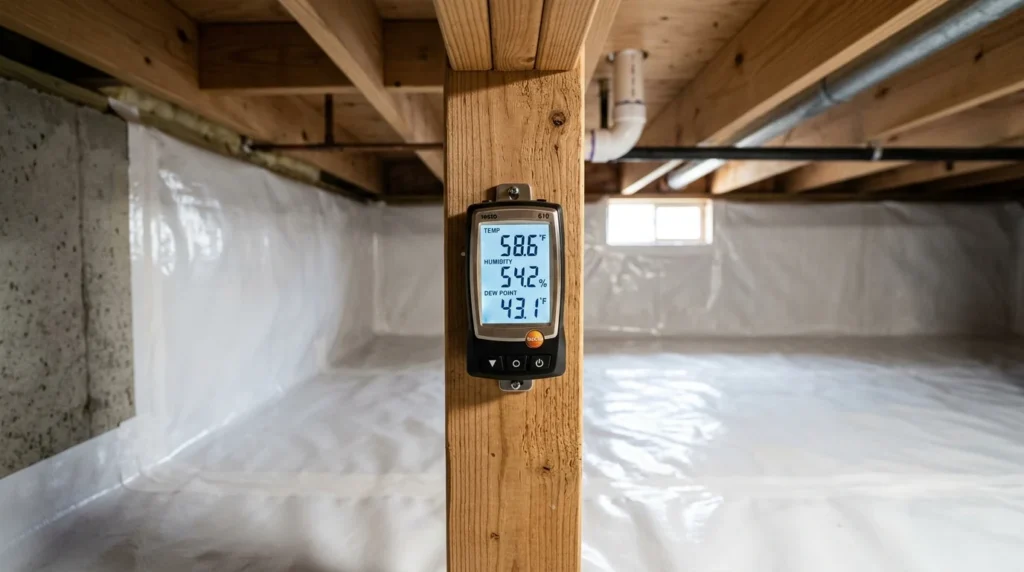
Maintaining balanced relative humidity inside residential crawl spaces is essential for structural longevity and healthy indoor air quality. Because the stack effect pulls up to 50% of first-floor indoor air directly from subgrade spaces, elevated humidity beneath the floor introduces fungal spores, musty odors, and airborne moisture into the home. Building science establishes that maintaining unconditioned or conditioned crawl space relative humidity strictly below 55% prevents mold spore colonization, stops wood rot decay, and protects subfloor framing.
This technical guide details the psychrometric physics governing subfloor moisture, provides practical mathematical calculations for dew point depression, establishes wood moisture equivalent (WME) safety thresholds, and outlines seasonal target management protocols.
Psychrometric Foundations: Temperature, RH & Dew Point
Relative humidity (RH) is a relative measurement: it reflects the percentage of moisture present in the air relative to the maximum volume of vapor the air can hold at that specific dry-bulb temperature. As subfloor air cools against subterranean foundation walls and earthen ground, its vapor-holding capacity contracts sharply. Air at 75°F with 55% RH reaches 100% RH (condensation) if cooled down to 57°F without changing absolute moisture content.
Building inspectors evaluate moisture risks through dew point depression ($T – T_{dp}$), which represents the temperature margin between ambient air and surface condensation. An accurate linear approximation for dew point temperature ($T_{dp}$) within normal indoor temperature ranges is:
T_dp = T - ((100 - RH) / 5)Where $T$ is temperature in degrees Fahrenheit and $RH$ is relative humidity percentage. For instance, if an encapsulated crawl space registers 65°F at 70% RH, the dew point is:
T_dp = 65 - ((100 - 70) / 5) = 65 - 6 = 59°FIf cooler air conditioning ductwork or perimeter foundation concrete in that space sits at or below 59°F, liquid condensation will form on those surfaces, creating the liquid water films required for fungal spore germination.
Stabilize Crawl Space Humidity with AlorAir
Maintain consistent relative humidity below 55% RH across all seasons. Commercial crawl space dehumidifiers prevent moisture condensation and eliminate structural wood decay.
Explore AlorAir Crawl Space Dehumidifiers →Wood Moisture Equivalent (WME) & Fungal Germination Thresholds
Airborne humidity creates risk primarily by raising the moisture content of porous organic materials—specifically wooden sills, rim joists, and floor framing. The critical metric is Wood Moisture Equivalent (WME), determined with calibrated pin-type resistance moisture meters:
- Safe Zone (8% to 14% WME): Normal equilibrium moisture content for residential framing lumber. Zero biological growth possible.
- Elevated Vulnerability (15% to 19% WME): Fungal hyphae of xerophilic molds (including Aspergillus and Penicillium species) can germinate and colonize wood surfaces under prolonged conditions exceeding 30 days.
- Active Rot & Fungal Proliferation (>20% WME): Wood decay fungi, such as Coniophora puteana (wet rot) and Serpula lacrymans (dry rot), break down cellulose and lignin structures, resulting in structural framing failure.
- Fiber Saturation Point (28% to 30% WME): Wood cell walls become completely saturated, with free water occupying cell cavities. Rapid wood collapse occurs.
To keep joist WME below 14%, crawl space air must not remain above 60% RH for extended periods. Operating dedicated dehumidification to maintain 50% to 55% RH establishes an equilibrium moisture barrier that keeps wood dry.
Seasonal Target Ranges & Psychrometric Targets Matrix
Managing subfloor moisture requires distinct operational strategies depending on the season and climate zone:
| Season | Ambient Outdoor Conditions | Crawl Space Air Temp | Target RH Range | Target Dew Point | Mechanical Control Action |
|---|---|---|---|---|---|
| Spring | 50°F – 65°F / 60–80% RH | 52°F – 58°F | 48% – 54% | 35°F – 42°F | Begin active dehumidifier cycling; seal foundation vents. |
| Summer | 75°F – 95°F / 65–90% RH | 62°F – 68°F | 50% – 55% | 43°F – 50°F | Peak dehumidifier run-time; ensure continuous drain clearance. |
| Autumn | 50°F – 70°F / 50–70% RH | 56°F – 62°F | 48% – 52% | 36°F – 44°F | Transition to periodic cycling; check filter cleanliness. |
| Winter | 25°F – 45°F / 40–60% RH | 44°F – 52°F | 45% – 50% | 25°F – 34°F | Verify hot-gas bypass defrost function down to 33°F. |
To determine the precise moisture removal capacity your crawl space requires under these seasonal conditions, utilize our Crawlspace Dehumidifier Sizing Calculator. For equipment reviews tailored to different space volumes, consult our reviews of the AlorAir Sentinel HD55 (55 PPD) and the higher-capacity AlorAir HDi90 with Built-In Pump (90 PPD).
Protect Your Foundation with Sealed Encapsulation
Pair a 12-mil reinforced vapor barrier with high-efficiency mechanical moisture removal. AlorAir units operate down to 33°F to ensure uninterrupted low-temperature dew point control.
View AlorAir Crawl Space Systems →The 4-Step Crawl Space Encapsulation Protocol
- Ground Vapor Barrier Sealing: Install minimum 10-mil to 12-mil reinforced polyethylene across 100% of the exposed dirt floor. Overlap all seams by at least 12 inches and seal with heavy acrylic vapor tape. Fasten the membrane 6 inches up perimeter concrete stem walls.
- Foundation Vent Closure: Seal all exterior foundation louver vents with rigid EPS foam boards and expanding polyurethane sealant. Outside summer air contains high absolute moisture (Grains Per Pound) that condenses upon entering cooler crawl spaces.
- Air Sealing Subfloor Penetrations: Seal all plumbing, electrical, and HVAC chases leading from the crawl space into the living floor with expanding foam to stop stack effect suction.
- Mechanical Dehumidification Commissioning: Install an appropriately sized, commercial-grade crawl space dehumidifier equipped with an automated humidistat set to 50–55% RH and continuous drainage routing.
Frequently Asked Questions
Why does opening crawl space vents increase summer humidity?
When warm, humid outside summer air enters a cooler crawl space, its temperature drops toward the subfloor dew point. This sharp temperature drop increases relative humidity, leading directly to condensation on cool surfaces.
What is GPP and why do building scientists measure it?
Grains Per Pound (GPP) measures absolute humidity—the exact weight of water vapor in dry air (7,000 grains = 1 pound of water). Unlike relative humidity, GPP does not change with temperature, making it ideal for tracking true moisture movement.
Can a crawl space be kept too dry?
Relative humidity levels below 40% over long durations can cause excessive drying shrinkage in older solid timber floor joists, resulting in floor squeaks. A target of 50% to 55% RH maintains optimal structural equilibrium.