
Disclosure: this guide contains two partner links, marked as sponsored. FoxyEco may earn a commission if you buy through them, at no extra cost to you. The checklist applies to any brand’s kit.
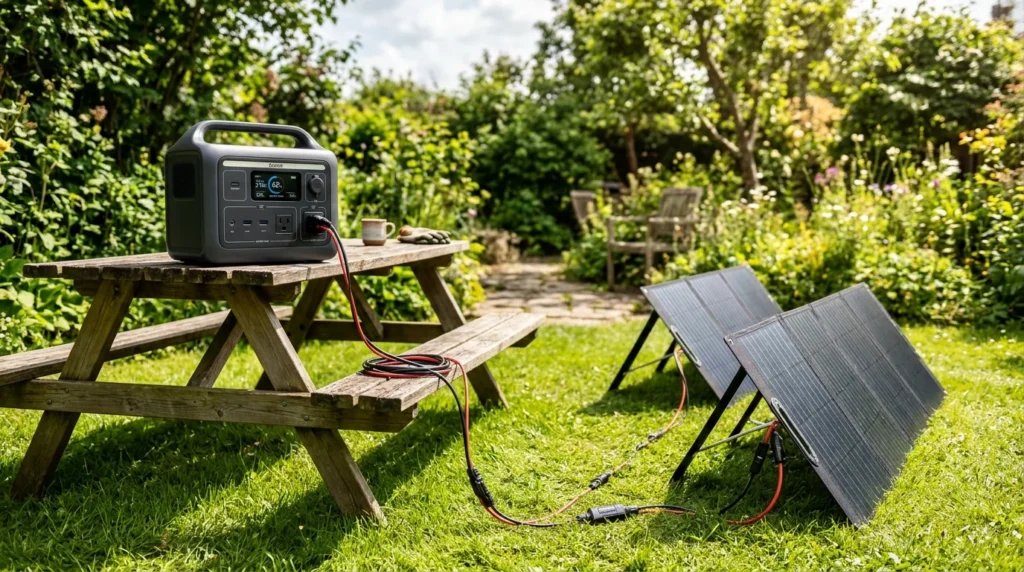
Short answer: a “solar generator” is a marketing name for a portable power station sold together with one or more solar panels and the cables to connect them. The box usually contains the station, the panels, an AC charging cable and a solar input cable or adapter. It usually does not contain enough panel wattage to use the station’s full solar input, extension cables for a realistic run from sun to shade, a stand or mount you would trust in wind, extra batteries, or anything that connects the station to your home’s wiring. Before buying a bundle, compare its panel watts with the station’s solar input ceiling, check the exact contents list for your region, and price the missing pieces.
This guide is for buyers comparing bundles from BLUETTI, Jackery, EcoFlow, Anker SOLIX and similar brands for home backup, camping or a cabin. It explains what is in and out of the box. For the electrical side of adding your own panels, see matching solar panels to a power station; for choosing the station, see portable power stations for home backup.
What is usually in the box
Contents vary by brand, region and the specific kit SKU, and listings for the same kit sometimes disagree. Three documented examples, checked 6 November 2026:
| Kit (as listed) | Listed contents | What the listing shows clearly missing or unclear |
|---|---|---|
| Jackery Solar Generator 2000 v2 (US) | Explorer 2000 v2 ×1, SolarSaga 200W panels ×2, AC charging cable ×1, solar charging cable(s) | Jackery’s own listings disagree on whether one or two solar cables are included; cable lengths not stated |
| BLUETTI AC200L solar kits (various regions) | AC200L station plus panels (for example 2 × 200 W or 2 × 350 W), with charging and solar input cables | Some retailer listings show the panel shipping separately; BLUETTI’s own pages also sell panels as optional add-ons, so check which bundle you are buying |
| Eco-Worthy 400 W 12 V kit (component kit, not a station) | 4 × 100 W panels, 40 A MPPT charge controller, 5 m 12 AWG MC4 extension, Z mounting brackets, Y-branch connector, tray cable | No battery or inverter; retail listings state the battery is sold separately |
The Eco-Worthy example is worth noticing: a component kit includes mounting brackets and a charge controller because it is designed to be fixed to a roof or van, while a power-station bundle usually includes neither, because the station has its own controller and the panels are meant to be propped up and put away.
Check 1: panel watts versus the station’s input ceiling
Kits are often built to a price, not to the station’s capability. A worked example with labelled assumptions: a station with a 1,200 W solar input sold with two 200 W panels uses only a third of its input, about 33%. With an assumed 4 peak sun hours and a 0.75 derate, 400 W of panels gives about 1,200 Wh a day, so recharging a 2,048 Wh station from empty takes about 1.7 days of that sun. The same station with 1,000 W of panels would harvest about 3 kWh a day and refill in roughly 0.7 days. Neither figure is a measurement; they show why the ratio matters. Run your own version in the runtime and array calculator.
The reverse problem also exists: bundling more panels than the input accepts, or panels whose combined voltage exceeds the input on a cold morning. The compatibility guide walks through the voltage check.
Check 2: cables, adapters and distance
The included solar cable is usually long enough to reach from the panel to the station a few metres away, which is fine at a campsite and often too short at home, where the sunny spot is in the garden and the station needs to be indoors, out of the weather. Measure the run before buying. Add:
- An MC4 extension cable pair of adequate gauge for the distance (10 or 12 AWG is common).
- Any adapter between MC4 and the station’s port (XT60, XT90, Anderson, DC7909 or a proprietary connector) if the kit does not include it.
- A Y-branch connector if you will wire panels in parallel, rated for the combined current.
- A way to route cable through a window or door without crushing it.
Check 3: where the panels will sit
Folding panels come with kickstands that work on calm days. They are not mounts. In wind, a foldable panel acts like a sail; on a balcony it is a falling hazard. If the panels will stay out for days during an outage, budget for weights, ground stakes or a frame, and keep them low and secured. Rigid panels on a fixed mount are more efficient, because you can set the tilt, but then you are building a small installation, and in many places a roof or wall mount needs permission.
Check 4: what connects the station to your house
No kit we found includes the equipment to power hardwired circuits such as a furnace blower, well pump or built-in lighting. That needs a transfer switch or a generator inlet with an interlock, installed by a licensed electrician, plus a cord rated for the station’s output. Some manufacturers sell their own home panels or transfer switches as separate products. Without them, a kit powers what you can plug directly into it. Never use a “suicide cord” between the station and a wall outlet.
Check 5: capacity you may add later
If the station accepts expansion batteries, check which models are compatible, how many can be stacked, and whether they charge from the same solar input. Expansion packs are rarely in a starter kit, and sometimes the compatible pack is discontinued before the station is. Our winter charging comparison includes one such case.
Reading a BLUETTI kit listing
BLUETTI is a useful example of why the SKU matters. The same AC200L station appears in several bundles with different panel types and counts, and BLUETTI’s regional sites also list panels as optional accessories rather than bundled items. The AC200L’s documented solar input is 12–145 V DC, 15 A and up to 1,200 W, so a two-panel bundle leaves plenty of headroom for adding panels later, provided the extra panels fit the voltage and current limits. When you compare bundles, list for each one: the panel model and count, total panel watts as a share of the 1,200 W input, which solar cables and adapters are included, and whether anything ships separately. Then price the same station plus panels bought individually, because a bundle is not always the cheaper route. For the documented station specifications and limits, see our AC200L review. You can check BLUETTI's US kit listings and their contents against those five checks before ordering.
When a component kit makes more sense
If the panels will be permanently mounted on a shed, van or cabin and you want to choose the battery and inverter separately, a component kit can be a better fit than a power-station bundle. The panels come with brackets and a separate charge controller, so the system can grow by replacing one part at a time, and standard MC4 wiring makes it easy to add panels later. The trade-offs are real: you have to choose and wire the battery, fuses, inverter and cabling yourself, or pay an installer, and a permanent system may need a permit and inspection. The Eco-Worthy 400 W kit in the table above is an example of this approach, and our off-grid cabin and RV guide shows how to size such a system. If that is the direction you are going, compare Eco-Worthy's current panel and controller kits with the battery voltage you plan to use, and confirm the included cable gauge and lengths.
Brands without a FoxyEco partnership
Jackery, EcoFlow, Anker SOLIX and DJI Power also sell solar generator bundles. FoxyEco has no partner link with these brands; we mention them because the same checks apply. Jackery’s listings for the Solar Generator 2000 v2, for example, are clear about the station and panel count but inconsistent on the number of solar cables, which is exactly the kind of detail to confirm with the seller.
Limitations
- FoxyEco has not unboxed or tested any of the kits named here; contents come from manufacturer and retailer listings checked on 6 November 2026, and listings change.
- Regional versions of the same kit can ship with different plugs, panels and cables.
- Recharge examples use assumed sun hours and losses, not measurements.
- No price comparisons are given, because bundle prices change frequently; compare on the day you buy, with tax and shipping, in your own currency and region.
Sources
- Jackery Solar Generator 2000 v2 product page (US)
- BLUETTI AC200L solar generator kit (Australia store)
- BLUETTI AC200L specifications (solar input)
- Eco-Worthy official store (kit contents listed per product)
- NREL PVWatts calculator (peak sun hours by location)
Related: balcony and plug-in solar rules, storing a power station at home.