
Disclosure: FoxyEco does not have a partner programme for grid-tied plug-in solar kits. Where we mention off-grid portable stations and panel kits for outage backup below, we include partner links to BLUETTI EU and Eco-Worthy, marked as sponsored; FoxyEco may earn a commission at no extra cost to you.
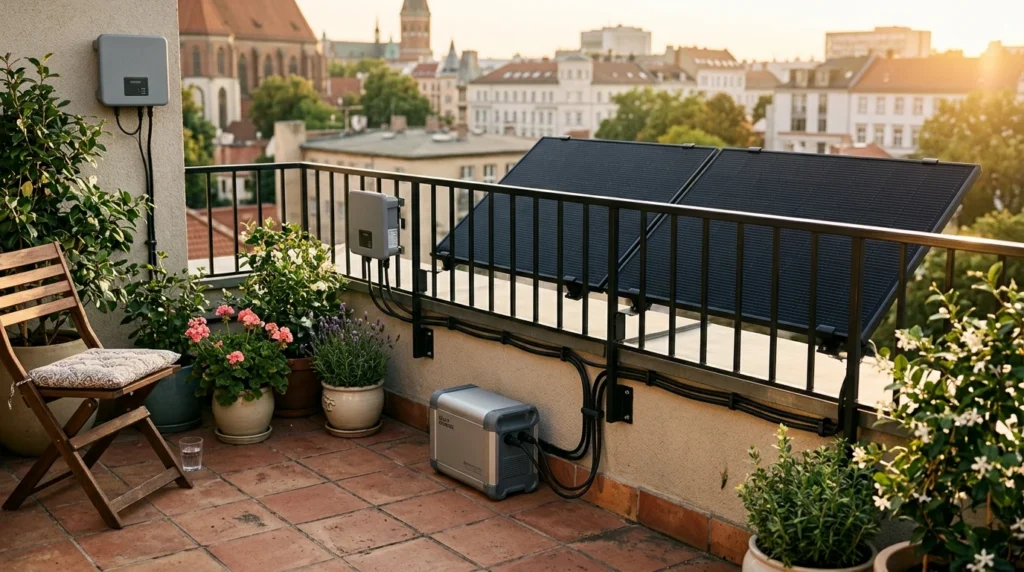
Short answer: “balcony” or “plug-in” solar means a small grid-connected system, usually one to four panels and a microinverter, that plugs into a household socket and feeds power into your home wiring. It is a different thing from charging a portable power station with panels, which never connects to the grid. In Germany, systems up to 800 VA of inverter output and 2,000 Wp of panels are allowed with simple online registration. In Great Britain, plug-in solar up to 800 W became legal on 27 August 2026 for devices that meet a new government product specification. In the US, it is legal only where a state law creates an exemption, such as Utah (since May 2025) and California (from 1 January 2027), usually up to 1,200 W and with safety certification. Everywhere else, plugging a grid-tied inverter into an outlet without utility approval is not allowed.
This guide is for renters and homeowners who want to know whether a plug-in kit is legal where they live and what to check before buying one. Rules were changing quickly through 2025 and 2026; every status below is dated and sourced, and you should confirm it with your utility, landlord or building manager before installing anything.
Two different things called “solar on the balcony”
| Plug-in (grid-tied) solar | Panels charging a power station | |
|---|---|---|
| What it connects to | A household socket; the microinverter synchronises with the grid | Only the power station’s solar input |
| Works in a power cut | No. The inverter must shut down when the grid is off | Yes. The station keeps running from its battery and panels |
| Main benefit | Cuts daytime grid use and bills | Backup power and off-grid use |
| Legal status | Depends on country and state (see below) | No grid connection, so no interconnection rules apply |
| Typical limit | 800 W (Germany, Great Britain) or 1,200 W (Utah, California) | The station’s solar input rating |
If backup power during outages is your goal, a plug-in kit does not provide it. Look at portable power stations for home backup and matching panels to a station instead. For readers comparing standalone off-grid hardware that continues working when the grid is down, see BLUETTI's European portable power station and solar lineup or Eco-Worthy's off-grid solar panel and LiFePO4 component kits. Never connect a power station’s output to a wall socket to feed the house: that is backfeeding, and it is dangerous for you and for line workers.
United States: state by state
There is no federal rule. Utilities require interconnection agreements for anything that feeds the grid, and the National Electrical Code, as adopted by states, was not written with socket-connected generators in mind. Plug-in solar becomes legal only where a state carves out an exemption.
- Utah, HB 340 (2025). Signed 25 March 2025 and in effect since 7 May 2025. It defines a “moveable photovoltaic generation device” with a maximum output of 1,200 W and exempts qualifying devices from the state’s interconnection requirements, provided they meet the safety conditions in the law. Coverage of the law reports that it does not provide net-metering credit, so exported energy earns nothing; check with your utility.
- California, SB 868, the Plug and Play Solar Act. Signed 30 September 2026, effective 1 January 2027. It allows kits up to 1,200 W connected to a standard outlet without an interconnection agreement, provided they are certified by UL or an equivalent nationally recognised testing laboratory. Reporting describes a 2030 sunset unless the legislature extends it, and notes that few products met all of the law’s requirements at signing.
- Other states. Advocacy trackers report that Maine (LD 1730, signed April 2026), Virginia, Colorado, Maryland, New Hampshire, Connecticut and Vermont also passed plug-in solar laws in 2026, with New York’s bill reported as awaiting the governor’s decision. Terms differ: some include landlord and homeowner-association provisions, some allow batteries. We have not verified each bill’s text, so read your state legislature’s page before relying on it.
Certification. UL published UL 3700, an outline of investigation for interactive plug-in PV equipment, in December 2025 and opened a certification programme in January 2026. Early marketing has blurred “certified to” and “designed to meet” UL 3700; ask for the certificate or the listing number before you buy. UL’s stated concerns include circuit overload, because the breaker only sees current from the grid side, compatibility with GFCI outlets, and voltage on plug pins after disconnection.
Germany: 800 VA and registration
Germany’s Solarpaket I, in force since May 2024, set the rules most European coverage refers to:
- Inverter output up to 800 VA and panel power up to 2,000 Wp. A larger inverter throttled in software is not enough; the inverter itself must be rated for the limit.
- Registration in the Bundesnetzagentur’s Marktstammdatenregister is required, with a short set of mandatory details. A separate notification to the grid operator is no longer needed within those limits.
- An older, non-returning electricity meter may temporarily run backwards until the grid operator replaces it.
- Since October 2024, tenants and owners in shared buildings have a legal right to request permission for a balcony system, and a landlord or owners’ association can refuse only for good reason, though they may set conditions on how it is mounted.
Product standards caught up later. Coverage of the DIN VDE V 0126-95 product standard, in force from December 2025, reports that a standard Schuko plug is permitted up to a defined module power, with a dedicated Wieland-type socket or fixed connection above it; check the current text or ask an electrician which applies to your kit.
Elsewhere in the EU
The EU’s network code for generators, Regulation (EU) 2016/631 (often called RfG), classifies generating units from 0.8 kW upwards as “type A”, which is one reason 800 W became the common European ceiling. Below that, national rules decide. Austria, the Netherlands, France and others allow some form of plug-in solar, but registration, plug type and whether exported power is credited vary. Check your national grid operator’s or energy regulator’s guidance.
Great Britain: legal from 27 August 2026
The Plugs and Sockets etc. (Safety) Regulations 1994 and Electricity Safety, Quality and Continuity Regulations 2002 (Amendment) Regulations 2026 (SI 2026/848) were made on 16 July 2026 and came into force on 27 August 2026. The key points:
- A “plug-in microgenerator” is a solar device with a maximum rated AC output of 800 W that connects through a standard plug and socket and runs in parallel with the grid.
- It must comply with the government’s Plug-in Solar Device Interim Product Specification (version 2, published 16 July 2026), and its plug type must be approved by a notified body.
- Devices that store energy taken from the home for later use are outside this route, so combined battery units do not qualify.
- Ofgem approved a matching change to the G98 connection rules. The government response says one device per household continues to apply until G98 is further amended.
- The amendment to the 2002 Regulations covers England, Wales and Scotland. Northern Ireland has separate arrangements.
Buy only devices sold as compliant with the specification, and keep the documentation. A kit bought before August 2026, or an import built for the German market, may not meet it.
Renters, landlords and buildings
Legality under electricity rules is only the first step. A lease, tenancy agreement, building rules, a homeowners’ association or a listed-building status can still restrict panels on a railing or façade. Ask in writing before you mount anything, and describe the weight, the fixing method and how the cable reaches the socket. Panels on a balcony must be secured against wind; a loose panel falling from height is a serious hazard and is the most common reason landlords refuse.
What a plug-in system can realistically save
A worked example with labelled assumptions: an 800 W system averaging 3 peak sun hours a day with a 0.75 overall derate produces about 1.8 kWh a day. You save money only on the energy your home uses at the same moment. If the household’s daytime base load (fridge, router, standby devices) is about 150 W over 8 sunny hours, around 1.2 kWh a day is used directly. At an assumed tariff of $0.30 per kWh, that is about $0.36 a day, or roughly $130 a year, before any credit for exports, which Utah does not give and many tariffs pay little for. A vertical railing mount, shade, or a north-facing balcony can cut the yield sharply. Estimate your own site with NREL’s PVWatts or the EU’s PVGIS tool, using the real tilt and orientation, and our sizing calculator for the daily energy arithmetic.
Risks and limitations
- Plug-in systems provide no power during outages; the inverter must stop when the grid is down.
- Outside the jurisdictions listed, connecting one breaches utility rules and may affect insurance.
- Sharing a circuit with heavy loads can overload wiring that the breaker cannot detect; use a dedicated or lightly loaded circuit and never a multi-way adapter or extension reel.
- Product certification for the US market was still thin in 2026; uncertified imports remain common.
- FoxyEco has not installed or measured any plug-in system; legal summaries are based on the sources below as of 6 November 2026 and are not legal advice.
Sources
- Utah Legislature: HB 340 (2025), enrolled bill text
- pv magazine USA: Newsom signs California plug-in solar bill (1 October 2026)
- Third Act Washington: state balcony solar legislation update (July 2026)
- Intertek: UL 3700 for plug-in PV systems
- legislation.gov.uk: SI 2026/848 (plug-in microgenerators)
- DESNZ: Plug-in Solar Device Interim Product Specification
- DESNZ: plug-in solar regulatory changes, government response (July 2026)
- Ofgem: decision on G98 amendment for plug-in microgeneration (August 2026)
- EUR-Lex: Commission Regulation (EU) 2016/631 (requirements for generators)
- Bundesnetzagentur: Marktstammdatenregister
Related: solar generator kits explained and how to size a home backup battery.