
Affiliate disclosure: This guide contains no affiliate links.
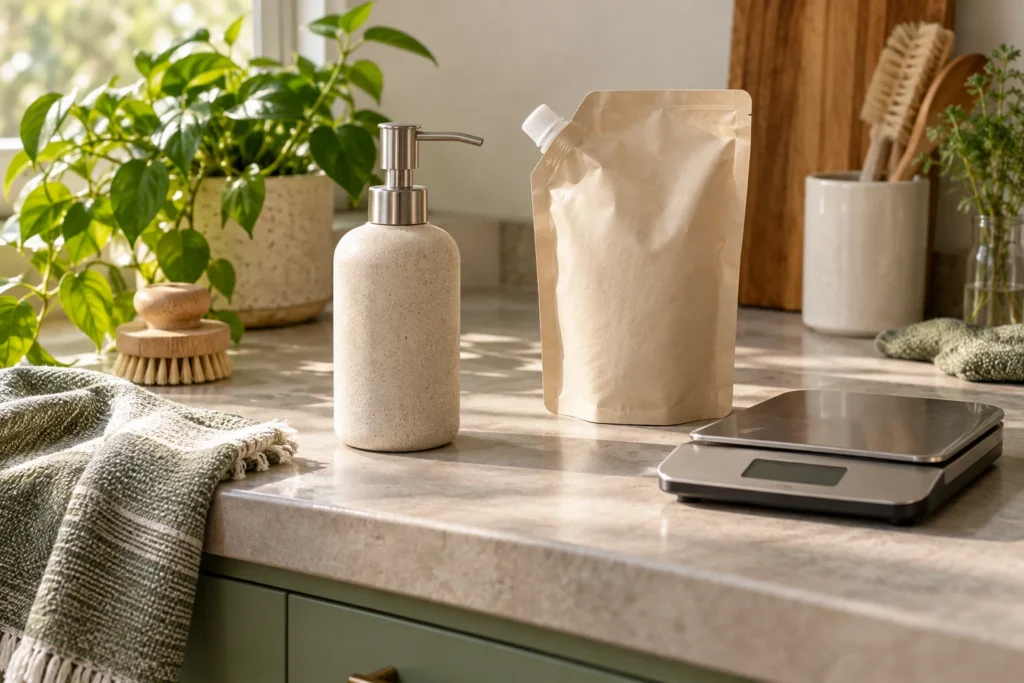
AI-generated editorial illustration. The scene is illustrative; it does not depict a FoxyEco product test or the exact appearance of a recommended model.
Refill pouches and concentrates can cut packaging—or create sticky sinks, orphan bottles, and unfinished product—if the system does not fit how you actually shop and clean. Compare usable doses, container life, access to refills, and delivered cost before assuming every refill is greener than a rigid bottle.
Whole-system check before the first pouch
A refill only works if you have a compatible bottle, a readable label, a pour you can control without spills, and a store or delivery route you will keep using. Concentrates need correct dilution; overdosing kills both the savings and sometimes the finish on floors or counters.
Ask four questions: Will I refill this next month? Can I measure the dose without guessing? Does the empty refill have a local disposal path? What happens if the brand changes scent or packaging and I am stuck with a proprietary bottle?
If the answer to the first question is “maybe if I remember,” start with one product category you already buy often—dish soap, laundry detergent, or all-purpose cleaner—rather than converting the whole cupboard at once.
Package vs package, including disposal
Pouches, pods, tablets, and bulk taps each have different disposal stories. Confirm what your local program accepts. A pouch marketed as “less plastic” that cannot be recycled locally is a different claim from a rigid bottle your city takes every week.
Watch for multi-material layers that feel soft but are not paper. Keep the claim tied to what you can verify: weight of packaging per usable dose, whether the bottle is reused, and whether leftovers expire unused.
Pods and tablets can reduce dosing mistakes for some households and create new ones for others—partial dissolves in hard water, stuck film in machines, and packaging that kids find interesting. Match the format to who uses the product.
Worked cost example (illustrative only)
Suppose a $12 refill provides 40 correctly diluted doses. That is $0.30 per dose before shipping, spills, and the cost of unfinished product when you abandon a scent. A $6 ready-to-use bottle that lasts 15 doses is $0.40 per dose—but only if you actually empty it.
Add delivery fees to subscriptions. A “cheap” monthly refill that arrives when you already have two unused pouches on the shelf is not cheaper. Pause rules matter more than introductory discounts.
Track three months of purchases in one category. The pattern (not a single receipt) tells you whether the refill habit stuck.
Labeling and safety
Never store cleaners in food bottles. Keep original hazard information with the working bottle, even if you use a prettier dispenser. Kids and pets change which packaging is acceptable in your house.
DIY cleaners from social media can mix chemicals that should not meet. Vinegar and bleach is the classic example; there are others. Follow chemistry safety, not memes. This guide does not establish a “natural cleaner” recipe.
If someone in the household has fragrance sensitivity, a refill that locks you into a scented line may create more waste when bottles get abandoned half-full.
When refills fail in practice
Common failure modes: nozzle clogs after a concentrate sits, labels peel so nobody knows what is inside, subscription cartons arrive crushed, and “universal” bottles do not seal with the next brand’s pouch spout.
Another failure: buying a beautiful glass dispenser that is heavier than you will lift daily, so it sits empty while you keep buying the plastic bottle “just this once.”
If a refill system needs a special funnel you never keep near the sink, expect spills and abandoned pouches.
Questions people ask
Are tablets always better? Only if they dissolve fully in your water hardness and machine, and if the packaging has a disposal path you will use.
Subscription traps? Read pause and cancel rules before the first shipment. Avoid stockpiles that expire or that you will not store upright.
Is bulk always greener? Bulk that spoils, spills, or requires a car trip you would not otherwise make can erase packaging savings. Compare the whole trip and the usable amount.
What about store refill stations? Useful when the station is clean, labeled, and on your normal route. Bring a bottle you can weigh or mark so dosing stays honest.
Failure modes worth logging
Write down the last three times this problem actually cost you time, money, or a second trip. Specific dates beat vague frustration. Shop and change habits against that log.
After any fix, schedule a verify date. Many household solutions look fine until the next full load, full shower, windy night, or guest weekend.
Brief everyone who shares the space. Put the rule where people already look—near the machine, by the door, or on the storage shelf.
Seasonal and occupancy notes
Peak-occupancy days stress systems differently from empty weekdays. Weather extremes change material behavior, battery voltage, draft paths, and drying times. Plan a five-minute inspection when seasons change.
Travel weeks are when sensors go quiet, bags stay home, laundry piles up, and packaging accumulates. Leave a short checklist for whoever is still in the house.
Decision checklist
- Name the failure in one sentence.
- Find the exact manual, label, or local rule that applies.
- Do only the checks you are allowed and equipped to do.
- Photograph serials, labels, and before/after conditions when useful.
- Decide: keep, repair, refill, replace, or stop buying.
- Calendar a verify date and keep consumables next to the equipment they serve.
Re-check model-specific limits after firmware, parts, or building-rule changes—yesterday’s setup can become tomorrow’s fault.
Keep receipts, manuals, and a one-page household note together so the next person can continue the same experiment without guessing.
Field notes from real households
Log the last three failures with dates, what you tried, and what actually fixed the symptom. Vague memory (“the dishwasher is bad”) leads to replacement shopping; dated notes (“Tuesday dinner plates still greasy after Eco, spray arm blocked by a ladle”) lead to a five-minute fix.
Trial any change for a set window—two weeks of laundry, three windy nights, one billing cycle—before buying the next accessory. Brief guests and housemates on the one critical habit so your experiment is not undone on day two.
Keep manuals, receipts, and a one-page household note together. The next person should continue the same experiment without guessing which pouch, seal, or program you chose.
Seasonal transitions and travel weeks cause most regressions. Schedule a five-minute inspection then: bags, seals, sensors, charge state, and the drawer where “spare” packaging goes to die.
Practical scenarios
Peak occupancy: Holidays and remote-work clusters need different settings than empty weekdays. Overload a machine or skip a seal check when eight people are showering and you will recreate the original problem.
Weather extremes: Cold adhesive fails, batteries show different voltages, drafts roar, and indoor drying saturates rooms. Do not judge a product only on a mild weekend.
Shared spaces: Write a default plus temporary overrides. “Eco unless towels” beats an argument every Sunday night.
Evening triage: Name the failure, find the manual, do allowed checks only, photograph, decide, calendar a verify date. Keep consumables next to the equipment they serve.
Common pitfalls
Buying before measuring. Trusting packaging icons without local verification. Skipping a second test after a fix. Storing spare parts unlabeled. Optimizing price or “natural” while ignoring the constraint that actually failed—fit, drying space, charger match, or handle strength.
Another pitfall: collecting ten half-solutions (bags, seals, pouches, sensors) instead of finishing one routine that people will repeat. Finish beats accumulate.
Measured refill example
Illustrative: a $12 concentrate making 40 doses is $0.30/dose; a $7 ready bottle lasting 18 doses is about $0.39/dose before spills. Track three months of actual empties—abandoned half-pouches erase the spreadsheet.
Weigh a rinsed empty pouch if your program cares about grams; otherwise log count of pouches finished versus thrown half-full over 90 days.
Sources
Related guides
- Plastic Labels Do Not Tell You What Your Bin Accepts
- A Lower-Waste Home Starts With What You Already Own
Verified Eco Recommendation: BLUETTI
High-efficiency LiFePO4 portable power stations, solar generators, and home battery backup systems.
Explore BLUETTI Official Store →