
Affiliate disclosure: This guide contains partner links. FoxyEco may earn a commission if you buy through them at no additional cost to you. Compare packaging options, move duration, and recycling availability before ordering.
Every year, residential relocations in North America consume more than 900 million single-use corrugated cardboard boxes, generating substantial municipal solid waste and driving timber processing demand. While kraft cardboard remains the legacy moving staple, high-density polyethylene (HDPE) and polypropylene (PP) interlocking totes have emerged as durable circular alternatives. This engineering guide performs an empirical lifecycle assessment (LCA) comparing both packaging mediums across total cost of ownership (TCO), Edge Crush Test (ECT) structural rigidity, and embodied carbon break-even points.
Selecting moving containers involves evaluating trade-offs between unit cost, structural integrity under moisture exposure, storage footprint, and end-of-life disposal. To provide actionable guidance for eco-conscious homeowners and frequent renters, we calculate the exact move frequency where reusable plastic totes surpass corrugated cardboard in both economic and ecological terms.
Structural Mechanics: Edge Crush Test vs Molded Plastic Rigidity
Corrugated cardboard strength is standardized by the Edge Crush Test (ECT), governed by TAPPI T 811. Standard single-wall moving boxes typically register an ECT rating of 32 lbs/in, meaning the corrugated fluting can withstand 32 pounds of vertical compressive force per linear inch before buckling. Under optimum dry laboratory conditions (73°F and 50% relative humidity), a standard 32 ECT box supports a maximum stacking load of approximately 65 pounds.
However, corrugated cellulose fibers are inherently hygroscopic. When relative humidity in a moving van or storage unit rises to 80%, cardboard absorbs ambient water vapor, causing fluting delamination and reducing structural stacking capacity by 45% to 60%. This degradation explains why stacked cardboard boxes frequently pancake during humid summer moves or rainy transit days.
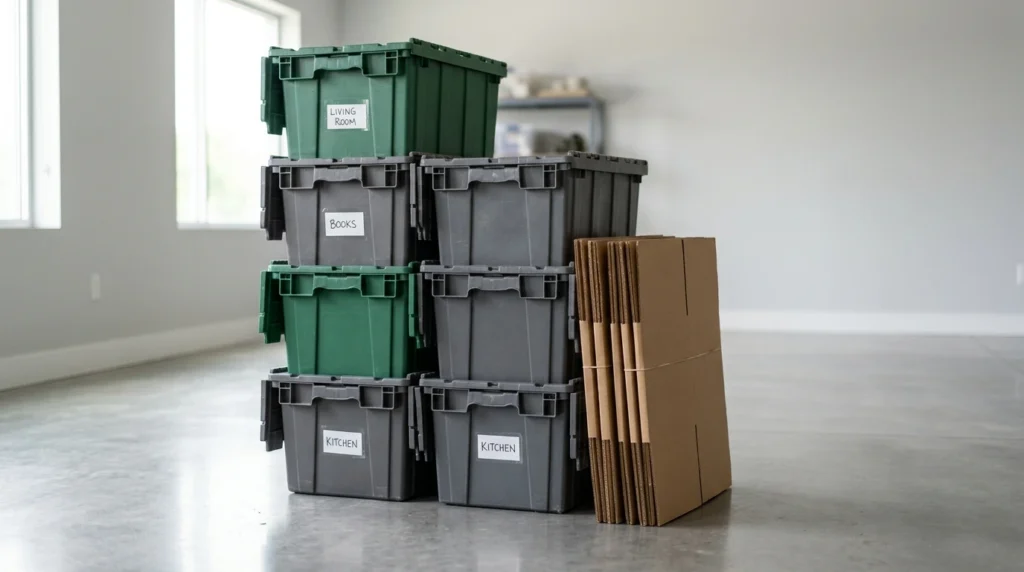
In contrast, commercial reusable moving crates are injection-molded from virgin or recycled HDPE and PP polymers. These crates feature reinforced ribbed sidewalls, interlocking nesting lids, and molded handles that provide over 100 to 120 pounds of vertical stacking rigidity regardless of ambient humidity. They do not degrade when exposed to wet ground, damp basements, or spilled liquids.
Streamlined Moving Supplies: Uboxes
High-grade packing protection, heavy-duty moving cartons, and specialty packing supplies designed to secure household items across multi-stage relocations.
Visit Uboxes Llc Official Portal →Lifecycle Comparison: Durability and Reusability Metrics
The fundamental environmental differentiator between packaging materials is cyclic durability. A standard single-wall corrugated box has a real-world lifespan of 1 to 3 moves before tape tearing, crease fatigue, and corner rounding destroy its structural viability. Even double-wall corrugated cartons (ECT 48) rarely survive beyond 4 or 5 handling cycles.
Reusable injection-molded HDPE containers are engineered for a service lifespan of 250 to 300 handling cycles. When outfitted with metal hinge pins and tamper-evident security seal slots, plastic totes can be rented, cleaned, and redistributed dozens of times per year. At end of life, HDPE carries a resin identification code #2, allowing clean mechanical shredding and remolding into industrial pallets or secondary consumer goods.
| Performance Parameter | Standard Corrugated (ECT 32) | Heavy-Duty Double-Wall (ECT 48) | Reusable HDPE Plastic Tote |
|---|---|---|---|
| Average Usable Lifespan | 1–2 moves | 3–5 moves | 250+ moves |
| Vertical Compression Strength | ~65 lbs (dry) | ~120 lbs (dry) | >200 lbs (all conditions) |
| Moisture Vulnerability | Severe loss of rigidity (>50%) | Moderate loss of rigidity (~35%) | Zero degradation (impervious) |
| Packing Tape Required | Yes (6–10 ft per box) | Yes (6–10 ft per box) | No (interlocking zip lids) |
| Pest and Rodent Infiltration | Susceptible (chewable cellulose) | Susceptible | Sealed barrier protection |
| End-of-Life Processing | Curbside recycling or landfill | Curbside recycling | Closed-loop polymer regrind |
Total Cost of Ownership (TCO) and Lifecycle Economics
Evaluating moving economics requires accounting for direct box purchase prices, auxiliary materials (packing tape, box cutters), assembly labor, and disposal costs. A typical three-bedroom home relocation requires roughly 60 medium and large boxes.
For single-use cardboard, buying 60 new cartons at an average price of $2.85 per box, plus four rolls of heavy-duty packing tape ($20), costs approximately $191 per move. When discarded or recycled after a single use, the packaging cost per move is $191. If reused twice, the amortized cost drops to $95.50 per move.
Purchasing 60 commercial reusable HDPE totes outright represents an upfront investment of approximately $900 ($15 per tote). While expensive for a single move, for commercial movers, frequent renters, or households undergoing multi-year renovation staging, the economics shift dramatically. Amortized across 50 moves, the cost drops to $18 per move ($0.30 per box). Across a full 250-move commercial lifespan, the amortized hardware cost is under $0.06 per box per move.
Homeowners planning major furniture investments or home reorganization can also audit repair and replacement timelines using our Eco Appliance Repair vs. Replace Lifecycle Calculator.
Embodied Carbon and Ecological Break-Even Analysis
A common ecological misconception is that plastic is universally less sustainable than paper. Producing a single corrugated box generates roughly 0.65 kg of CO2 equivalent (CO2e), factoring in logging, pulping, bleaching, and transport. Producing a robust 5-lb HDPE moving tote requires petroleum cracking and high-pressure injection molding, emitting approximately 10.5 kg of CO2e per crate.
Because the initial carbon debt of plastic is 16 times greater than paper, a reusable tote is an ecological burden if used only a handful of times. The mathematical carbon break-even equation is:
Break-Even Cycles = 10.5 kg CO2e / 0.65 kg CO2e ≈ 16.1 Cycles
At approximately 16 to 18 uses, the reusable plastic tote achieves carbon neutrality compared to single-use cardboard. Beyond 18 cycles, every subsequent use avoids the pulping, chemical processing, and transport emissions of fresh corrugated cardboard. Over a 250-cycle lifespan, a single reusable tote eliminates the manufacturing and disposal of more than 160 kg of virgin paper products.
Professional Packing Protection & Boxes
Ensure zero damage in transit with heavy-duty corrugated cartons, bubble cushioning, and eco-friendly packing paper engineered for seamless moves.
Visit Uboxes Llc Official Portal →Practical Moving Recommendations: Hybrid Strategy
For most households, an optimal zero-waste relocation combines both systems based on cargo vulnerability and timeline:
- Use Reusable Plastic Totes For: Fragile dishware, electronics, books, kitchen pantry items, and heavy bathroom essentials that require water resistance and high stacking crush strength.
- Use Clean Recycled Cardboard For: Awkwardly shaped floor lamps, lightweight bedding, wardrobe hanging garments, and artwork that require custom-folded cartons.
- Explore Rental Services: In metropolitan areas, renting plastic crates for a 2- to 3-week window delivers all the structural and ecological benefits of HDPE totes without the long-term storage burden or high upfront purchase cost.
If you are coordinating furniture upgrades during your move, review our detailed guide on modular repairability in our Monvane Modular Sofa Review.
Frequently Asked Questions
Do plastic moving totes require adhesive packing tape?
No. Commercial plastic totes feature interlocking “finger-style” hinged lids that mesh securely when folded down. They can be sealed against tampering using reusable zip ties or tamper-evident plastic security seals inserted through molded eyelets.
Can reusable plastic crates be stored outdoors during staging?
Yes. Because HDPE is non-porous and hydrophobic, sealed plastic crates resist rain, snow, and garden soil. However, avoid prolonged multi-month UV sun exposure unless the totes contain UV-inhibitor masterbatch additives, as solar radiation can eventually cause polymer embrittlement.
How do I recycle plastic totes at the end of their lifecycle?
Most commercial moving totes are molded from high-density polyethylene (#2 HDPE) or polypropylene (#5 PP). At end of life, they can be deposited at commercial plastics recycling drop-offs or municipal polymer reclamation facilities where they are processed into industrial regrind pellets.