
Affiliate disclosure: This guide contains no affiliate links.
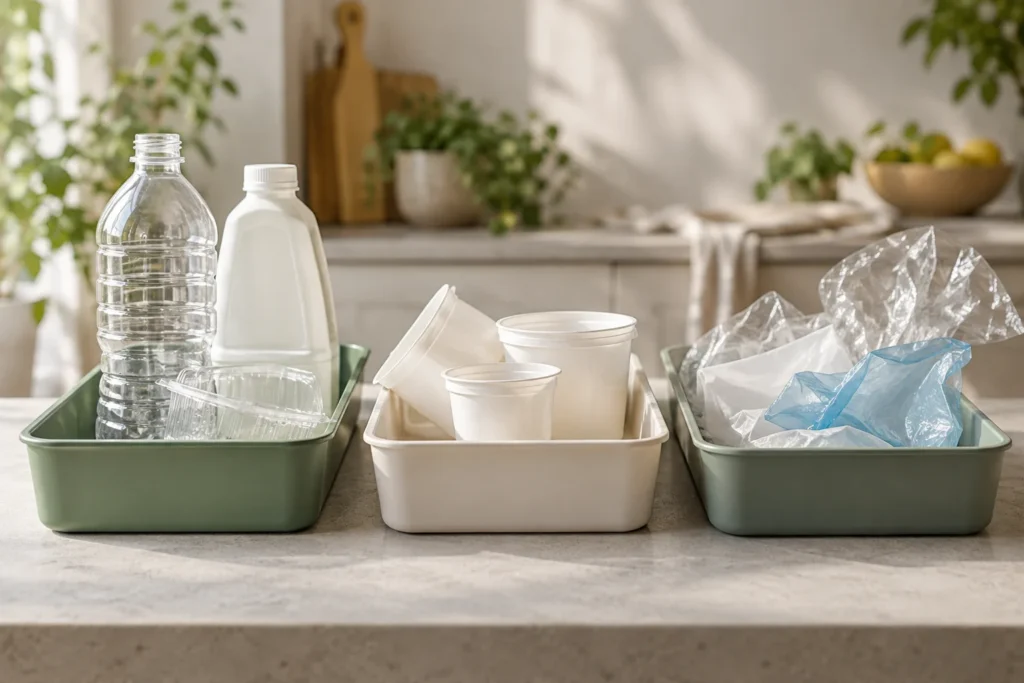
AI-generated editorial illustration. The scene is illustrative; it does not depict a FoxyEco product test or the exact appearance of a recommended model.
The number inside the chasing-arrows triangle is not a hall pass for your recycling bin. It names a resin family. Your city, hauler, or apartment program decides which shapes leave the curb. Mixing those two questions is how clean streams fill with film, pumps, and “wishcycled” clamshells that get sorted out as trash—or worse, contaminate a load.
Start with the official instructions for your address. Then use resin codes, recycled-content claims, and prep rules as secondary clues.
Open the local rules first—every time the contractor changes
Find the current page or leaflet for your exact service, including accepted shapes (bottles, tubs, trays) and prep (empty, rinse, lids on/off). A neighboring town’s graphic does not count. Save the URL and the date you checked it. When a new bin appears or the hauler switches, re-read; remove fridge magnets that still show the old list.
If an item is ambiguous, ask with a photo: “clear berry clamshell,” “pump soap bottle with metal spring,” “mailing film.” Form matters as much as resin.
What the resin number actually tells you
EPA notes that a resin identification code does not mean the item is recyclable locally. Use #1 PET or #2 HDPE as material information, not a command. A package without a readable code may still have brand or municipal guidance—do not guess from stiffness or color alone.
Keep this separate from “made with recycled plastic.” That claim is about inputs. It does not decide your outbound bin. FTC green-claim guidance cares about scope; household sorting should too.
Rigid vs film: split the streams
Bottles and tubs often follow one rule; bags, wraps, and air pillows another—sometimes store drop-off, sometimes trash. Do not stuff film into the cart with rigid containers unless the program says so. If you collect film for months “for a drop-off,” confirm the site still takes it before the pile takes over a closet.
Lids, pumps, and mixed materials
Local guidance may say leave lids on, take lids off, or trash pumps entirely. Follow that page—not a universal internet tip. Multi-layer pouches, metal springs, and permanently attached inserts often need a different route than a simple yogurt tub.
Do not dismantle hazardous or pressurized products to “save” a scrap of plastic. Empty and handle within the supplier’s safety instructions; chemicals and batteries are not food packaging with a harder label.
Prep enough to meet the rule—not enough to scrub forever
Empty and rinse to the program’s standard. You are meeting acceptance criteria, not making museum pieces. If a niche stream demands intensive washing every time, factor that labor into whether the packaged product is worth buying again.
Label household bins the way the service speaks: “bottles & tubs OK” beats a vague “plastic” sign that invites every toy and hose.
Count one week of rejects to spot a buying pattern
Example log: 12 snack wrappers, 3 pump assemblies, 2 shipping films your program rejects. That is not a recycling rate—it shows where a different package size, bulk bin, or less frequent purchase would cut the hassle. If a “recyclable” swap costs $1 more four times a month ($4) but half the food is wasted, the label did not win.
Keep batteries and gadgets out of the plastic cart
EPA has separate guidance for household batteries, especially lithium-ion restrictions for trash and municipal bins. A plastic shell does not make a powered device “plastic #7.” Use the electronics/battery route your area names.
A kitchen-counter decision tree
Hold the item. Ask in order: (1) Does my local list name this shape? (2) If yes, is it empty/dry enough? (3) If no, is there a store drop-off or specialty program? (4) If still no, trash or other hazardous route—do not “hope.” Teaching kids this sequence beats arguing about every yogurt pot at bedtime.
When you travel, leave the home rules at home. Hotel rooms and vacation rentals often use different contractors; a #1 bottle that is fine in one county may be trash two hours away.
Recycled-content shopping without the guilt spiral
Prefer products you will finish, in packages your local system actually takes back, over a “30% recycled” claim on a format your cart rejects. If two detergents clean equally, and only one bottle is on your accepted list, that is a concrete reason—more useful than a leaf logo with no percentage or scope.
For mailers and air pillows, flatten and store only what you will reuse for returns within a month. Endless bags of film “for someday recycling” become household clutter with the same end fate.
Questions at the kitchen bin
My yogurt tub is #5—can it go? Only if your local list accepts tubs of that resin and shape. Many programs take bottles only.
Is the triangle a recycling promise? No. It is a resin ID. Local acceptance is the promise that matters.
What about compostable-looking film? Usually not with plastics recycling. Check whether you have industrial compost access—and whether that facility takes the exact item.
Black plastic and “other” codes
Some optical sorters struggle with black trays; even when the resin number looks friendly, your MRF may reject them. If your local FAQ calls out black plastic or #3/#6/#7 explicitly, believe the FAQ over the package icon. When in doubt, photograph the item against the municipal examples page before building a habit.
Sources
- US EPA: common recyclables and resin-code limitations
- FTC: qualifications for environmental claims
- US EPA: household battery collection guidance
Related guides
- Rechargeable Batteries: Match the Device and Keep Them Organized
- Reduce Delivery Packaging With Better Order and Return Habits
Verified Eco Recommendation: BLUETTI
High-efficiency LiFePO4 portable power stations, solar generators, and home battery backup systems.
Explore BLUETTI Official Store →