
Affiliate disclosure: This guide contains no affiliate links.
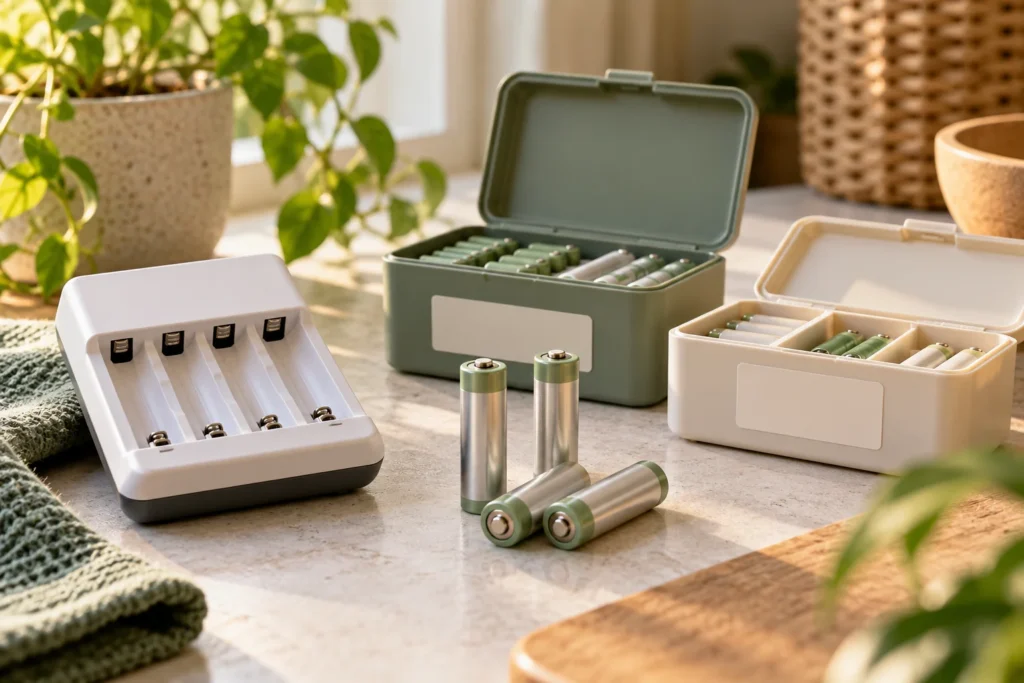
AI-generated editorial illustration. The scene is illustrative; it does not depict a FoxyEco product test or the exact appearance of a recommended model.
Rechargeable cells save waste and money only when chemistry, charger, and device match. Shoving random NiMH into a device that expects alkaline voltages—or charging lithium with the wrong brick—creates heat, leaks, or dead gadgets. Organize by type, label chargers, and plan end-of-life collection.
Audit devices
List remotes, lights, toys, cameras. Note battery size and whether the manual allows rechargeables. Some smoke alarms specify alkaline only—follow that.
Chemistry cheat sheet
NiMH AA/AAA for many household devices. Li-ion packs usually come with dedicated chargers—do not freestyle. Watch for NiCd leftovers; recycle them, do not mix into NiMH chargers casually.
Charger discipline
One labeled charger per chemistry. Soft-brick cables that “kinda fit” are how packs overheat. Charge on hard surfaces, not under pillows.
Storage
Partial charge for long storage if the maker says so. Cool dry drawer, not a hot car. Keep spares in cases so terminals cannot short on keys.
Collection
EPA guidance restricts lithium-ion in trash and many curbside bins. Use retailer or municipal battery drop-offs. Tape lithium terminals as instructed.
Questions people ask
Are “1000 cycle” claims real? Depends on depth of discharge and heat—treat as marketing until your log says otherwise.
Mix old and new cells? Avoid in series packs; weak cells get abused.
Power banks on planes? Follow airline watt-hour rules; carry-on usually required.
Field notes from real households
Write down the last three times this problem annoyed you: dates, what failed, and what you tried. Patterns appear fast. Take that log shopping so the product’s care steps match your recorded failure—not a lifestyle photo.
After you change something, give it a defined trial window. Judge against the log. Share the working setup with anyone else who uses the space so a roommate does not undo it.
Budget a small contingency of spare parts or consumables so busy months do not trigger panic duplicate orders.
Seasonal and travel checks
Before heat waves, freezes, or trips, run a five-minute inspection tied to this topic. Brief guests on the one switch or bin that matters. When you return, assume something drifted and walk a short homecoming checklist.
Keep receipts and manuals in one folder—photos are fine—so the next quote starts from facts.
If two options seem equal, pick the one you can maintain with tools and time you already have.
Re-read the model-specific manual when seasons change; generic blog tips age badly across product revisions.
Practical scenarios
Scenario A: you notice the problem only on weekends when the house is full. That points to occupancy-driven load—more showers, more laundry, more open fridge doors—not a random product defect. Adjust routines for peak days before buying capacity you will not use Monday through Thursday.
Scenario B: the issue appears after a cold snap or heat wave. Materials shrink, seals harden, batteries sag, and fans work harder. Season-proof the setup with the maker’s temperature limits in mind rather than blaming the brand’s average-review score.
Scenario C: two household members disagree on the “right” setting. Write a default, allow temporary overrides, and review weekly. Silent wars over thermostats, wash temperatures, or bin sorting create more waste than any single imperfect tool.
Checklist you can finish in one evening
1) Name the failure in one sentence. 2) Find the model manual. 3) Complete only the user-allowed checks. 4) Record measurements or photos. 5) Decide repair, adjust, replace, or stop. 6) Set a calendar reminder to verify the fix. Crossing those six steps prevents both neglect and endless tinkering.
If you stall at step 2 because the manual is missing, search the maker’s site with the serial plate photo before inventing a procedure from social video. Wrong disassembly can void warranties and create unsafe assemblies.
Keep consumables (filters, batteries, tape, detergent dose cups) with the equipment they serve. Orphan supplies in a junk drawer are how routines die.
Confirm local rules and model-specific limits before copying a neighbor’s setup—buildings and product revisions differ.
Common pitfalls
Pitfall one: buying before measuring. Tape measures and five minutes of observation prevent returns.
Pitfall two: trusting packaging icons without local verification—recycling marks, “universal fit,” and “eco” badges all need scope checks.
Pitfall three: skipping the second test after a fix. Many repairs look good until the next full load, full shower, or full workday.
Pitfall four: storing spare parts unlabeled. A mystery bag of screws and seals wastes the original repair.
Pitfall five: optimizing one metric (price, weight, “natural”) while ignoring the constraint that actually failed (fit, drying space, charger match).
Field notes
Log the last three failures with dates. Shop against that log. Trial any change for a set window. Brief everyone who shares the space. Keep manuals and receipts together.
Seasonal transitions and travel weeks cause most regressions—schedule a five-minute inspection then.
Evening checklist: name the failure, find the manual, do allowed checks only, photograph, decide, calendar a verify date.
Peak-occupancy days need different settings than empty weekdays. Weather extremes change material and battery behavior.
Do not optimize the wrong metric: price without fit, natural without care access, or capacity without a place to store it.
Chemistry and charger matching
NiMH, Li-ion packs, and disposable alkalines are not interchangeable without checking the device label. A charger meant for one chemistry can damage another. Keep chemistries in separate labeled bins and recycle through accepted drop-off points—never household trash where prohibited.
Remote controls that sit for months may leak; remove cells from seasonal devices.
Measured battery example
Illustrative: eight AA NiMH cells at $3 each plus a $25 charger is $49 upfront. If they replace 40 alkaline packs per year at $1.20 each ($48), year-one arithmetic is close—year two favors rechargeables if the devices accept them.
Log discharge: a remote that eats alkalines every 45 days but lasts 90 days on NiMH under the same use pattern is a real measured win; one that dies in a week on NiMH is a chemistry mismatch.
Sources
Related guides
Verified Eco Recommendation: BLUETTI
High-efficiency LiFePO4 portable power stations, solar generators, and home battery backup systems.
Explore BLUETTI Official Store →