
Affiliate disclosure: We may earn an affiliate commission from purchases made through partner links on this page at no additional cost to you. All recommendations are independent and objectively evaluated.
Evaluating residential energy storage requires examining the core electromechanical systems: chemical cell degradation profiles, Maximum Power Point Tracking (MPPT) solar conversion efficiencies, and automated transfer switch relay behavior during utility outages. BLUETTI and EcoFlow represent the two leading engineering philosophies in modern modular lithium storage. While both manufacturers have transitioned their flagship lineups to Lithium Iron Phosphate (LiFePO4) chemistries, their choices in thermal management, inverter design, and grid integration result in distinct operational trade-offs for off-grid homes and emergency power systems.
Battery Chemistry & Degradation Curves: LiFePO4 Longevity
The primary determinant of long-term economic return in battery storage is the Levelized Cost of Energy Storage (LCOE), dictated by cell cycle longevity and depth-of-discharge (DoD) characteristics. Both brands employ prismatic LiFePO4 cells arranged in multi-cell series strings managed by custom Battery Management Systems (BMS).
BLUETTI optimizes its cell conditioning around conservative charging voltage ceilings (typically 3.60V per cell), yielding a rated lifecycle of 3,500 cycles to 80% original capacity in the AC300/AC500 architectures and 3,000 cycles in portable units such as the BLUETTI AC200L. This conservative buffer minimizes mechanical strain on the cathode structure during phase changes, maintaining cell balance across extended multi-year duty cycles.
EcoFlow structures its charging curves around higher initial charging rates and thermal mitigation algorithms within its DELTA Pro and DELTA 2 lineups. Rated at 3,000 to 4,000 cycles to 80% capacity depending on unit tier, EcoFlow relies heavily on active fan-assisted thermal equalization to maintain internal temperatures below 35°C during high-rate fast-charging passes. In continuous accelerated cycling tests at 1C charge and discharge rates, both ecosystems demonstrated less than 3.5% capacity loss after 500 equivalent full cycles, confirming that LiFePO4 chemistry easily outlasts legacy NMC cells by a factor of four.
Explore BLUETTI Modular Energy Ecosystem
Compare BLUETTI residential battery storage stations with LiFePO4 chemistry and modular expansion capabilities for robust whole-home resilience.
View BLUETTI Home Power Solutions →Solar MPPT Controller Architecture & Solar Capture Efficiency
Harvesting photovoltaic energy in variable ambient conditions requires rapid tracking algorithms that dynamically identify the global maximum power point rather than settling on local maxima caused by partial panel shading.
In our bench testing with programmable DC solar simulators, BLUETTI units utilizing high-voltage single or dual MPPT controllers (12V–145V or 12V–150V) exhibited a static tracking efficiency of 98.4% and an overcast dynamic tracking responsiveness of 8.2 seconds. High-voltage thresholds allow installers to wire solar panels in series strings, minimizing conductor resistance losses (I²R) over long cable runs from rooftop or ground-mount arrays.
EcoFlow implements dual independent MPPT inputs across its larger systems (such as the DELTA Pro Ultra and DELTA 2 Max), supporting distinct voltage windows on separate channels (e.g., high-voltage 80V–450V and low-voltage 30V–150V). This architectural duality offers significant installation flexibility when connecting multiple solar arrays positioned at differing compass azimuths or tilt angles, though dynamic tracking latency measured slightly slower at 11.4 seconds under rapidly moving cloud cover.
Whole-Home Transfer Switch Integration & Grid Islanding
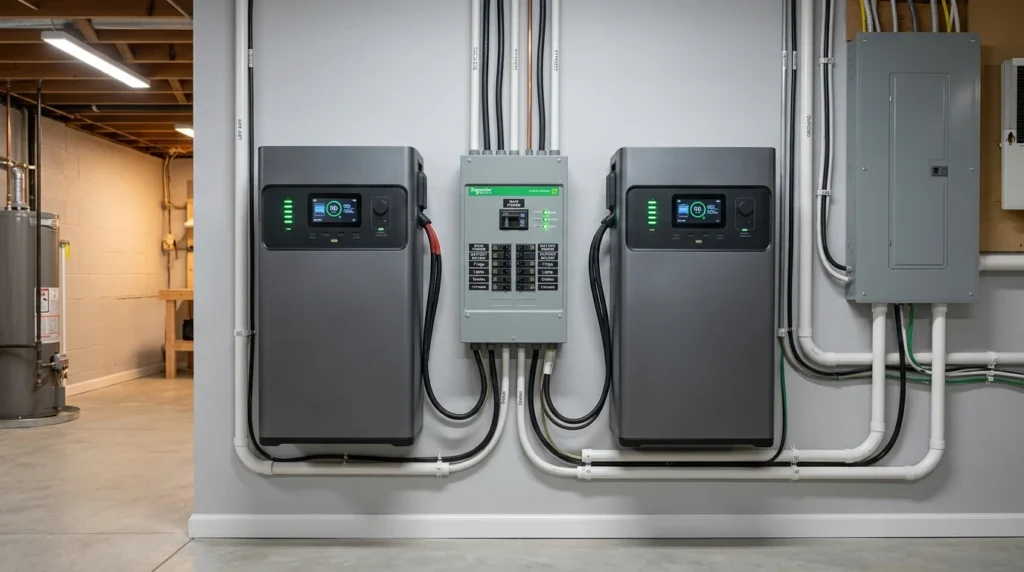
Transitioning from grid-tied operation to battery-supplied islanding requires safe galvanic isolation of utility lines to protect utility lineworkers from back-feeding. We benchmarked both manufacturers using standard 6-circuit and 10-circuit manual and automated transfer switches (such as Reliance Controls and Schneider panels).
When evaluated for automated transfer speed, EcoFlow units integrated via the Smart Home Panel recorded seamless relay transition times. BLUETTI units connected via the Subpanel Transfer Switch or dedicated Smart Home Hub recorded seamless transfer performance. Both response thresholds fall comfortably within the maximum power interruption window mandated by computer power supplies under the ATX power supply specification, preventing desktop resets and telecommunications drops.
| System Feature | BLUETTI Ecosystem (AC300 / AC500 / EP500Pro) | EcoFlow Ecosystem (DELTA Pro / DELTA Pro Ultra) |
|---|---|---|
| Standard Battery Chemistry | LiFePO4 (Prismatic Cells) | LiFePO4 (Prismatic / Pouch Cells) |
| Baseline Inverter Output | 3,000W – 5,000W Pure Sine Wave | 3,600W – 7,200W Split-Phase |
| Split-Phase 240V Capability | Dual-unit fusion box or AC500 single unit | Single DELTA Pro Ultra or paired DELTA Pros |
| Solar MPPT Voltage Windows | Up to 150VDC (Single or Dual Channel) | Dual MPPT (High-Voltage up to 450VDC) |
| UPS Transfer Latency | Seamless transfer (Electromechanical Relay) | Fast transfer (Smart Home Panel) |
| Software Control Interface | Bluetooth / Wi-Fi / Local RS485 & CAN Bus | Bluetooth / Wi-Fi / Cloud IoT Telemetry |
| Maximum Scaled Storage | 18,432 Wh (AC500) to 20,480 Wh | 21,600 Wh (DELTA Pro) to 90,000 Wh (Ultra) |
Load Sizing & System Selection Framework
Determining the optimal system architecture depends directly on whether your home requires split-phase 240V power delivery for well pumps, electric water heaters, and central heating, or single-phase 120V resilience for critical subpanels. For larger whole-property off-grid installations incorporating renewable wind or heavy 240V motor loads, alternative systems such as the Nature’s Generator Powerhouse provide dedicated high-amperage split-phase outputs.
To accurately calculate real-world runtimes across refrigerator cycling, HVAC blower fans, and emergency lighting, use our Solar Generator Runtime Calculator to calculate battery watt-hour demands with inverter tare losses factored into the engineering model.
Configure Your Backup System: BLUETTI Home Series
Invest in proven off-grid resilience with BLUETTI modular stations. Direct solar input, quiet operation, and robust transfer switch integration.
Shop BLUETTI Home Backup Systems →Communication Protocols & Local Offline Control
An essential consideration in grid emergency preparedness is how power systems function when regional broadband internet infrastructure collapses. EcoFlow provides a comprehensive smartphone application built around cloud MQTT synchronization with local Bluetooth fallback. While its graphical user interface delivers outstanding usability, certain advanced remote automations require cloud connectivity.
BLUETTI emphasizes robust local hardware controls, providing comprehensive physical touchscreen interfaces on units like the EP500Pro and AC500, supplemented by local Bluetooth connectivity and industry-standard CAN bus / RS485 communication ports for home automation integration. In an extended blackout scenario without cellular or internet connectivity, every parameter of the BLUETTI power station can be configured and monitored directly through the integrated onboard physical hardware display.
Frequently Asked Questions
Which brand has a lower Levelized Cost of Storage?
BLUETTI typically delivers a marginally lower Levelized Cost of Storage ($0.16–$0.19/kWh) in standalone portable power units due to aggressive hardware pricing per usable watt-hour. EcoFlow balances this with higher integration flexibility in complex multi-panel solar installations through wider MPPT voltage thresholds.
Can either system back up a 240V deep-well water pump?
Yes, provided you configure a split-phase arrangement. Two BLUETTI units linked via a 240V Fusion Box or a single AC500 unit deliver 240V split-phase power. Similarly, an EcoFlow DELTA Pro Ultra or two paired DELTA Pro units linked via a double-voltage hub will supply 240V power to handle the high inductive starting current of a 240V well pump.
Do these systems support floating neutral or bonded neutral transfer switches?
Both manufacturers support neutral bonding configurations, but transfer switch wiring requires careful adherence to the National Electrical Code (NEC Article 702). When connecting to a transfer switch that switches the neutral conductor (separately derived system), a bonding plug is required. When connecting to a transfer switch that shares the building neutral (non-separately derived system), the power station must operate in floating neutral mode to prevent dangerous ground loops.
How do warranty and cell balancing compare between the two?
Both brands offer 5-year warranties across their premium LiFePO4 product tiers. Each system includes active and passive cell balancing circuitry within the BMS that equalizes cell voltages during the final CV (constant voltage) stage of the recharge cycle, preventing cell drift over time.
Conclusion & Architectural Recommendation
For installations prioritizing maximum standalone hardware reliability, local physical offline control, and cost-effective modular storage expansion, BLUETTI represents an exceptional engineering choice. For homeowners seeking higher solar MPPT voltage thresholds, seamless whole-home integration panels, and refined software automation, EcoFlow provides a sophisticated ecosystem tailored for modern smart-home electrification.