
Affiliate disclosure: This guide contains no affiliate links.
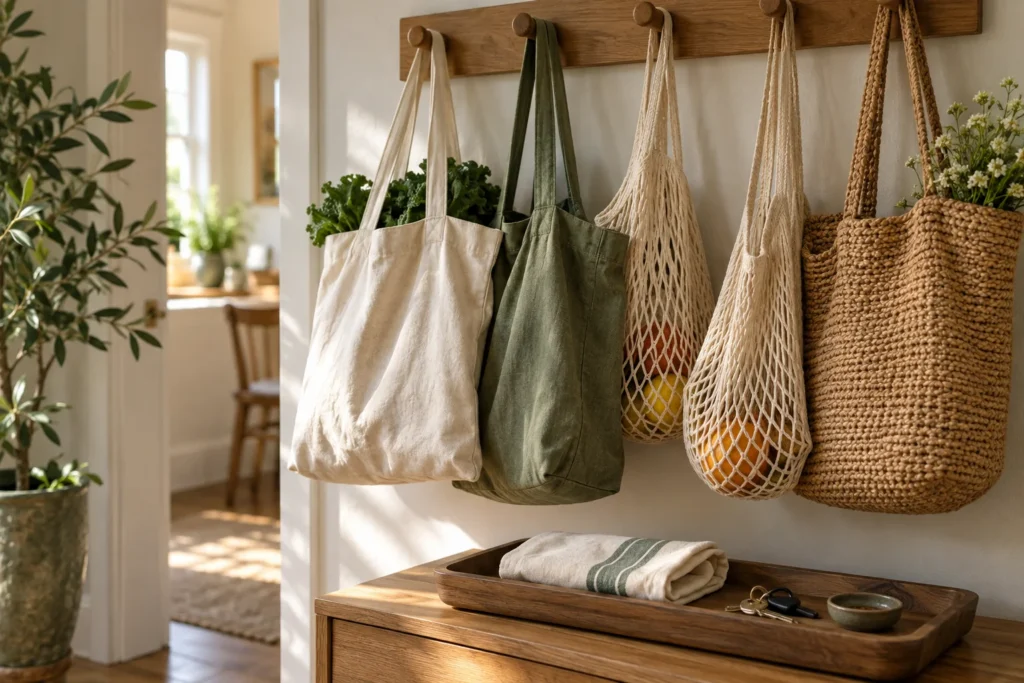
AI-generated editorial illustration. The scene is illustrative; it does not depict a FoxyEco product test or the exact appearance of a recommended model.
Reusable bags cut waste when they leave the house with you and survive washing. A closet full of free promotional totes is not a system. Match bag type to trip (groceries, produce, library), keep a stash where you grab keys, and retire damaged bags that dump cans in the parking lot.
Placement beats quantity
One bag in each backpack and by the door outperforms ten in a hall closet. Trunk hooks help drivers; transit users need compact folds that survive being sat on. If bags live only in the pantry, you will keep buying single-use bags “because I forgot.”
Pick a home for clean bags and a separate home for dirty ones waiting for wash day. Mixing them is how raw-meat residue ends up on library books.
For households with several shoppers, label or color-code a few bags so people stop arguing about whose tote disappeared.
Choose by trip, not by slogan
Grocery runs need volume and handle strength. Farmers-market trips may need washable produce bags. A laptop bag is not a produce carrier. Waterproof liners help for cold packs and wet greens; mesh helps airflow but shows stains.
Cotton canvas feels sturdy and can be heavy when wet. Polypropylene folds small and may not love high-heat drying. Neither material is automatically “eco” without looking at use count and end-of-life options in your city.
Inspect seams and handles before loading heavy glass. A failed handle in a parking lot creates broken jars and a decision to buy disposables again.
Care that actually happens
Fabric bags need washing—especially after raw meat, eggs, or leaky produce. Wipe waterproof liners. Air-dry thoroughly; damp bags smell and grow mildew in a trunk.
Do not assume “wipeable” means food-safe forever. Deep stains and torn liners are retirement signals. Retire early rather than inventing a hygiene ritual you will not keep.
Keep a laundry day for bags with towels if that is the only way they get cleaned. Orphan bags in the trunk never see soap.
Count uses honestly
A thick tote used twice is worse packaging theater than a lighter bag used weekly for years. Track by habit, not by ownership count. If you have twenty bags and use three, donate or recycle the rest through accepted local routes.
Store fees for paper or plastic change the math but do not fix forgetfulness. A foldable backup in every jacket pocket covers surprise stops better than another branded canvas tote.
Failure modes
Bags left in a hot car for months can crack or smell. Bags overloaded beyond handle ratings fail at the worst moment. “Reusable” produce bags that stay home while you still take store plastic for greens mean you solved the wrong trip.
Another failure: washing bags with detergent that leaves residue, then putting food directly against the fabric. Use a liner or a wash routine you trust.
Questions people ask
Cotton vs polypropylene? Different wash and wet-strength stories; pick for your trips and drying space.
How many bags do I need? Enough for your largest regular shop plus one backup set in transit. More than that usually becomes clutter.
What about insulated bags? Useful for long trips with cold goods if you will wash the liner; otherwise they become heavy garage ornaments.
Can I recycle old bags? Check local rules—many soft plastics need store drop-off, not the curbside bin.
Failure modes worth logging
Write down the last three times this problem actually cost you time, money, or a second trip. Specific dates beat vague frustration. Shop and change habits against that log.
After any fix, schedule a verify date. Many household solutions look fine until the next full load, full shower, windy night, or guest weekend.
Brief everyone who shares the space. Put the rule where people already look—near the machine, by the door, or on the storage shelf.
Seasonal and occupancy notes
Peak-occupancy days stress systems differently from empty weekdays. Weather extremes change material behavior, battery voltage, draft paths, and drying times. Plan a five-minute inspection when seasons change.
Travel weeks are when sensors go quiet, bags stay home, laundry piles up, and packaging accumulates. Leave a short checklist for whoever is still in the house.
Decision checklist
- Name the failure in one sentence.
- Find the exact manual, label, or local rule that applies.
- Do only the checks you are allowed and equipped to do.
- Photograph serials, labels, and before/after conditions when useful.
- Decide: keep, repair, refill, replace, or stop buying.
- Calendar a verify date and keep consumables next to the equipment they serve.
Re-check model-specific limits after firmware, parts, or building-rule changes—yesterday’s setup can become tomorrow’s fault.
Keep receipts, manuals, and a one-page household note together so the next person can continue the same experiment without guessing.
Field notes from real households
Log the last three failures with dates, what you tried, and what actually fixed the symptom. Vague memory (“the dishwasher is bad”) leads to replacement shopping; dated notes (“Tuesday dinner plates still greasy after Eco, spray arm blocked by a ladle”) lead to a five-minute fix.
Trial any change for a set window—two weeks of laundry, three windy nights, one billing cycle—before buying the next accessory. Brief guests and housemates on the one critical habit so your experiment is not undone on day two.
Keep manuals, receipts, and a one-page household note together. The next person should continue the same experiment without guessing which pouch, seal, or program you chose.
Seasonal transitions and travel weeks cause most regressions. Schedule a five-minute inspection then: bags, seals, sensors, charge state, and the drawer where “spare” packaging goes to die.
Practical scenarios
Peak occupancy: Holidays and remote-work clusters need different settings than empty weekdays. Overload a machine or skip a seal check when eight people are showering and you will recreate the original problem.
Weather extremes: Cold adhesive fails, batteries show different voltages, drafts roar, and indoor drying saturates rooms. Do not judge a product only on a mild weekend.
Shared spaces: Write a default plus temporary overrides. “Eco unless towels” beats an argument every Sunday night.
Evening triage: Name the failure, find the manual, do allowed checks only, photograph, decide, calendar a verify date. Keep consumables next to the equipment they serve.
Common pitfalls
Buying before measuring. Trusting packaging icons without local verification. Skipping a second test after a fix. Storing spare parts unlabeled. Optimizing price or “natural” while ignoring the constraint that actually failed—fit, drying space, charger match, or handle strength.
Another pitfall: collecting ten half-solutions (bags, seals, pouches, sensors) instead of finishing one routine that people will repeat. Finish beats accumulate.
Measured bag example
Illustrative: three sturdy totes used 2 grocery trips per week for 50 weeks are 300 carry events. At an assumed $0.10 avoided bag fee each, that is $30/year—secondary to the habit of actually bringing them.
Wash fabric bags every 14 days if they carry produce; time the laundry add-on at about 8 minutes including hang-dry setup.