
Affiliate disclosure: This guide contains no affiliate links.
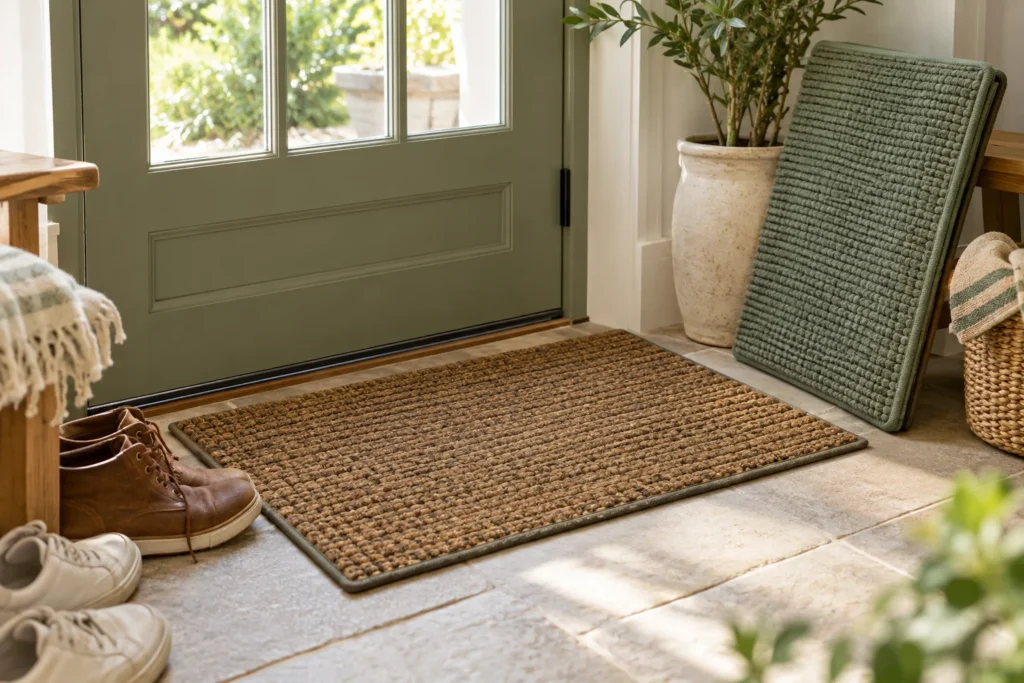
AI-generated editorial illustration. The scene is illustrative; it does not depict a FoxyEco product test or the exact appearance of a recommended model.
A doormat earns its keep when it catches the grit your household actually tracks in—wet leaves in October, dry dust in August, dog paws after rain—without becoming a trip hazard or dyeing the hardwood underneath. “Natural coir” or “extra absorbent” on the hangtag does not settle door clearance, backing chemistry, or whether you will hose it off in January.
Walk the entry for a day before you shop. Notice where shoes land, where the door sweeps, and whether rain reaches the mat. That map beats a styled porch photo.
Clearance and traffic first
Open the door fully with the candidate thickness in mind. A plush mat that jams the door gets kicked aside within a week. Measure the landing zone so the mat sits where feet actually plant, not where the catalog placed it. Keep exits clear for emergencies; curled corners are not a style choice—they are a fall risk.
Read the whole construction
Ask about face fiber, backing, and edge binding separately. A washable top does not make rubber-backed sandwich machine-safe. Indoor vs covered outdoor vs fully exposed use should be written down, not inferred from a lifestyle shot. Keep the care card after you toss the polybag.
Protect the floor under it
Some backings stain or trap moisture on wood and certain vinyls. If the listing is vague, ask the mat seller and the floor maker. Lift the mat when you mop; let both surfaces dry. Never use a mat to hide a chronic leak—fix the water first.
Pick a cleaning method you will repeat
Shake, vacuum, hose, or machine-wash only as allowed. Check vacuum brush-roll warnings for rubber backs. A “machine washable” mat can still be too heavy wet for your washer—read weight and program limits. If professional cleaning is the only option and you will never book it, buy something simpler.
One mat or two?
A coarse outdoor scraper plus a softer indoor wipe can work for muddy seasons, but only if people step on both. If dirt bypasses a lonely mat by the hinge side, move it before replacing the fiber. Avoid collecting a stack of novelty mats that never see the door.
Replace for function, not fashion alone
Retire a mat that curls, sheds dangerously, or no longer lies flat. A cosmetic stain on a still-safe mat is different from a frayed edge that catches heels. Do not pass a trip hazard to the garage entry “to keep using it.”
Worksheet without fake lifespans
Example: $25 mat ÷ 50 cleaning cycles = $0.50 per cycle before cleaning labor. Invented cycle counts are for comparing habits, not predicting durability. If a permitted pro clean costs $15, weigh that against buying another $25 mat only when the backing has failed.
Green claims stay narrow
FTC guidance still applies: recycled-content claims need a component and amount. Local disposal may not take mixed rubber-textile mats. Repeated useful service beats a shelf of “eco” mats that never fit the door.
Scenario: the mat everyone walks around
You bought a long runner that looked perfect online. In your hallway, people step from the porch onto bare floor beside it because the door opens over the mat’s left third. Fix placement first: shift so the first footfall lands on the scraper surface. If the door still catches, return or trim only if allowed—do not stack a second mat on top “for now.”
Questions at the threshold
Why is my floor sticky under the mat? Moisture or plasticizer transfer—lift, dry, and check compatibility.
Coir outdoors in rain? Many coir mats shed and mold when soaked; check the use rating.
Can I cut a mat to fit? Only if the maker says so; cut edges may unravel or lose backing seal.
Mud season vs dust season
In wet months, prioritize scrape-and-shed surfaces you can hose. In dry months, a tighter weave that vacuuming handles may be enough. Switching mats seasonally can be smarter than one compromised “all-year” product that fails at both jobs. Store the off-season mat dry and flat so the backing does not take a permanent curl.
If you share an entry with delivery drivers dropping packages, place a shorter scraper where boxes land so cardboard grit does not grind into the longer runner.
Check landlord or HOA rules before screwing down outdoor mats or using adhesives on shared hall floors. Removable solutions avoid deposit fights later.
Buying checklist you can take to the store
Write four lines on your phone before you shop: (1) indoor or outdoor exposure, (2) maximum thickness that clears the door, (3) floor type underneath, (4) cleaning method you will actually use this month. Cross off any mat that fails one line, no matter how cute the pattern. If shopping online, order only from sellers with clear return shipping for bulky textiles—return freight on a muddy mat can erase the “deal.”
After the first week, photograph the underside. Early dye transfer or dampness is cheaper to catch while returns are open. If the mat sheds heavily onto socks, vacuum daily for a week; if shedding does not taper, it may be a manufacturing dud rather than normal break-in.
For apartment buildings, ask whether hallway runners are supplied by management. Doubling private mats in a shared corridor can violate fire egress rules even when your unit entry is fine.
Sources
Related guides
- Choose a Rug for the Room and the Care It Needs
- Bathroom Moisture: Make the Exhaust Fan Part of the Routine
Verified Eco Recommendation: BLUETTI
High-efficiency LiFePO4 portable power stations, solar generators, and home battery backup systems.
Explore BLUETTI Official Store →