
Section 1
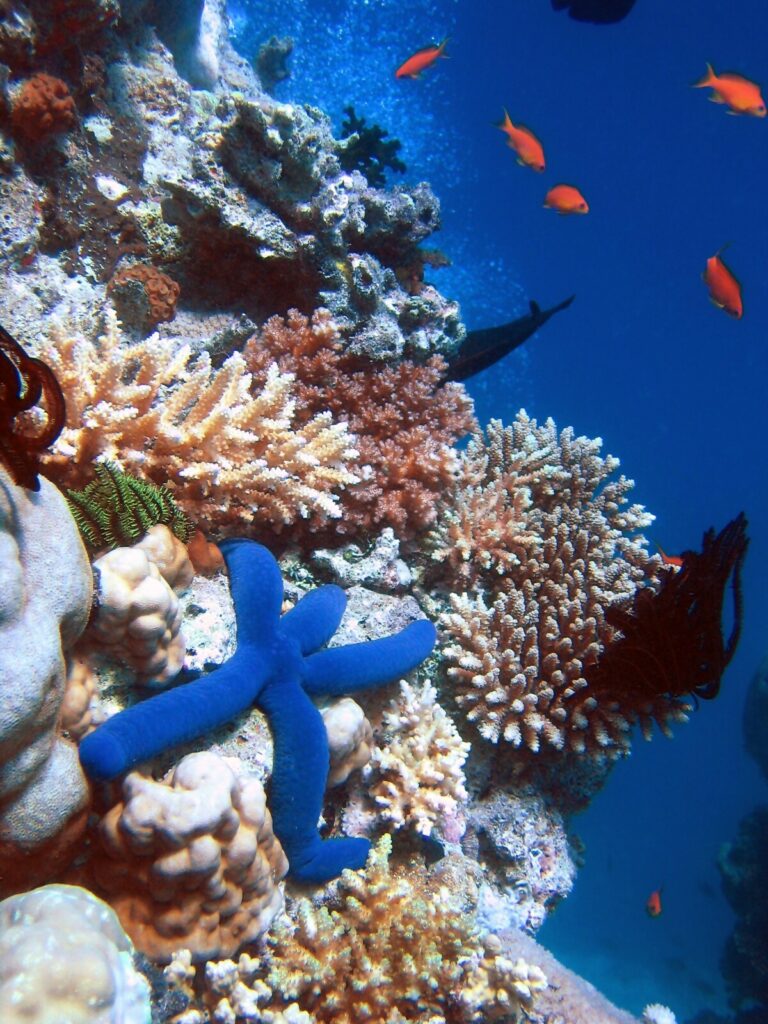
Section 1 The Crisis Beneath the Waves Coral reefs are often described as the rainforests of the sea. Despite covering less than 1% of the ocean floor, they support roughly 25% of all marine species. They provide crucial nurseries for commercial fish populations, protect coastlines from storm surges, and contribute billions of dollars annually to local economies through tourism and fishing. However, these vibrant underwater ecosystems are facing an unprecedented existential threat. Global warming has led to rising sea temperatures, which trigger widespread coral bleaching events. When stressed by heat, corals expel the symbiotic algae (zooxanthellae) living in their tissues, causing them to turn completely white. Without these algae, the coral loses its primary source of food and becomes highly susceptible to disease and death. In addition to climate change, ocean acidification, agricultural runoff, overfishing, and physical destruction from coastal development are compounding the stress on these delicate organisms.
Section 2
Section 2 The Great Barrier Reef, the largest coral reef system in the world, has suffered multiple mass bleaching events over the past decade, sounding a global alarm. If current warming trends continue unchecked, scientists warn that up to 90% of the world’s coral reefs could be lost by the year 2050. Innovative Micro-Fragmentation Techniques In the face of this ecological disaster, marine biologists are not standing idly by. One of the most promising breakthroughs in coral restoration is a technique known as micro-fragmentation. Historically, coral restoration involved taking small clippings from healthy corals and growing them in underwater nurseries until they were large enough to be planted back onto the reef. This process was incredibly slow, as some boulder corals take years to grow just a few centimeters. Micro-fragmentation accelerates this timeline dramatically. By using specialized diamond saws, scientists cut live coral into tiny pieces, roughly the size of a coin.
Section 3
Section 3 This severe fragmentation triggers a rapid healing response in the coral, causing it to grow at up to 40 times its normal rate as it attempts to fuse back together. Once these micro-fragments reach a viable size in land-based or ocean nurseries, they are planted close together on dead reef structures. Over time, because they share the same genetic code, the fragments fuse together to form a large, reproductively mature coral head in a matter of months rather than decades, significantly accelerating the pace of reef regeneration. Breeding Super Corals for a Warmer Future Restoring a reef is futile if the newly planted corals succumb to the next marine heatwave. To address this, conservationists are focusing on creating resilient ‘super corals’. Researchers are actively surveying reefs in extreme environments, such as naturally warm or acidic lagoons, to find coral colonies that have survived harsh conditions. These resilient survivors are brought into laboratories and bred with other hardy specimens. The goal is to facilitate assisted evolution, actively selecting for genetic traits that confer heat and stress tolerance.
Section 4
Section 4 Some labs are even exploring the manipulation of the symbiotic algae itself, cultivating heat-resistant strains of zooxanthellae that can be introduced into bleached corals to help them recover and withstand future temperature spikes. In addition to selective breeding, cryogenic preservation is being utilized to freeze and store coral sperm and eggs, creating biobanks that safeguard genetic diversity for future restoration efforts. By planting these thermally tolerant super corals back into the wild, scientists aim to create highly resilient reef systems that can endure the warmer ocean temperatures expected in the coming decades. Acoustic Enrichment and Artificial Reefs Another fascinating avenue of restoration involves the use of sound. Healthy coral reefs are incredibly noisy places, filled with the clicks, pops, and grunts of thriving marine life. This acoustic signature acts as a beacon, guiding free-swimming coral larvae and young fish to settle on the reef. Degraded reefs, by contrast, are eerily silent, making it less likely that new life will find its way there. Researchers have discovered that by broadcasting recordings of healthy reef sounds using underwater speakers—a technique called acoustic enrichment—they can significantly increase the settlement rate of coral larvae and the return of diverse fish species to damaged areas.
Section 5
Section 5 Furthermore, the physical foundation of the reef often needs rebuilding. To achieve this, engineers are deploying 3D-printed artificial reef structures made from eco-friendly concrete or terracotta. These structures mimic the complex topography of natural reefs, providing nooks and crannies for fish to hide and a stable substrate for coral larvae to attach and grow. Combining these high-tech structural solutions with acoustic enrichment creates an inviting environment that accelerates the natural recovery processes. Community Action and the Path Forward While cutting-edge scientific interventions offer crucial lifelines, the long-term survival of coral reefs depends heavily on community involvement and global policy shifts. Restoration efforts are increasingly incorporating local coastal communities, training them as ‘coral gardeners’ to maintain underwater nurseries and outplant corals. This community-driven approach not only scales up restoration capacity but also provides alternative, sustainable livelihoods that reduce reliance on destructive fishing practices. Furthermore, establishing effectively managed Marine Protected Areas (MPAs) is essential to shield recovering reefs from local stressors like overfishing and pollution, giving them the best chance to thrive. However, scientists unanimously agree that restoration and local management are only band-aids if the root cause is ignored. A monumental global effort to curb greenhouse gas emissions and halt climate change is the only definitive way to ensure the long-term survival of coral reefs. As the window of opportunity narrows, the combination of aggressive climate action and innovative restoration techniques remains our best hope for preserving these irreplaceable underwater ecosystems for future generations.