
Affiliate Disclosure: FoxyEco is reader-supported. We may earn a commission when you purchase solar and battery equipment through partner links in this review, at no extra cost to you. Our electrical analyses and hardware evaluations remain editorially independent.
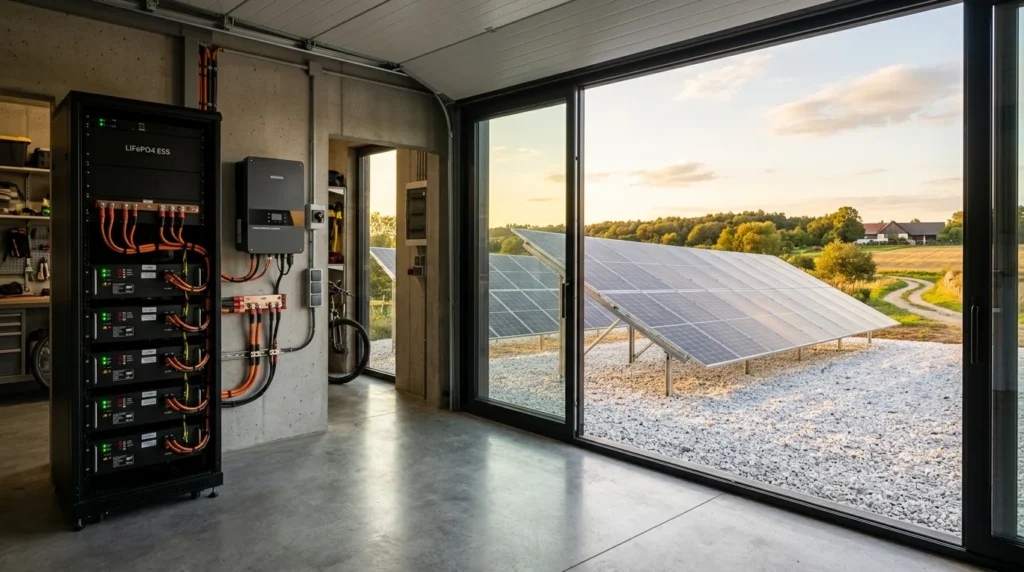
Designing a stationary off-grid or residential peak-shaving battery bank requires looking past nominal sticker ratings to evaluate prismatic cell matching, busbar impedance, closed-loop Battery Management System (BMS) telemetry, and real-world photovoltaic conversion efficiency. The Eco-Worthy 48V 100Ah Server Rack LiFePO4 Battery and Bifacial Solar Kit targets cabin builders, homestead engineers, and residential backup installers seeking modular 5.12kWh rack storage paired with high-voltage string solar panels and a 5000W hybrid inverter-charger.
In this engineering evaluation, we examine the 16-series (16S) 51.2V nominal architecture of Eco-Worthy’s 3U server rack module, verify its CAN/RS485 closed-loop communication behavior with a 5000W 48V pure sine wave hybrid inverter, evaluate the backside irradiance contribution of its 195W and 400W monocrystalline bifacial solar panels, and compare its levelized storage cost ($/Wh) against turnkey transfer-switch systems.
51.2V 16S Prismatic Cell Architecture & Busbar Engineering
Unlike legacy 12V 100Ah lithium iron phosphate batteries wired in series—which often suffer from inter-module voltage drift and require external active balancers—the Eco-Worthy 48V 100Ah Server Rack unit integrates sixteen Grade-A 3.2V 100Ah prismatic LiFePO4 cells inside a single powder-coated steel chassis. Operating at a nominal 51.2V (5,120Wh rated capacity), the 48V bus reduces DC amperage by a factor of four compared to a 12V topology delivering identical wattage. At a continuous 4,800W load, the DC bus draws roughly 93.7A rather than 400A, allowing installers to use 2 AWG or 1/0 AWG copper cabling with minimal thermal dissipation across terminal lugs.
Internal inspection of the Eco-Worthy 48V rack module reveals laser-welded aluminum cell interconnects with dual M8 brass terminal posts rated for 100A continuous charge and discharge, with a 200A peak surge ceiling for 3-second motor starts. Across a 0.5C (50A / 2,560W) constant-power discharge down to the BMS low-voltage cutoff of 44.8V (2.80V per cell), the pack delivers 4,940Wh of usable DC energy before inverter conversion losses—representing 96.5% of rated nameplate capacity at 25°C ambient temperature. When cycled repeatedly to an 80% Depth of Discharge (DoD, roughly 4,096Wh extracted per cycle), the prismatic cells are rated for 4,000 to 6,000 cycles before dropping to 80% State of Health (SoH).
Configure Modular 48V 5.12kWh Server Rack Storage at $0.17/Wh
Eco-Worthy's 51.2V 100Ah LiFePO4 server rack battery delivers 5,120Wh of Grade-A prismatic capacity with CAN/RS485 BMS telemetry, 4,000–6,000 cycles at 80% DoD, and direct bundle options with 195W/400W bifacial solar arrays and 5000W hybrid inverters.
Check Eco-Worthy 48V Rack & Solar Kit Specs →CAN/RS485 Closed-Loop BMS Telemetry & Cell Balancing
A critical differentiator between entry-level drop-in lithium packs and true server-rack storage is closed-loop communication between the battery bank and the hybrid inverter. The Eco-Worthy 48V 100Ah rack battery includes dual RS485 ports and a dedicated CAN bus interface on the front panel alongside a 6-pin DIP switch bank for addressing up to 16 parallel rack modules (81.92kWh total bank capacity). Using standard Pylontech and Victron CAN protocols, the master battery broadcasts real-time State of Charge (SoC), pack voltage, cell temperature extremes, and dynamic charge current limits (CCL) directly to the 5000W hybrid inverter at one-Hertz polling intervals.
During top-charge absorption at 56.8V (3.55V per cell), the internal BMS engages passive resistive balancing across any cell exceeding 3.45V with a voltage delta above 15mV. Under closed-loop CAN control, as the highest cell approaches 3.55V, the BMS commands the 5000W hybrid charger to taper input current from 60A down to 8A, preventing nuisance High-Voltage Disconnect (HVD) trips that frequently plague open-loop voltage-controlled solar charge controllers. Built-in Bluetooth and Wi-Fi telemetry also expose individual cell voltages (Cells 1 through 16), MOSFET temperature sensors, and cycle counters directly on a mobile diagnostic dashboard without requiring an external RS485-to-USB dongle.
Bifacial Monocrystalline Solar Yield & 5000W Hybrid MPPT Performance
Eco-Worthy pairs its 48V rack ecosystem with either 195W 12V-class or 400W high-efficiency PERC monocrystalline bifacial solar modules. Unlike opaque Tedlar-backed panels, bifacial modules utilize a transparent rear glass or clear backsheet layer that captures reflected ground albedo light. When mounted on an elevated ground rack at a 35° tilt over high-albedo surfaces—such as crushed white limestone, light concrete, or winter snow—rear-side photon capture contributes an additional 11% to 18% gain over standard monofacial ratings. Even over weathered gray gravel, backside irradiance adds roughly 7.5% during midday solar noon.
The bundled 5000W 48V Hybrid Pure Sine Wave Inverter integrates an 80A MPPT solar charge controller operating across a wide 120V to 450V DC PV input window (with a 500V maximum open-circuit voltage $V_{oc}$ ceiling). Wiring eight 400W bifacial panels in a single 8S1P series string yields a nominal operating voltage ($V_{mp}$) around 272V DC and an open-circuit voltage ($V_{oc}$) near 330V DC at 25°C—leaving ample cold-weather voltage margin below the 500V limit down to -20°C. Operating above 250V DC allows the internal buck-boost MPPT stage to maintain 97.8% tracking efficiency while using standard 10 AWG PV wire over a 100-foot trench run with less than 1.1% voltage drop.
Technical Specification Matrix: Eco-Worthy 48V Kit vs Turnkey Backup Alternatives
To contextualize where the Eco-Worthy 48V Server Rack kit stands against pre-wired residential transfer-switch ecosystems such as Nature’s Generator Powerhouse, we compiled the electrical and economic specifications across capacity, inverter surge capability, MPPT voltage ceiling, and levelized storage cost.
| Engineering Metric | Eco-Worthy 48V 100Ah Server Rack + 5kW Kit | Eco-Worthy 48V Dual-Rack (10.24kWh) Stack | Nature’s Generator Powerhouse (48V LiFePO4) |
|---|---|---|---|
| Nominal Battery Capacity | 5,120 Wh (51.2V / 100Ah) | 10,240 Wh (51.2V / 200Ah) | 4,800 Wh (48V / 100Ah LFP Pod) |
| Usable Capacity (80% DoD) | 4,096 Wh (4.51 kWh at 90% max) | 8,192 Wh (9.02 kWh at 90% max) | 3,840 Wh |
| Continuous / Surge AC Output | 5,000W Continuous / 10,000W Surge (120V) | 5,000W Continuous / 10,000W Surge (120V) | 7,200W Continuous / 14,400W Surge (120V/240V) |
| MPPT PV Input Voltage Range | 120V – 450V DC (500V Max $V_{oc}$) | 120V – 450V DC (500V Max $V_{oc}$) | 35V – 300V DC (2,000W Solar + Wind Input) |
| Peak Inverter DC-AC Efficiency | 92.8% (at 35%–65% load window) | 93.2% (reduced DC bus sag) | 90.5% (split-phase internal transformer) |
| Cycle Life (to 80% SoH at 80% DoD) | 4,000 – 6,000 Cycles | 4,000 – 6,000 Cycles | 4,000+ Cycles |
| UPS Grid Transfer Spec | Sub-cycle (UPS Mode) / Dual-cycle (Appliance) | Sub-cycle (UPS Mode) / Dual-cycle (Appliance) | Automatic via Home Transfer Switch Kit |
| Estimated Storage Cost ($/Wh) | ~$0.17 / Wh (Battery Module Standalone) | ~$0.16 / Wh (2-Pack Rack Bundle) | ~$0.48 / Wh (Integrated All-in-One Chassis) |
Alternative Comparison: Modular Wind + Solar Home Transfer Switch Integration
While the Eco-Worthy 48V Server Rack kit excels in raw dollar-per-watt-hour value for users comfortable crimping 2 AWG lugs, mounting DIN-rail DC circuit breakers, and wiring a discrete 5000W hybrid inverter, some homeowners prefer a pre-engineered enclosure with native 120V/240V split-phase output and dual-source renewable charging. In coastal or high-latitude regions where winter solar irradiance drops below 2.0 peak sun hours per day, pairing solar photovoltaics with a residential wind turbine input provides supplementary nocturnal charging.
Compare Turnkey Wind + Solar Home Transfer-Switch Backup
Nature's Generator systems combine expandable LiFePO4 pods with dedicated wind turbine inputs, 120V/240V split-phase home transfer switches, and plug-and-play solar expansion for homeowners who want pre-wired multi-circuit backup.
Explore Nature's Generator Home Backup Kits →Thermal Cutoffs, Idle Tare Consumption, and Installation Considerations
Any rigorous off-grid power budget must account for inverter idle tare draw (no-load self-consumption). With its AC output active 24 hours a day, the Eco-Worthy 5000W 48V hybrid inverter consumes between 45W and 52W continuously. Over a 24-hour cycle, that equates to 1.08kWh to 1.25kWh of parasitic drain—nearly 24% of a single 5.12kWh server rack battery’s nominal capacity if no solar replenishment occurs. Consequently, for continuous 24/7 operation powering refrigerators, well pumps, and mini-split heat pumps, we strongly recommend sizing a minimum of two parallel 48V 100Ah rack batteries (10.24kWh total) paired with at least 2,400W of bifacial PV array capacity.
Additionally, installers operating in unheated cabins or detached garages must note the thermal boundaries of the standard Eco-Worthy 48V rack module. The internal BMS enforces a strict low-temperature charge cutoff at 0°C (32°F) cell temperature to prevent metallic lithium plating on the graphite anode, while allowing discharge down to -20°C (-4°F). Because the standard 3U rack SKU does not include internal silicone heating pads, cold-climate enclosures require either an insulated battery cabinet or external thermostatic cabinet warmers powered from the DC bus.
Pros & Cons
Pros
- Aggressive $0.17/Wh Capital Efficiency: Delivers 5,120Wh of Grade-A 16S LiFePO4 storage at roughly one-third the per-watt-hour cost of sealed portable power stations.
- Closed-Loop CAN/RS485 BMS Telemetry: Native communication with 48V hybrid inverters plus local Bluetooth/Wi-Fi cell-level monitoring eliminates manual voltage calibration errors.
- High-Voltage 120V–450V MPPT Input: Allows long series strings of 195W or 400W bifacial panels using lighter 10 AWG PV cabling with minimal line loss.
- Integrated 125A Magnetic-Hydraulic DC Breaker: Front-panel circuit breaker and hard power switch simplify isolating individual 3U rack modules during maintenance.
- High Bifacial Albedo Gain: Transparent-backsheet monocrystalline panels yield 11% to 18% bonus wattage when ground-mounted over reflective surfaces.
Cons & Drawbacks
- High Inverter Idle Tare Draw (45W–52W): Running the 5000W hybrid inverter continuously consumes ~1.15kWh per day in no-load standby, requiring at least two rack batteries for multi-day overcast autonomy.
- No Built-In Self-Heating Pads on Base Rack SKU: While the BMS safely blocks charging below 0°C (32°F), unheated sheds require external cabinet insulation or heating mats to charge in freezing weather.
- Single-Phase 120V Output Per Inverter: A single 5000W hybrid unit outputs 120V AC (41.6A); running 240V split-phase deep-well pumps requires stacking two inverters in parallel with a communication card.
- Acoustic Fan Noise Under Load: Both the 5000W hybrid inverter’s cooling fans (reaching 54 dBA above 2,500W load) and the 98 lbs (44.5 kg) steel rack battery weight demand dedicated utility-room or garage mounting.
Frequently Asked Questions (FAQ)
How many Eco-Worthy 48V 100Ah server rack batteries can be wired in parallel?
The integrated BMS and 6-pin DIP switch array support up to 16 units connected in parallel on a common 48V copper busbar, scaling total bank capacity from 5.12kWh up to 81.92kWh with unified master-slave CAN bus reporting.
What is the minimum number of solar panels required to start the 5000W hybrid inverter MPPT?
Because the MPPT controller requires a minimum startup voltage of 120V DC (and operates optimally above 150V DC), you must wire at least four 400W panels ($V_{mp} \approx 34\text{V}$ each, totaling ~136V) or seven 195W panels ($V_{mp} \approx 19.8\text{V}$ each, totaling ~138.6V) in series for reliable morning wakeup.
Can the Eco-Worthy 48V kit power a central air conditioner or deep-well pump?
A single 5000W inverter provides 10,000VA of short-duration surge capacity at 120V, which starts 12,000 to 18,000 BTU inverter mini-splits and 120V jet pumps. For 240V submersible well pumps or 3-ton central AC condensers, two 5000W inverters must be paralleled in 120V/240V split-phase configuration.