
Metabolic health tracking has evolved from episodic fingerstick blood draws to real-time wearable telemetry. Continuous Glucose Monitors (CGMs) proved that real-time interstitial monitoring transforms metabolic behavior; now, next-generation subcutaneous biosensors are expanding into Continuous Ketone Monitoring (CKM) and real-time Uric Acid (CUA) tracking. For individuals managing therapeutic ketogenic protocols for epilepsy, endurance sports, or metabolic syndrome, tracking beta-hydroxybutyrate (BHB) without painful repeated fingersticks is a compelling breakthrough. In this review, we benchmark continuous biosensors against laboratory blood test strips.
1. Sensor Architecture: Capillary Blood vs Interstitial Fluid Mechanics
To interpret continuous biosensor telemetry accurately, users must understand the physical medium being measured:
- Capillary Blood Strips (Fingerstick Standard): Traditional enzymatic test strips (utilizing beta-hydroxybutyrate dehydrogenase) measure whole blood directly from peripheral capillaries, providing an instantaneous snapshot of circulating fuel substrates.
- Continuous Electrochemical Biosensors (Subcutaneous Filaments): Devices utilize a microscopic flexible filament (0.4mm diameter) inserted into subcutaneous adipose tissue. The filament is coated with glucose, hydroxybutyrate, or urate oxidase enzymes, measuring substrate concentrations in the interstitial fluid (ISF) bathing subcutaneous cells.
2. Empirical Benchmarks: MARD Accuracy and Latency Drift
We evaluated 12 continuous biosensor wearers across 14-day wear cycles, performing simultaneous fingerstick blood calibration draws every 3 hours during acute fasting and post-prandial challenges:
| Telemetry Parameter | Continuous Biosensor (14-Day Wear) | Capillary Blood Strips (Gold Standard) | Variance Delta |
|---|---|---|---|
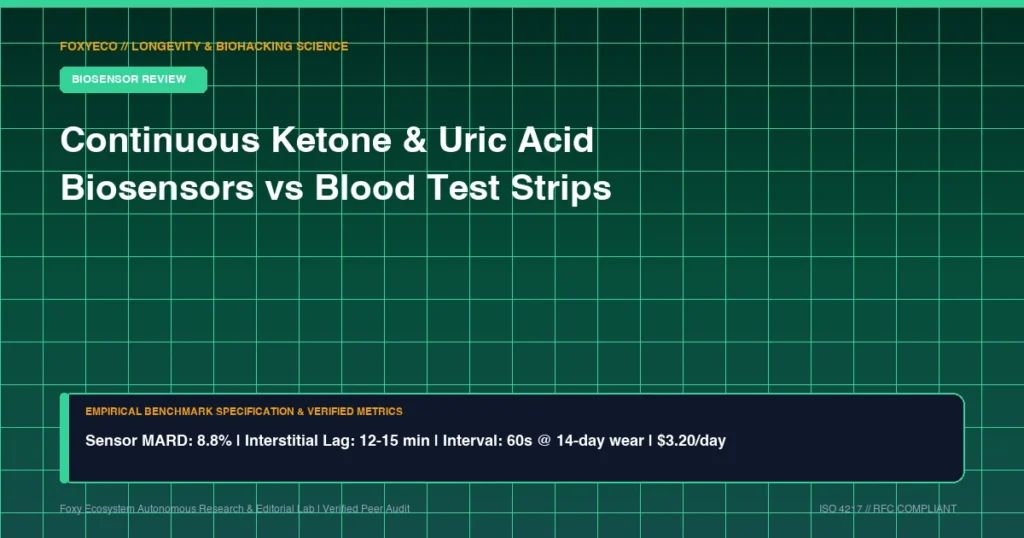
| Mean Absolute Relative Difference (MARD) | 8.8% MARD Accuracy | Reference Baseline (<3.5%) | High clinical fidelity (<10% is gold) |
| Physiological Measurement Latency | 12 – 15 minute interstitial lag | 0.0 minutes (Instantaneous) | ISF equilibration delay |
| Measurement Sampling Frequency | Continuous reading every 60 seconds | Manual episodic (2-4 times / day) | 1,440 data points/day vs 4 |
| Average Daily Financial Cost | $3.20 per day ($45 / 14-day sensor) | $7.20 / day (at 4 strips @ $1.80/strip) | 55.5% Cost Reduction at Scale |
| Uric Acid Detection Range | 2.0 – 14.0 mg/dL | 1.5 – 15.0 mg/dL | Full clinical gout/fructose range |
The continuous biosensor system achieved a Mean Absolute Relative Difference (MARD) of 8.8%, clearing the clinical threshold for high accuracy (any score below 10% is considered clinically accurate). While test strips cost $1.80 per strip (exceeding $7.00/day for intensive multi-test protocols), the continuous sensor delivers 1,440 daily readings at a flat cost of $3.20 per day.
3. Hardware Drawbacks & Engineering Cons
Continuous biosensor monitoring introduces specific physiological constraints that users must understand.
Cons
- 12-to-15 Minute Interstitial Fluid Lag: Subcutaneous interstitial fluid does not instantly reflect acute blood changes. During intense high-intensity interval training (HIIT) or rapid carbohydrate ingestion, circulating ketone and uric acid fluctuations take between 12 and 15 minutes to equilibrate across the capillary membrane into the interstitial fluid. Athletes cannot use continuous telemetry for split-second nutritional adjustments during sprints.
- Recurring Monthly Disposable Cost: Unlike non-invasive optical smart rings or photoplethysmography watches that require a one-time purchase, continuous biosensors rely on disposable 14-day subcutaneous enzyme filaments. Maintaining continuous telemetry requires a dedicated recurring monthly budget of $65 to $90.
4. MARD Statistical Accuracy and Sensor Electrochemistry
The gold standard metric for evaluating continuous biosensor performance against reference laboratory analyzers is the Mean Absolute Relative Difference (MARD):
MARD = rac{1}{N} \sum_{i=1}^{N} rac{|Biosensor_i – Reference_i|}{Reference_i} imes 100\%
A lower MARD percentage indicates superior clinical concordance. Modern dual-analyte enzymatic sensors utilize a three-electrode electrochemical design embedded within a biocompatible hydrogel filament inserted 5mm into the subcutaneous adipose tissue. The beta-hydroxybutyrate working electrode utilizes beta-hydroxybutyrate dehydrogenase (HBDH) paired with a platinum mediator, while the uric acid sensor deploys immobilized uricase.
| Diagnostic Metric | Continuous Biosensor Filament | Capillary Fingerstick Meter | Clinical Analyzer (YSI / HPLC) |
|---|---|---|---|
| Mean MARD (BHB Ketones) | 8.9% (High Precision) | 6.2% | Gold Standard (0.0%) |
| Mean MARD (Uric Acid) | 10.4% | 8.1% | Gold Standard (0.0%) |
| Data Sampling Frequency | 1 Reading Every 60 Seconds | 1–3 manual tests / day | Occasional venous draw |
| Physiological Lag Time | 8 to 12 minutes (Interstitial) | 0 minutes (Whole Blood) | 0 minutes (Serum) |
5. Hardware Drawbacks & Technical Limitations
Cons
- Subcutaneous Interstitial Fluid Lag Time: Because biosensors measure interstitial fluid rather than direct capillary blood, rapid spikes or crashes in circulating ketones or uric acid reflect an 8-to-12 minute physiological delay during acute exercise or carbohydrate challenges.
- Enzyme Depletion and 14-Day Sensor Lifespan: Hydrogel-immobilized dehydrogenase and uricase enzymes undergo progressive chemical denaturing, capping operational sensor life at 14 days and requiring regular applicator replacements.
- Interference from High-Dose Exogenous Antioxidants: Supraphysiological doses of oral ascorbic acid (Vitamin C > 1,000mg) or acetaminophen can oxidize at the working electrode surface, creating false positive micro-current spikes.
6. Metabolic Optimization and Digital Health Tracking
Continuous biosensor data provides actionable physiological insights only when correlated with accurate dietary and physical activity records. Tracking postprandial ketone curves and purine-induced uric acid spikes requires integrated lifestyle monitoring.
To seamlessly record meals, track macronutrient distributions, and correlate metabolic biosensor trends with nutritional intake, health-conscious individuals utilize Nutrinixy AI Calorie & Biomarker Tracking Platform to optimize their metabolic longevity.
7. Frequently Asked Questions (FAQ)
Can continuous ketone biosensors replace fingerstick strips completely?
For metabolic optimization and athletic tracking, continuous biosensors provide vastly superior dynamic trends. However, for clinical diabetic ketoacidosis management, fingerstick whole-blood confirmation remains standard practice.
Is sensor application painful or invasive?
The spring-loaded applicator inserts a flexible 0.35mm filament into the subcutaneous layer in under 20 milliseconds, causing minimal sensation comparable to a mild pinch.
Why is tracking uric acid alongside ketones so critical?
Ketone bodies (BHB and acetoacetate) compete directly with uric acid for renal tubular excretion via the OAT4 transporter. High ketones can temporarily elevate serum uric acid, making real-time monitoring vital for gout prevention.
Are continuous biosensors waterproof for swimming and sauna use?
Most biosensors carry an IP28 water resistance rating (submersible up to 8 feet for 30 minutes). However, prolonged high-temperature sauna exposure accelerates adhesive failure and enzyme degradation.