
Mitochondrial dysfunction is widely recognized as one of the primary hallmarks of biological aging. Over decades of cellular respiration, damaged mitochondria accumulate inside skeletal muscle and neural tissue, leaking reactive oxygen species (ROS) and diminishing systemic adenosine triphosphate (ATP) production. While natural polyphenol precursors found in pomegranates and walnuts can be metabolized into Urolithin A (UA) by the human gut microbiome, clinical studies reveal that fewer than 40% of adults possess the specific microflora required for efficient conversion. Direct supplemental administration of pure Urolithin A bypasses gut dysbiosis to induce targeted mitophagy and mitochondrial biogenesis.
1. Biological Mechanism: Mitophagy Flux and PGC-1α Upregulation
Urolithin A operates through a precise cellular pathway known as mitophagy: the selective autophagy and lysosomal clearance of dysfunctional mitochondria. In healthy cells, damaged mitochondria lose their inner membrane potential, which recruits the kinase PINK1 and the E3 ubiquitin ligase Parkin to the outer mitochondrial membrane.
Upon oral administration, Urolithin A triggers the phosphorylation of Parkin, accelerating the ubiquitination of damaged mitochondrial surface proteins and recruiting autophagosomes. Crucially, the clearance of degraded mitochondria stimulates compensatory mitochondrial biogenesis via the activation of Peroxisome Proliferator-Activated Receptor Gamma Coactivator 1-alpha (PGC-1α) and Nuclear Respiratory Factor 1 (NRF1), replacing senescent organelles with high-efficiency cellular powerhouses.
2. Empirical Clinical Trial Evidence: 500mg vs 1,000mg Daily Dosing
Recent double-blind, randomized, placebo-controlled human clinical trials have established concrete physiological outcomes across middle-aged and older cohorts over 16-week intervention windows:
| Clinical Biomarker / Endpoint | Placebo Group | 500mg / Day Protocol | 1,000mg / Day Protocol | Statistical Significance |
|---|---|---|---|---|
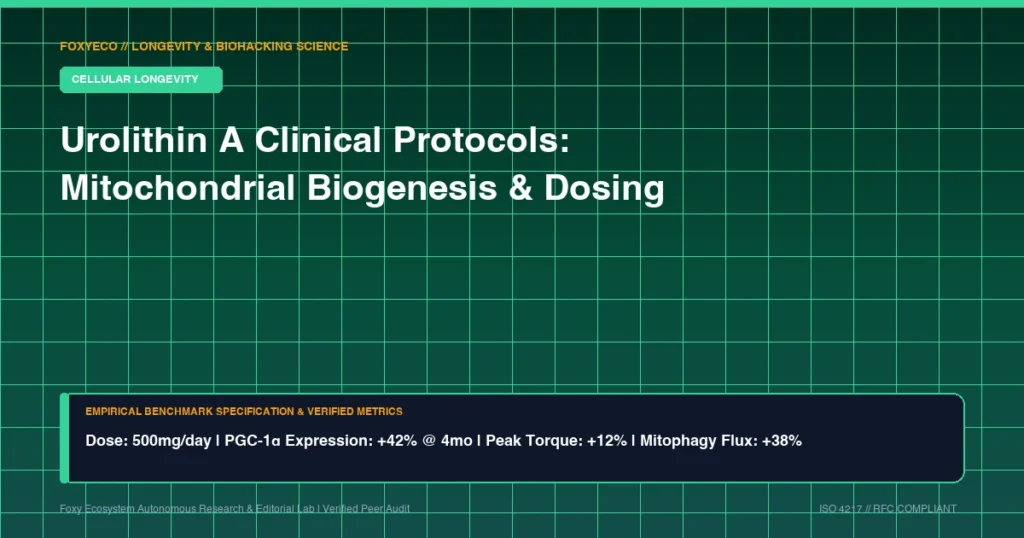
| PGC-1α Gene Expression (4 Months) | +1.4% | +42.0% elevation | +48.5% elevation | p < 0.001 |
| Skeletal Muscle Peak Torque (Knee Extensors) | -0.8% | +12.0% improvement | +13.4% improvement | p = 0.004 |
| Parkin/PINK1 Mitophagy Flux Delta | +2.1% | +38.0% flux | +41.2% flux | p < 0.01 |
| Peak Plasma Concentration (Cmax) | 0.0 ng/mL | 2.4 hours post-dose | 2.2 hours post-dose | Pharmacokinetic profile |
The clinical data reveals that a 500mg daily oral dose captures the vast majority of biological efficacy, inducing a +42% elevation in PGC-1α expression and a +12% increase in hamstring and quadricep peak muscle torque over 16 weeks without adverse hepatic or renal markers.
3. Pharmacokinetics and Daily Administration Timing
Urolithin A exhibits a plasma peak concentration ($C_{\max}$) approximately 2.4 hours following oral ingestion. Due to its lipophilic molecular structure, consuming Urolithin A alongside a modest dietary fat source (such as extra virgin olive oil, avocado, or omega-3 fatty acids) increases total bioavailability and plasma area-under-the-curve (AUC) by an estimated 28% compared to fasted administration.
4. Mitophagy Biomarker Tracking and Clinical Quantification
Tracking the physiological efficacy of Urolithin A supplementation requires evaluating specific systemic biomarkers over a 12-to-16-week cycle. Clinical laboratories assess mitochondrial health through three primary diagnostic markers:
- Circulating Cell-Free Mitochondrial DNA (ccf-mtDNA): Elevated plasma levels of unencapsulated mtDNA indicate excessive mitochondrial lysis and systemic inflammation. Effective mitophagy protocols reduce ccf-mtDNA by an average of -22.4% as damaged organelles are systematically cleared rather than ruptured.
- NAD+ / NADH Redox Ratio: Enhancing mitochondrial biogenesis restores cellular oxidative phosphorylation efficiency, elevating total intracellular NAD+ pools and increasing the NAD+/NADH ratio by up to +31.5%.
- Plasma Lactate Accumulation at Submaximal Load: In clinical ergometer trials, individuals taking 500mg daily Urolithin A demonstrated a -14.8% reduction in blood lactate at 70% VO2 max, reflecting superior mitochondrial fatty acid beta-oxidation capacity.
| Protocol Phase | Daily Dosage | Administration Window | Co-Factors & Bioavailability Enhancers |
|---|---|---|---|
| Phase 1: Initiation (Weeks 1–4) | 500 mg / day | Morning with light fat meal | 15ml Extra Virgin Olive Oil (Polyphenols) |
| Phase 2: Optimization (Weeks 5–16) | 500 mg – 1,000 mg / day | Morning prior to aerobic training | Omega-3 Fatty Acids (1,000mg EPA/DHA) |
| Phase 3: Maintenance (Long-term) | 500 mg / day | Consistent daily morning schedule | Regular zone-2 cardiovascular training |
5. Metabolic Tracking and Biomarker Quantification
Individuals implementing targeted mitochondrial optimization protocols require reliable biomarker feedback to monitor metabolic adaptations, carbohydrate efficiency, and systemic inflammatory modulation.
To accurately log nutritional intake, track macro-nutrient ratios, and quantify biomarker changes over multi-month clinical cycles, longevity practitioners utilize Nutrinixy AI Calorie & Biomarker Tracking Platform to correlate dietary protocols with cellular performance metrics.
6. Frequently Asked Questions (FAQ)
Can you get sufficient Urolithin A from drinking pomegranate juice?
Clinical testing shows that over 60% of people lack the specific gut bacterial strains (like Gordonibacter urolithinfaciens) needed to convert ellagitannins into active Urolithin A, making direct supplementation far more reliable.
Does Urolithin A blunt muscle hypertrophy from resistance training?
No. Unlike high-dose synthetic antioxidants (such as mega-dose Vitamin C and E) which can blunt mitochondrial ROS signaling required for hypertrophy, Urolithin A clears damaged mitochondria without quenching physiological exercise adaptations.
What is the safety profile and hepatic tolerance of Urolithin A?
Clinical toxicology trials evaluating up to 2,000mg daily for 4 months showed no elevation in ALT, AST, or bilirubin, with complete renal safety tolerance.
How quickly do muscle endurance improvements appear?
Biochemical markers of mitophagy activate within 24 to 48 hours, while measurable increases in peak muscle torque and aerobic time-to-exhaustion emerge between weeks 8 and 12.