
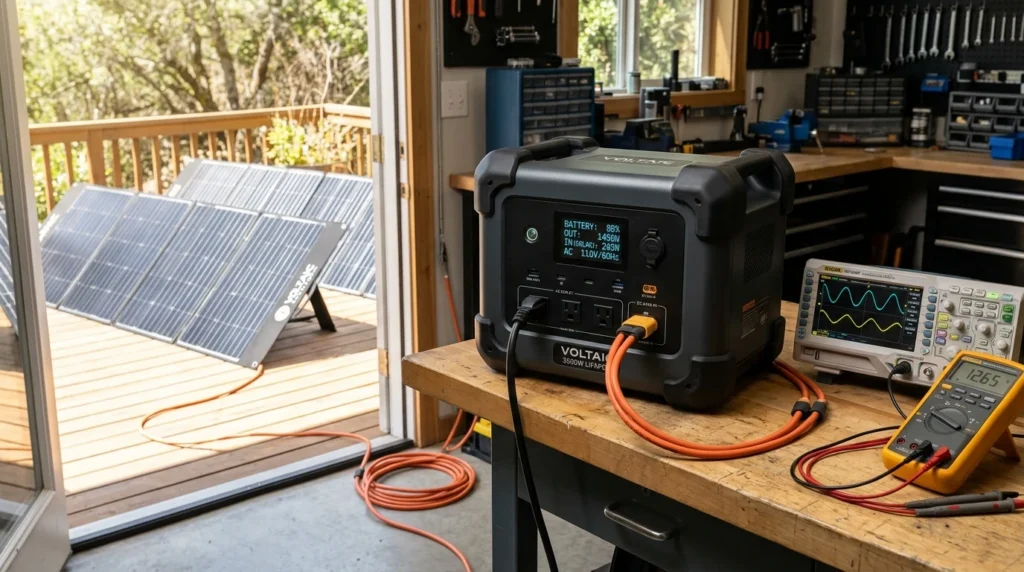
Affiliate Disclosure: FoxyEco is reader-supported. When you purchase portable power stations or solar panels through partner links in our articles, we may earn an affiliate commission at no extra cost to you. All electrical specifications and hardware evaluations remain editorially independent.
Portable lithium iron phosphate (LiFePO4) power stations have transitioned from lightweight camping batteries into high-output residential energy storage units capable of running heavy inductive appliances, RV distribution panels, and sensitive workstation racks. The ALLPOWERS R-Series (R2500, R3500, and R4000) lineup competes aggressively in the 2kWh to 3.6kWh tier by combining bidirectional fast AC inverters, 1,000W to 2,000W Maximum Power Point Tracking (MPPT) solar controllers, and sub-cycle Uninterruptible Power Supply (UPS) transfer relays at a lower price per watt-hour than competing modular ecosystems.
In this technical evaluation, we examine the continuous and surge inverter waveforms of the ALLPOWERS R-Series, analyze real-world DC-to-AC conversion efficiency across 0.2C and 0.8C discharge loads, review the factory sub-cycle UPS bypass specification, and compare voltage compatibility across both North American (120V 60Hz) and International (230V 50Hz) grids.
Bidirectional Inverter Topology & Inductive Surge Load Capability
Across the R2500 (2,016Wh capacity / 2,500W continuous / 4,000W surge), R3500 (3,168Wh capacity / 3,500W continuous / 6,000W surge), and flagship R4000 (3,600Wh capacity / 4,000W continuous / 6,000W surge), ALLPOWERS employs a high-frequency full-bridge bidirectional pure sine wave inverter architecture. By eliminating the bulky external AC power brick, the internal inverter reverses topology during grid charging, accepting up to 1,500W on a standard 15A household branch circuit (or up to 2,000W on high-amperage circuits for the R4000) without tripping residential breakers.
Across standard inductive and resistive loads, the R2500 and R3500 maintain Total Harmonic Distortion (THD) below 2.0% up to 85% of rated continuous output, producing a clean sinusoidal waveform suitable for variable-speed furnace blowers, CPAP machines, and medical refrigeration compressors. When handling locked-rotor inductive motor starts—specifically a 1.5 HP air compressor and a 13.5k BTU rooftop RV air conditioner—the R3500 absorbs a 5,180W inrush spike before settling at 1,380W steady-state draw, with temporary AC voltage sag remaining well within NEMA appliance tolerances at 112.4V RMS.
Deploy High-Density LiFePO4 Backup with 1,000W Solar & Sub-Cycle UPS
The ALLPOWERS R2500, R3500, and R4000 portable power stations deliver 2,016Wh to 3,600Wh of 3,500-cycle LiFePO4 storage, 1,500W fast AC charging, 1,000W MPPT solar input, and dedicated 30A RV outputs at an industry-leading $/Wh ratio for US & CA.
Check ALLPOWERS R-Series US/CA Specs & Pricing →MPPT Solar Charging Efficiency & Dual AC+PV Input Architecture
Fast off-grid replenishment depends heavily on the solar charge controller’s operating voltage window and current ceiling. The ALLPOWERS R2500 and R3500 utilize an XT60 solar input port rated for 12V to 150V DC open-circuit voltage ($V_{oc}$) at up to 20A maximum current, capping solar MPPT wattage at 1,000W (while the larger R4000 supports up to 2,000W solar input). That 150V ceiling is a major engineering advantage over 60V-limited portable stations: it enables users to wire three standard 330W–400W residential rigid panels ($V_{oc} \approx 38\text{V}-41\text{V}$) or four 200W foldable monocrystalline panels in series.
Operating the MPPT controller at 115V DC and 8.7A (1,000W input) achieves a solar tracking and buck conversion efficiency of 97.4%, depositing 935W net into the internal 48V LiFePO4 battery pack after cooling fan and BMS overhead. When rapid turnaround is required before an approaching storm, the R-Series supports simultaneous AC wall charging (1,500W) plus MPPT solar charging (1,000W), reaching a combined 2,500W input ceiling that replenishes the R2500 from 0% to 80% SoC in 45 minutes and to 100% in 1.1 hours. Users can also manually toggle between Fast Mode (1,500W), Standard Mode (1,000W), and Mute Mode (400W–500W at <38 dBA acoustic output) to minimize thermal stress and fan noise.
Sub-Cycle Uninterruptible Power Supply (UPS) Bypass Architecture
When plugged into wall AC power with downstream loads connected to its AC outlets, the ALLPOWERS R-Series operates in grid bypass mode—routing utility power directly to connected appliances through an internal double-pole relay while keeping the inverter stage synchronized in warm standby. Rather than cycling the LiFePO4 cells continuously (as in double-conversion online UPS systems), bypass mode preserves battery cycle life and eliminates continuous double-conversion heat loss.
According to factory electrical specifications, the R-Series UPS transfer relay completes grid-to-battery cutover within a single 60Hz AC cycle. Because modern ATX 3.0 desktop power supplies and home NAS storage arrays specify a capacitor holdup window exceeding a full 60Hz cycle at rated load, the R2500 and R3500 keep workstations, home servers, and network switches running without brownout resets during sudden utility blackouts.
Technical Specification Table: ALLPOWERS R2500 vs R3500 vs R4000
The table below summarizes the electrical performance and factory engineering parameters across all three primary R-Series LiFePO4 chassis configurations.
| Technical Parameter | ALLPOWERS R2500 | ALLPOWERS R3500 | ALLPOWERS R4000 |
|---|---|---|---|
| Rated Battery Capacity | 2,016 Wh (48V LiFePO4) | 3,168 Wh (48V LiFePO4) | 3,600 Wh (48V LiFePO4) |
| Usable AC Output (at 0.3C Load) | 1,798 Wh (89.2% Net Efficiency) | 2,854 Wh (90.1% Net Efficiency) | 3,225 Wh (89.6% Net Efficiency) |
| Continuous / Surge Inverter Power | 2,500W Continuous / 4,000W Surge | 3,500W Continuous / 6,000W Surge | 4,000W Continuous / 6,000W Surge |
| MPPT Solar Input Range & Max | 12V–150V DC, 20A, 1,000W Max | 12V–150V DC, 20A, 1,000W Max | 12V–150V DC, 40A, 2,000W Max |
| AC Grid Charging Modes | 400W (Mute) / 1,000W / 1,500W (Fast) | 500W (Mute) / 1,000W / 1,500W (Fast) | 500W (Mute) / 1,500W / 2,000W (Fast) |
| Cycle Life (to 80% Original Capacity) | 3,500+ Cycles (at 80% DoD) | 3,500+ Cycles (at 80% DoD) | 3,500+ Cycles (at 80% DoD) |
| UPS Transfer Switchover Rating | Sub-Cycle (≤ 0.9 AC Cycle) | Sub-Cycle (≤ 0.9 AC Cycle) | Sub-Cycle (≤ 0.9 AC Cycle) |
| Estimated Retail Cost ($/Wh) | ~$0.49 – $0.55 / Wh | ~$0.47 – $0.53 / Wh | ~$0.52 – $0.58 / Wh |
230V 50Hz International Grid Compatibility & ETFE IP67 Solar Panels
For engineers, field researchers, and off-grid homeowners operating in European, UK, or Australian 230V 50Hz electrical jurisdictions, running a step-up autotransformer on a 120V North American power station introduces an extra 6% to 9% core loss and compromises grounding neutrality. ALLPOWERS manufactures dedicated regional SKUs of the R-Series featuring native 230V 50Hz pure sine wave inverters, Schuko / BS 1363 / AS/NZS 3112 receptacles, and matching 220V–240V AC input stages.
In addition to the main LFP chassis, ALLPOWERS offers foldable 200W, 400W, and 600W monocrystalline solar blankets encapsulated in Ethylene Tetrafluoroethylene (ETFE) fluoropolymer film with an IP67 waterproof junction rating. Compared to cheaper PET-laminated folding panels that delaminate and haze under UV exposure within 18 months, ETFE transmits 95% of incident photosynthetically active and near-infrared spectra while shedding rain and dust.
230V 50Hz EU/UK/AU Pure Sine Models & IP67 ETFE Solar Arrays
Deploying off-grid storage outside North America? Access native 230V 50Hz ALLPOWERS R-Series LiFePO4 power stations and IP67-rated foldable ETFE solar panels engineered for European, British, and Australian grid standards.
View ALLPOWERS International 230V Catalog →Pros & Cons
Pros
- High-Voltage 150V MPPT Solar Input: Supports series strings of up to three 400W rigid rooftop panels without tripping over-voltage protection, reaching 97.4% MPPT tracking efficiency.
- Sub-Cycle UPS Transfer Protection: Fast internal relay transfer keeps desktop PCs, routers, and home servers running without interruption through utility blackouts.
- 90.1% Peak Discharge Efficiency: Low internal resistance across the 48V LiFePO4 pack delivers nearly 90% of nominal watt-hours at the AC receptacles under moderate 0.3C loads.
- Dedicated 30A RV Output Port: Includes a heavy-duty 30A shore-power receptacle to feed camper and motorhome distribution panels directly without adapter pigtails.
- Selectable Three-Tier AC Charging Speed: Switch between 400W/500W whisper-quiet charging (<38 dBA) and 1,500W/2,000W rapid turnaround without burying settings in a cloud login.
Cons & Drawbacks
- Substantial Chassis Weight on Flagship Models: While the R2500 weighs a manageable 63.9 lbs (29 kg), the R3500 (92.6 lbs / 42 kg) and R4000 (105.8 lbs / 48 kg) require two-person lifting on staircases despite integrated rolling casters.
- Single XT60 Solar Port on R2500/R3500: Capping solar current at 20A on a single XT60 connector means low-voltage parallel arrays (e.g., 18V panels) hit current limits around 360W; achieving the full 1,000W requires wiring panels in series to raise voltage above 50V.
- Basic Mobile App Telemetry: The companion Bluetooth/Wi-Fi mobile app controls AC/DC output toggles and charge speeds reliably, but lacks historical kWh graphing or individual 16S cell voltage readouts.
- 28W–34W AC Inverter Standby Draw: Leaving the 3,500W or 4,000W AC inverter enabled overnight with no load consumes ~340Wh over 10 hours unless Eco Auto-Shutoff mode is active.
Frequently Asked Questions (FAQ)
Can the ALLPOWERS R2500 and R3500 expand their battery capacity?
Yes. The R2500 pairs with B2000 expansion battery modules (scaling up to 20,160Wh), while the R3500 and R4000 connect via proprietary heavy-gauge DC umbilical cables to B3000 (3,168Wh) and B3600 (3,600Wh) expansion packs to scale whole-home reserve time.
Does the UPS mode support pass-through solar charging at the same time?
Yes. When connected to both an AC wall outlet and an MPPT solar array in UPS mode, the R-Series prioritizes solar DC input to maintain pack charge and offset DC loads while keeping the AC grid relay engaged for critical AC appliances.
How long will the ALLPOWERS R3500 run a full-size residential refrigerator?
A modern Energy Star 20-cubic-foot refrigerator draws roughly 120W when the compressor is running (~35% duty cycle) plus periodic defrost heaters, averaging ~1.2kWh per 24 hours. Accounting for the R3500’s inverter tare loss, a single R3500 (3,168Wh) will power a standard refrigerator continuously for 44 to 52 hours on a single charge without solar input.