
Disclosure: this article contains one affiliate link to GoSun. If you buy through it, FoxyEco may earn a commission at no extra cost to you. We have not tested a GoSun oven; specifications are from GoSun’s product pages, checked on 2026-11-06.
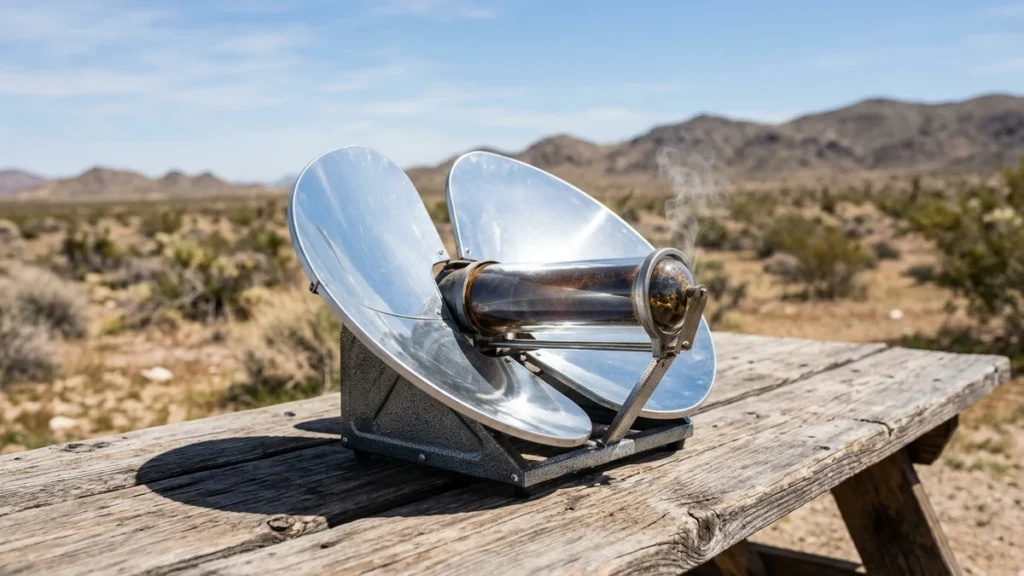
Short answer: GoSun ovens cook food inside an evacuated glass tube at the focus of curved reflectors. In clear sun they reach high temperatures (GoSun publishes 550°F, 288°C, for the Sport and Fusion) and cook small meals in roughly 20 minutes to an hour without fuel or a battery. For off-grid cabins, RVs and outages they save stored electricity or fuel for other loads. The limits are capacity (1.2 L for the Sport, about 3 L for the Fusion), the need for direct sun, and cooking one tube-shaped batch at a time. The Fusion adds a 12 V DC heating element for cloudy days and evenings, but GoSun does not publish its wattage, so measure it before relying on battery power.
Where solar cooking fits in an off-grid plan
Cooking is one of the hardest loads for a battery. An electric hob or kettle draws 1,000 to 2,000 W, so boiling a few litres a day can take a large share of a 2 kWh power station’s usable energy. A solar oven moves that load off the battery on sunny days. Our off-grid cabin power guide and runtime calculator show how much battery capacity cooking would otherwise need; for outage planning see best portable power station for home backup.
GoSun’s published specifications
| Model | Capacity | Max temperature | Weight | Size | Power source | Listed price (USD, 2026-11-06) |
|---|---|---|---|---|---|---|
| GoSun Go | 420 mL (14 oz), 1 meal | Not stated | 2 lb | 17 × 9 × 6 in | Sun only | $89 (listed as sold out) |
| GoSun Sport | 1.2 L (40 oz), 2 to 3 meals | 550°F | 7 lb | 29 × 12 × 6 in | Sun only | $199 sale, $249 regular (listed as sold out) |
| GoSun Sport-E | 1.2 L (40 oz) | Not stated | 7 lb | 29 × 12 × 6 in | Sun or electric | $249 sale, $349 regular |
| GoSun Fusion | 3.01 L (101 oz), 4 to 5 people | 550°F (288°C) | 14 lb (6.4 kg) | 27 × 11 × 12 in | Sun or 12 V DC element | $399 sale, $599 MSRP |
GoSun states cook times of about 20 minutes in direct sun for the Go and Sport, and “full meals in under an hour” for the Fusion. The Fusion carries a one-year limited warranty and includes stainless steel trays, a thermometer, folding legs and a 12 V cord. Wattage and current draw for the electric elements are not published.
How a vacuum-tube oven works
The cooking chamber is a double-walled borosilicate glass tube with a vacuum between the walls, the same principle as a vacuum flask and many solar water heaters. Sunlight passes through, is absorbed by a dark coating on the inner tube, and the vacuum stops most of that heat escaping. Reflectors concentrate extra light onto the tube. That is why these ovens get far hotter than simple box or panel cookers, and why the outside of the tube stays relatively cool to touch. It also means the tube is the part to protect: avoid thermal shock, such as cold water into a hot tube, and transport it in its case.
Measure cooking power yourself
Peak temperature tells you little about how fast an oven cooks. Solar cooker researchers instead measure cooking power, the rate at which the cooker heats a known mass of water, following the approach in the ASAE S580 test standard. A simplified home version:
- Weigh the water you can fit in the cooking tray (for example 1.0 kg, which is 1 litre).
- Note the starting water temperature with a probe thermometer and aim the oven at the sun.
- Record the temperature every 10 minutes until it nears boiling.
- Calculate power for each interval: watts = mass (kg) × 4,186 × temperature rise (°C) ÷ seconds.
Example: 1.0 kg of water rising from 40°C to 50°C in 10 minutes gives 1.0 × 4,186 × 10 ÷ 600 ≈ 70 W of useful cooking power. The standard also normalises results to a reference solar irradiance of 700 W/m² and reports power at a 50°C difference between water and air, so lab figures are comparable; a phone app or cheap meter only gives a rough irradiance reading, so treat home results as a guide to your own location and season.
Using the 12 V option from a battery
The Fusion’s 12 V element lets it keep cooking when clouds come in. Before relying on it, measure its draw with an inline DC watt meter on a power station’s 12 V port: watts × hours of use = Wh taken from the battery. Check that the port’s rated current is enough for the element. Electric cooking from a battery is efficient in an insulated vacuum tube, but it still uses stored energy that solar cooking would have saved.
Pros and limits for off-grid use
- Pros: no fuel, no smoke, no battery drain in sun; light and packable (Go and Sport); high temperatures for baking and roasting; Fusion’s 12 V backup.
- Limits: small, tube-shaped batches; needs direct sun and occasional re-aiming; glass tube can break; several models were listed as sold out when we checked; electric element power not published.
If those limits suit your cabin, RV or outage kit, you can check GoSun's current solar oven range and stock. Compare capacity with the number of people you cook for; the Sport suits one or two people, the Fusion a family.
Safety
- The cooking tray and food reach oven temperatures; use oven gloves and keep children away from the open tube.
- Do not leave reflectors aimed where they could dazzle drivers or neighbours.
- Follow food safety temperatures; a probe thermometer confirms meat is cooked through.