
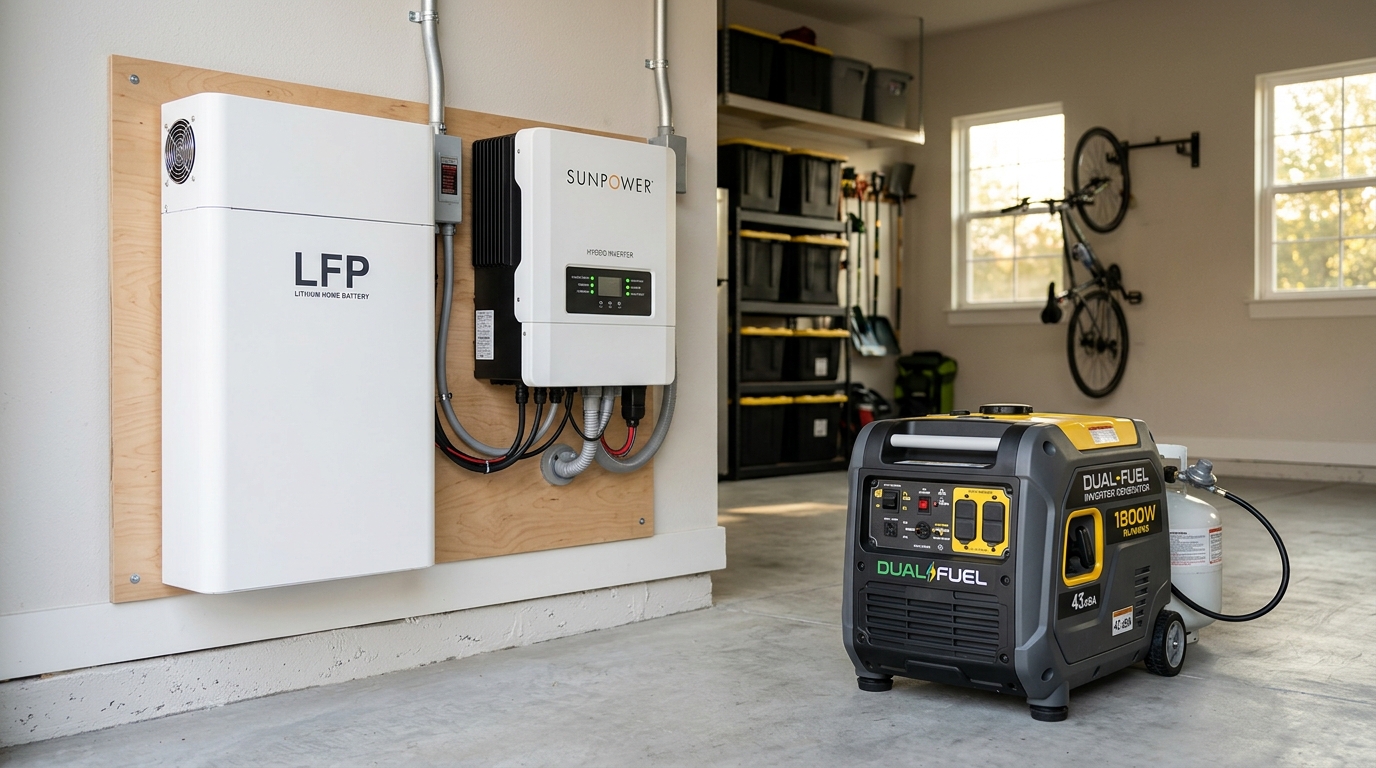
The Evolution of Residential Outage Resilience
As severe weather events, extreme summer temperature anomalies, and utility grid stress become recurring realities across North America and Europe, homeowners face a critical infrastructural decision: how to secure continuous power when the distribution grid collapses. Historically, the automatic response was the installation of an internal combustion engine (ICE) backup generator running on liquid gasoline or natural gas. However, rapid cost deflation in stationary Lithium Iron Phosphate (LiFePO4 / LFP) battery chemistry and hybrid inverter technology has created a viable, zero-emission alternative.
Choosing between a stationary home battery storage system and a dual-fuel portable or standby generator requires evaluating technical metrics that transcend upfront price tags. Homeowners must weigh instant transfer switching speeds, fuel shelf-life degradation, harmonic distortion (THD), noise footprints, round-trip energy efficiency, and long-term levelized cost of energy (LCOE).
Round-Trip Efficiency: Chemistry vs. Thermodynamics
The thermodynamic physics underlying batteries and combustion generators highlight the fundamental trade-off between energy storage density and conversion efficiency:
- Chemical Storage Round-Trip Efficiency (85% to 92%): Modern LFP home batteries charged from rooftop solar photovoltaics (PV) or off-peak grid utility power operate at an exceptional round-trip efficiency (RTE). For every 10 kilowatt-hours (kWh) injected into the DC bus, between 8.5 and 9.2 kWh of usable AC electricity is delivered to household subpanels. There are no moving parts, no thermal idling losses, and zero fuel evaporation.
- Internal Combustion Efficiency (18% to 28%): Portable and standby generators convert chemical energy in hydrocarbon fuels into mechanical motion, and subsequently into electrical energy via an alternator. Even high-efficiency inverter generators lose between 72% and 82% of fuel energy as waste heat and acoustic vibration. Under light electrical loads (e.g., running only a refrigerator and LED lighting at 500W on a 5,000W generator), fuel efficiency plummets drastically, consuming disproportionately high fuel volumes per kilowatt-hour produced.
Fuel Logistics: Degradation, Storage Limits, and Cold Starts
The operational Achilles’ heel of combustion generation during protracted natural disasters is fuel supply chain vulnerability. Standard pump gasoline containing 10% ethanol (E10) begins degrading within 30 to 90 days as ethanol absorbs atmospheric moisture, leading to phase separation, varnish buildup in carburetors, and fuel line gumming. Stabilized gasoline must be cycled constantly, and municipal fire codes typically restrict residential gasoline storage to 25 gallons—enough for only 24 to 48 hours of continuous moderate-load operation.
Dual-fuel generators mitigating this issue by operating on liquefied petroleum gas (propane / LPG) enjoy an indefinite fuel shelf-life, as propane does not break down or gum fuel jets. However, LPG delivers approximately 10% to 15% fewer BTUs per gallon than gasoline, resulting in reduced peak wattage ratings. Stationary batteries, when coupled with rooftop solar arrays, recharge indefinitely without relying on roads being clear for fuel delivery trucks or retail gas station pumps having electrical power to dispense fuel.
Power Quality: Total Harmonic Distortion and Transfer Switching
Modern residential loads are dominated by sensitive microprocessors, variable-speed heat pump inverters, home network routers, and automated medical devices. Standard open-frame contractor generators frequently produce raw AC power with Total Harmonic Distortion (THD) exceeding 15% to 25%. High THD causes electronic power supplies to overheat, triggers circuit board failures in high-efficiency HVAC equipment, and introduces audible hum into audio-visual systems.
Inverter generators reduce THD to under 3%, matching clean utility grade specifications. However, any combustion generator requires either a manual pull-start or an automatic standby starter that takes 10 to 30 seconds to crank, synchronize, and transfer loads. Stationary home battery systems integrated with intelligent gateway transfer switches achieve switching times under 16 milliseconds—fast enough that desktop computers, Wi-Fi routers, and clocks do not reset during a sudden grid blackout.
| Engineering Parameter | LFP Home Battery Storage (10-15 kWh) | Dual-Fuel Inverter Generator (7-9 kW) |
|---|---|---|
| Transfer Speed / Latency | Instantaneous (< 16 ms UPS rating) | 15-45 seconds (engine crank & warm-up) |
| Noise Level @ 7 Meters | 0 dB (silent convection/fan cooling) | 58 dB to 74 dB(A) continuous exhaust |
| Emissions & Indoor Safety | Zero local emissions (garage/indoor rated) | Lethal CO exhaust (20 ft outdoor standoff) |
| Annual Maintenance Overhead | Zero scheduled maintenance (software updates) | Oil changes (50-100 hrs), spark plugs, filters |
| Cycle Life Expectancy | 6,000+ cycles to 80% capacity (15-20 years) | 1,000 to 2,500 total engine runtime hours |
| Economic Utility Outside Outages | Daily Time-of-Use (TOU) arbitrage & VPP revenue | Zero (sits idle depreciating in storage) |
The Economic Reality: Daily TOU Arbitrage vs. Emergency Idling
The decisive financial distinction between a home battery and a backup generator is operational frequency. A backup generator is an emergency-only insurance policy. It sits in a shed or garage for 360 days a year, depreciating, requiring periodic test runs, oil changes, and fresh fuel. Its levelized cost per kilowatt-hour generated over its operational lifetime is exceptionally high when calculating equipment cost divided strictly by outage hours.
A home battery system, by contrast, operates daily. Under utility Time-of-Use (TOU) rate structures, intelligent battery management systems charge during cheap off-peak hours (or directly from rooftop solar) and discharge during expensive peak evening hours (such as 4 PM to 9 PM). By avoiding peak grid utility rates of $0.35 to $0.50/kWh, a 13.5 kWh battery can generate $400 to $900 in annual utility bill savings, actively amortizing its capital expenditure while maintaining 20% to 30% reserve capacity for unexpected emergency blackouts.
The Hybrid Resilience Architecture: The Best of Both Worlds
For rural properties, micro-farms, and medical-dependent households facing potential multi-week grid collapses in winter storms, neither technology alone represents the optimal engineering solution. An oversized battery bank capable of powering central electric heat for two weeks without sun is cost-prohibitive. Conversely, relying solely on a generator burns hundreds of gallons of scarce fuel while subjecting the household to relentless noise and carbon monoxide risk.
The state-of-the-art resilience design is a hybrid microgrid: a 10-15 kWh LFP battery bank acts as the primary electrical buffer, supplying 100% clean, silent, zero-latency power to critical circuits. A compact, quiet dual-fuel inverter generator is wired into the battery’s auxiliary generator input. The generator runs only 2 to 3 hours per day at its optimal peak-efficiency fuel curve to rapidly bulk-charge the battery, then automatically shuts off, preserving fuel, reducing engine wear by 80%, and ensuring completely silent overnight operation.
Frequently Asked Questions (FAQ)
How long will a 13.5 kWh home battery run my house during a blackout?
Runtime depends entirely on load management. Powering critical loads (refrigerator, Wi-Fi, LED lights, device charging, and gas furnace blower totaling 400W to 600W continuous), a 13.5 kWh battery delivers 22 to 30 hours of continuous power on a single charge. If central electric air conditioning or heat pumps (3,000W to 5,000W) are run continuously without solar replenishment, the battery will deplete in 2.5 to 4 hours.
Can I install a backup generator inside my garage with the door cracked?
Absolutely not. Internal combustion generators produce lethal concentrations of carbon monoxide (CO), a colorless, odorless gas. Generators must always be operated outdoors, positioned at least 20 feet away from all windows, doors, and fresh air intake vents, with the exhaust pointing downwind.
Do lithium iron phosphate (LFP) batteries suffer from thermal runaway fires?
No. Unlike older Nickel Manganese Cobalt (NMC) chemistries commonly used in early electric vehicles, LFP chemistry possesses a chemical bond between iron, phosphorus, and oxygen that is exceptionally stable up to 500°C (932°F). LFP cells do not release free oxygen when punctured or overcharged, virtually eliminating the risk of self-sustaining thermal runaway.