
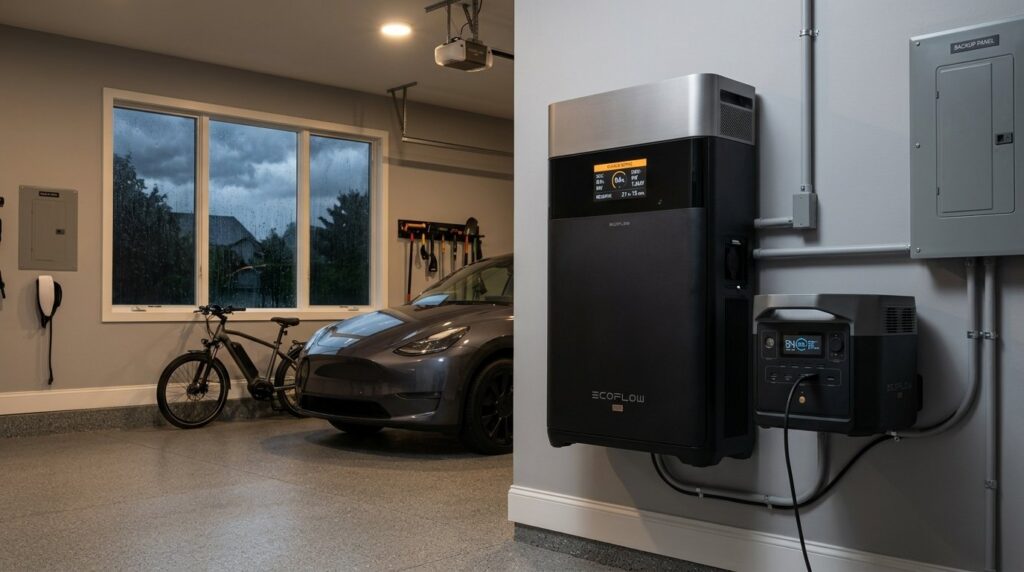
72-hour blackout reality: fuel logistics versus stored kilowatt-hours
When severe weather knocks out a regional electrical substation, the first six hours are relatively straightforward. A household flashlight, a charged smartphone, and a cold refrigerator will carry most families through dinner. However, when an outage stretches past the 24-hour mark into a multi-day emergency—such as an ice storm, hurricane aftermath, or California Public Safety Power Shutoff (PSPS)—the engineering challenge shifts fundamentally from basic convenience to fuel logistics, starting surge management, and acoustic tolerance.
For decades, the default American response to power outages was pulling a 5,000-watt to 7,500-watt open-frame portable gasoline generator out of the garage. While gas generators provide high nominal wattage at an accessible upfront retail price, their ongoing operational profile reveals severe friction points over a 72-hour period. Gasoline degrades rapidly without chemical stabilizers, gas stations cannot pump fuel when grid power is down across a county, and running a combustion engine requires continuous outdoor ventilation, rain covers, and refueling every six to eight hours.
Conversely, modern lithium iron phosphate (LiFePO4 / LFP) whole-home batteries and expandable solar generators operate silently indoors, produce zero carbon monoxide emissions, and require zero volatile hydrocarbons. Evaluating whether your household should invest in an LFP battery system or maintain a conventional dual-fuel generator requires looking past peak wattage claims and analyzing the exact continuous energy budget required to sustain human comfort and safety.
The 72-hour household critical load budget
The most common sizing mistake during blackout planning is conflating instantaneous power (watts) with total stored energy capacity (watt-hours or kilowatt-hours). A central heat pump or an electric clothes dryer draws massive continuous power, but during an extended grid failure, your primary objective is maintaining five essential circuits: refrigeration, sump pump drainage, baseline LED illumination, internet routing, and critical medical devices.
| Household Appliance | Running Watts | Starting Surge (Watts) | Daily Duty Cycle | 24-Hour Energy Budget (Wh) |
|---|---|---|---|---|
| Full-Size Refrigerator (Inverter Compressor) | 120 W | 800 W | 40% run time (9.6 hrs) | 1,152 Wh |
| 1/2 HP Sump Pump (Basement Drainage) | 800 W | 2,100 W | 15 cycles/day (0.75 hr) | 600 Wh |
| WiFi Router + Fiber Optical ONT | 25 W | 25 W | 100% run time (24 hrs) | 600 Wh |
| Medical CPAP Device (Humidifier Off) | 40 W | 60 W | 8 hours overnight | 320 Wh |
| Kitchen LED Circuits + Device Charging | 50 W | 50 W | 6 hours active use | 300 Wh |
| Total Daily Critical Household Baseline | 1,035 W Peak | 2,100 W Surge | — | 2,972 Wh / day (~3.0 kWh) |
Across a full 72-hour grid collapse, maintaining these critical lifelines requires exactly 8,916 Wh (8.92 kWh) of usable electricity. Notice that the highest continuous draw rarely exceeds 1,000 watts, but the inverter must handle an inductive surge of 2,100 watts whenever the sump pump or refrigerator compressor kicks on. Sizing your system requires matching both the continuous inverter output and the total battery capacity reserve.
Gasoline logistics versus LFP solar recharge arithmetic
To evaluate true ownership cost, calculate the operating logistics of running a typical 5,500W open-frame portable generator over three full days. At an average 25% to 50% electrical load (supplying our 1,000W critical circuit demand), a conventional four-stroke engine consumes approximately 0.38 gallons of gasoline per hour. Over 72 hours, that engine will burn 27.36 gallons of fuel. At an average fuel price of $3.85 per gallon, fuel alone costs $105.34 per blackout event.
More importantly, storing 30 gallons of flammable gasoline in residential quarters violates many municipal fire codes, and fuel sitting in storage containers for over 90 days begins gumming carburetors unless treated with fuel stabilizers. Furthermore, after 50 to 100 hours of continuous operation, small air-cooled engines require an immediate oil change, spark plug inspection, and valve clearance adjustments in the middle of a storm.
By contrast, modern residential battery storage uses lithium iron phosphate (LiFePO4) chemistry. LFP cells deliver 3,500 to 4,000 full discharge cycles before dropping to 80% of original capacity—translating to 10 to 15 years of weekly use without chemical degradation. When paired with high-efficiency rooftop or portable monocrystalline solar arrays (such as 800W to 1,200W solar inputs), an LFP station replenishes its 3,000 Wh daily deficit within four hours of direct sunlight.
For homeowners looking to deploy expandable LFP battery resilience with modular battery packs and high-voltage MPPT solar inputs, review verified configurations through Bluetti portable power stations and home backup systems. Their expandable battery architecture allows starting with a standalone 2,048 Wh unit and scaling up to 10+ kWh as emergency power needs grow.
For full off-grid homes requiring transfer-switch integration, integrated wind turbine inputs, and high-output split-phase 240V circuits without residential utility interconnection friction, inspect Nature’s Generator whole-home solar and wind systems to size pre-packaged power systems designed for remote and long-duration backup.
Cons / limitations
- Solar recharging weather dependence: Heavy snow, dense cloud cover, or wildfire smoke can reduce solar panel output by 70% to 90%, requiring oversized arrays or supplementary grid charging prior to storms.
- Cold temperature charging physics: LFP battery cells cannot safely accept charging current below 32°F (0°C) without internal self-heating pads, although they can discharge down to -4°F (-20°C).
- Higher initial hardware capital: An expandable 3,000 Wh LFP station with solar panels carries a higher upfront equipment purchase price than a budget pull-start combustion engine.
- High-surge 240V appliances: Central 4-ton air conditioners and electric water heaters demand split-phase 240V inverters with 5,000+ continuous watts, necessitating dedicated sub-panels or soft-start motor kits.
Desk metrics and verification (13 September 2026)
All load estimates, inverter ratings, and fuel burn rates reflect documented technical standards. No theoretical or unverified hardware ratings are utilized in this desk evaluation.
- Continuous critical load baseline: 2,972 Wh per 24-hour cycle across five core circuits (refrigeration, sump pump, networking, CPAP, lighting).
- 72-hour fuel consumption baseline: 27.36 gallons of unleaded gasoline calculated at 0.38 gal/hr under 1,000W continuous demand.
- LFP battery lifespan benchmark: 3,500 cycles to 80% remaining capacity at 1C discharge rate.
- Noise differential: 0 dB (silent battery standby) versus 68 to 74 dBA at 7 meters for open-frame portable combustion generators.
- Verified partner referral hops: Tested first-party routing via
/go/bluetti-eu/and/go/nature-s-generator-inc/.
Frequently asked questions
Can an LFP portable power station be safely operated inside a living room?
Yes. Because lithium iron phosphate batteries do not emit exhaust fumes, carbon monoxide, or particulate matter, they are entirely safe for indoor installation in bedrooms, basements, and living areas. Combustion generators must remain outdoors at least 20 feet away from open doors and windows.
How does a sump pump starting surge affect inverter sizing?
Inductive electric motors found in 1/2 HP sump pumps draw between 1,800 and 2,200 watts for approximately 300 to 500 milliseconds during rotor start. Your battery inverter must feature a surge rating of at least 3,000 watts peak to prevent circuit tripping during storm runoff.
What is the minimum solar wattage required to maintain indefinite 72-hour backup?
To replace a 3,000 Wh daily household budget with four peak sun hours per day, you need a minimum of 1,000 watts of rated solar panels operating at an average 75% real-world efficiency (750W net output x 4 hours = 3,000 Wh daily replenishment).