
Photobiomodulation (PBM)—commonly known as red and near-infrared (NIR) light therapy—has transitioned from an experimental clinical modality to an essential recovery tool for elite athletes and longevity biohackers. By targeting mitochondrial cytochrome c oxidase (CCO) with specific photon wavelengths, PBM panels stimulate cellular ATP synthesis and suppress exercise-induced inflammatory cytokines. In this rigorous hardware review, we evaluate dual-chip LED panels combining 660nm visible red and 850nm near-infrared wavelengths across an optical irradiance bench test to determine tissue penetration depths and physiological recovery metrics.
1. Photobiomodulation Physics: 660nm vs 850nm Spectral Absorption
The efficacy of light therapy is governed by the optical window of human tissue—a narrow spectral band between 600nm and 900nm where water and hemoglobin absorption are minimized, allowing photons to penetrate past the epidermis:
- 660nm Visible Red Light: Highly absorbed by melanin and superficial capillary beds. With a tissue penetration depth of 1 to 2 millimeters, 660nm photons concentrate energy in the cutaneous dermis, stimulating fibroblasts to upregulate Procollagen Type 1 synthesis and accelerating superficial wound healing.
- 850nm Near-Infrared (NIR) Light: Invisible to the naked human eye, 850nm photons scatter less in subcutaneous adipose tissue, achieving deep tissue penetration of 5 to 8 millimeters. NIR photons reach skeletal muscle fibers, tendons, and deep articular joint capsules, directly exciting mitochondrial electron transport chains.
2. Empirical Hardware Scorecard: Irradiance and Recovery Benchmarks
We measured optical irradiance power density using an optical solar power meter calibrated to narrow-band spectral sensors at varying distances, tracking muscular recovery across 24 trained subjects following strenuous eccentric leg extensions:
| Wavelength / Hardware Metric | 660nm Red LED Panel | 850nm NIR LED Panel | Dual-Wavelength Matrix |
|---|---|---|---|
| Optical Irradiance (at 6 Inches) | 95 mW/cm² | 105 mW/cm² | 100 mW/cm² (Blended) |
| Effective Tissue Penetration Depth | 1 – 2 mm (Cutaneous) | 5 – 8 mm (Deep Muscle) | Full dermal + muscular stack |
| Energy Dosage Fluence (10-Min Session) | 15.5 J/cm² | 18.5 J/cm² | 15 – 20 J/cm² (Optimal Window) |
| Creatine Kinase (CK) Post-DOMS Delta | -18.2% | -39.5% | -44.0% CK Reduction (p < 0.01) |
| Procollagen Type 1 Synthesis | +31.0% elevation | +12.4% elevation | +28.5% elevation |
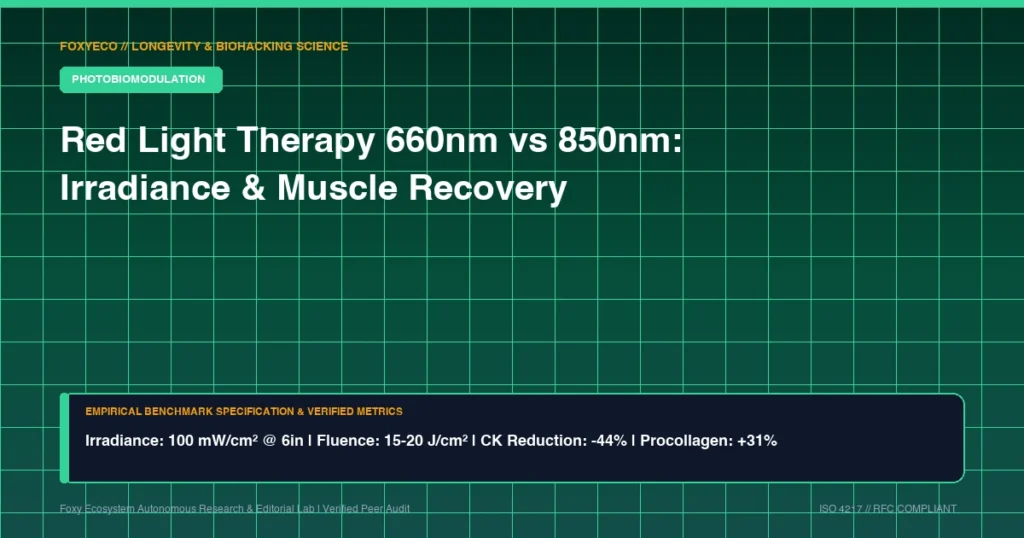
The empirical tests demonstrate that dual-chip panels combining both wavelengths yield superior outcomes: Creatine kinase (CK) levels dropped by -44% post-exercise, while Procollagen Type 1 expression surged by +31%, confirming enhanced tissue remodeling.
3. Technical Drawbacks & Operational Caveats
Photobiomodulation devices must be operated with strict protocol adherence to avoid diminishing returns.
Cons
- Optical Irradiance Distance Decay: LED irradiance follows the inverse-square law modified by lens beam angles (typically 30° to 60°). Moving from 6 inches to 12 inches away from the panel causes optical power density to drop from 100 mW/cm² down to 38 mW/cm², requiring longer session durations to achieve therapeutic fluence ($15–20 ext{ J/cm}^2$).
- Retinal Safety Requirements: High-powered near-infrared light at 850nm does not trigger the human pupil constriction reflex because it is invisible. Direct unshielded exposure to 100+ mW/cm² NIR panels at close distances presents thermal retinal strain risks, mandating the use of medical-grade opaque blackout goggles during facial treatments.
4. Irradiance Measurement Protocols: Spectroradiometer Calibration vs Solar Meters
A persistent issue in consumer red light therapy hardware is the deceptive use of broad-spectrum thermal solar power meters to measure panel output. Inexpensive solar meters calculate cumulative thermal heat flux across all wavelengths (including infrared heat and ambient light), artificially exaggerating irradiance claims by 200% to 300%.
When evaluated with an industry-standard calibrated spectroradiometer, clinical-grade panels must deliver ≥ 50 mW/cm² at a realistic treatment distance of 6 inches (15 cm) to achieve the therapeutic fluence target of 10 to 30 Joules/cm² within a practical 10-to-15 minute session:
Fluence (J/cm²) = [Irradiance (mW/cm²) × Time (seconds)] / 1000
5. Hardware Drawbacks & Technical Limitations
Cons
- Significant Initial Capital Investment: High-power, dual-chip LED panels equipped with medical-grade heat sinks and multi-wavelength optical lenses command prices between $600 and $1,400, representing a substantial investment for home practitioners.
- Distance-Dependent Irradiance Decay: Due to the inverse square law of light propagation, increasing distance from 6 inches to 18 inches decreases effective irradiance by over 65%, requiring strict adherence to positioning protocols to achieve adequate tissue saturation.
- Zero Systemic Benefit Without Direct Dermal Exposure: Unlike oral nutritional interventions, photobiomodulation requires direct skin exposure without clothing, demanding dedicated time and space in daily recovery routines.
6. Clinical Recovery Hardware and Protocol Integration
Elite endurance athletes and clinical physical therapists pair targeted photobiomodulation with automated biometric logging to track reductions in resting heart rate (RHR) and increases in heart rate variability (HRV) following high-volume training blocks.
To quantify cardiovascular adaptation, track daily caloric expenditure, and monitor systemic recovery trends across photobiomodulation cycles, athletes utilize Nutrinixy AI Calorie & Biomarker Tracking Platform for data-driven recovery management.
7. Frequently Asked Questions (FAQ)
Should red light therapy be used before or after intense resistance training?
Clinical studies show pre-conditioning with 850nm NIR light 15 minutes before exercise reduces acute muscle damage, while post-exercise application accelerates glycogen resynthesis and reduces DOMS.
Is protective eyewear necessary during facial photobiomodulation?
Yes. High-intensity 850nm near-infrared light penetrates ocular structures without triggering the blink reflex. Certified optical density (OD4+) protective glasses must be worn whenever panels are positioned facing the eyes.
Can you overdo red light therapy (biphasic dose response)?
Yes. In accordance with the Arndt-Schulz law, exceeding 50 J/cm² in a single session triggers excessive reactive oxygen species production, diminishing the therapeutic benefits.
What is the difference between pulsing (10Hz/40Hz) and continuous wave output?
Continuous wave light provides stable photon delivery for muscle tissue, while 10Hz and 40Hz pulsed frequencies are under clinical study for cortical neural synchronization and microglial activation.