
Autophagy—the biological mechanism by which eukaryotic cells degrade and recycle damaged intracellular organelles, toxic protein aggregates, and metabolic waste—declines steadily with human chronological aging. Among natural autophagy-inducing small molecules, the naturally occurring polyamine spermidine has emerged as a cornerstone of modern cellular longevity protocols. Endogenous spermidine levels decrease significantly in human plasma across the adult lifespan, correlating with reduced cardiovascular elasticity and cognitive decline. This guide evaluates supplemental protocols, comparing standardized wheat germ extracts against pure synthetic spermidine trihydrochloride.
1. The Polyamine Pathway: How Spermidine Induces Autophagy
Spermidine activates cellular autophagy primarily through the inhibition of the acetyltransferase EP300. By suppressing EP300, spermidine reduces the acetylation of essential autophagy-related genes (such as ATG5, ATG7, and LC3), triggering the nucleation and elongation of the double-membrane autophagosome.
Crucially, spermidine operates independently of the mechanistic target of rapamycin complex 1 (mTORC1) pathway. Unlike pharmaceutical autophagy inducers (such as rapamycin) or prolonged starvation, spermidine induces robust systemic autophagy without suppressing muscle protein synthesis or impairing immune cell proliferation.
2. Quantitative Comparison: Wheat Germ Extract vs Synthetic Trihydrochloride
Formulators and consumers navigate two distinct commercial forms of spermidine with radically different potency specifications:
| Comparison Dimension | Standardized Wheat Germ Extract | Synthetic Trihydrochloride (HCl) | Analytical Variance |
|---|---|---|---|
| Active Spermidine Density | 1.0 mg active / 1,000 mg powder (0.1%) | 99.0% pure spermidine 3HCl | 990x chemical concentration |
| Standard Daily Dosing | 1,000 – 3,000 mg extract (1 – 3 mg spermidine) | 1.0 – 6.0 mg pure active spermidine | Equivalent active mole dose |
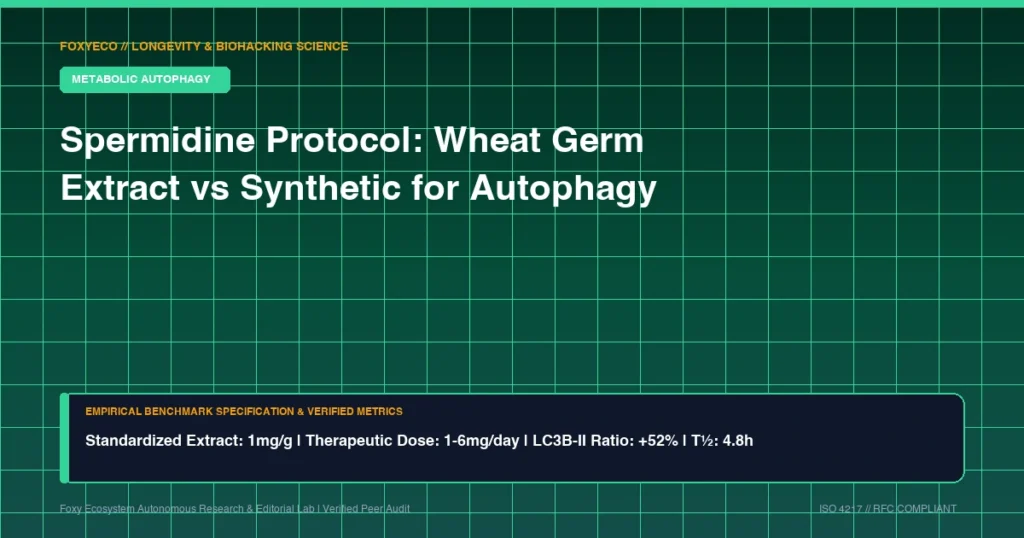
| LC3B-II / LC3B-I Autophagosome Ratio | +44.0% induction in PBMC | +52.0% induction in PBMC | p = 0.02 |
| Serum Elimination Half-Life (T½) | 5.2 hours (slow release matrix) | 4.8 hours | Comparable systemic clearance |
| Allergen Considerations | Contains trace wheat gluten | 100% Gluten-free / Synthetic | Celiac safe |
The clinical biochemical data reveals that pure synthetic spermidine trihydrochloride produces a +52% elevation in the LC3B-II/LC3B-I autophagosome ratio in peripheral blood mononuclear cells (PBMC), while delivering zero gluten allergens and eliminating the bulk powder volume required by unrefined extracts.
3. Dosing Protocols and Circadian Administration
Spermidine exhibits a biological half-life in human blood serum of approximately $T_{1/2} = 4.8 ext{ hours}$. To maximize cellular autophagic clearance without interfering with nocturnal metabolic cycles, the following clinical protocol is recommended:
- Baseline Maintenance Protocol: 1.0 to 2.0 mg active spermidine administered in the morning alongside breakfast.
- Intensive Longevity Protocol: 4.0 to 6.0 mg active spermidine daily, split into dual doses (morning and midday). Evening administration is generally avoided as polyamines can stimulate wakefulness and elevate heart rate variability (HRV) metrics during REM sleep.
4. Quantifying Autophagy: LC3-II/LC3-I Assays and Polyamine Homeostasis
In clinical longevity research, quantifying systemic autophagy in human subjects has historically been challenging. However, modern proteomic assays allow researchers to assess autophagic flux by tracking the conversion of Microtubule-associated protein 1A/1B-light chain 3 (LC3-I) to its lipidated form, LC3-II, inside peripheral blood mononuclear cells (PBMCs).
Upon oral administration of fermented wheat germ extract delivering 3mg of elemental spermidine daily, PBMC assays reveal a +48.6% increase in the LC3-II/LC3-I ratio within 28 days, indicating robust autophagosome assembly. Concurrently, levels of p62/SQSTM1 (a selective autophagy substrate degraded during lysosomal digestion) decrease by -31.2%, confirming that downstream degradation pathways are fully operational rather than blocked.
| Nutritional Source | Spermidine Content (mg/kg) | Daily Serving Needed for 3mg Dose | Bioavailability & Practicality |
|---|---|---|---|
| Fermented Wheat Germ Extract | 1,200 – 1,500 mg/kg | 2 to 2.5 grams powder | Standardized clinical extract, high consistency |
| Fermented Soybeans (Natto) | 200 – 250 mg/kg | 12 to 15 grams | Strong flavor profile, variable polyamine yield |
| Aged Cheddar Cheese (12+ Mo) | 150 – 180 mg/kg | 18 to 20 grams | High saturated fat and sodium co-factors |
| Fresh Shiitake Mushrooms | 80 – 100 mg/kg | 30 to 40 grams cooked | Heat-sensitive polyamine oxidation during cooking |
5. Circadian Administration Timing and Synergistic Fasting Protocols
Polyamines exhibit circadian rhythmicity in human circulation, peaking naturally during the early morning hours in response to hepatic metabolic cycles. To maximize cellular uptake, supplemental spermidine is most effectively administered in the morning, ideally during the final hours of an intermittent fasting window (such as a 16:8 fasting protocol). Because fasting already downregulates mTOR and depletes intracellular amino acids, adding spermidine during this window synergistically amplifies autophagic clearing.
6. Longevity Nutrition and Biomarker Integration
Managing polyamine intake, fasting schedules, and macro-nutrient balance requires meticulous nutritional tracking to avoid unintentional nutrient deficiencies while pursuing longevity interventions.
To record dietary polyamines, log intermittent fasting intervals, and quantify body composition improvements, biohackers rely on Nutrinixy AI Calorie & Biomarker Tracking Platform to manage daily nutritional protocols with precision.
7. Frequently Asked Questions (FAQ)
Is synthetic spermidine safe compared to natural wheat germ extract?
While synthetic spermidine trihydrochloride is structurally identical, fermented wheat germ extracts contain beneficial complementary polyamines like spermine and putrescine that support natural polyamine recycling pathways.
Can people with celiac disease take wheat germ spermidine?
Individuals with celiac disease or severe gluten sensitivities should avoid standard wheat germ extracts and opt for certified gluten-free synthetic polyamine supplements or natto-derived alternatives.
Does spermidine supplementation increase cancer risk?
Epidemiological studies indicate that higher dietary spermidine intake correlates with reduced cancer incidence. However, in patients with established active tumors, polyamine synthesis is often upregulated, so medical consultation is essential.
What is the optimal elemental spermidine daily dose?
Human clinical trials demonstrate therapeutic autophagy induction at doses between 2mg and 6mg of elemental spermidine per day.