
Silicon’s ceiling is a physics note, not a store price
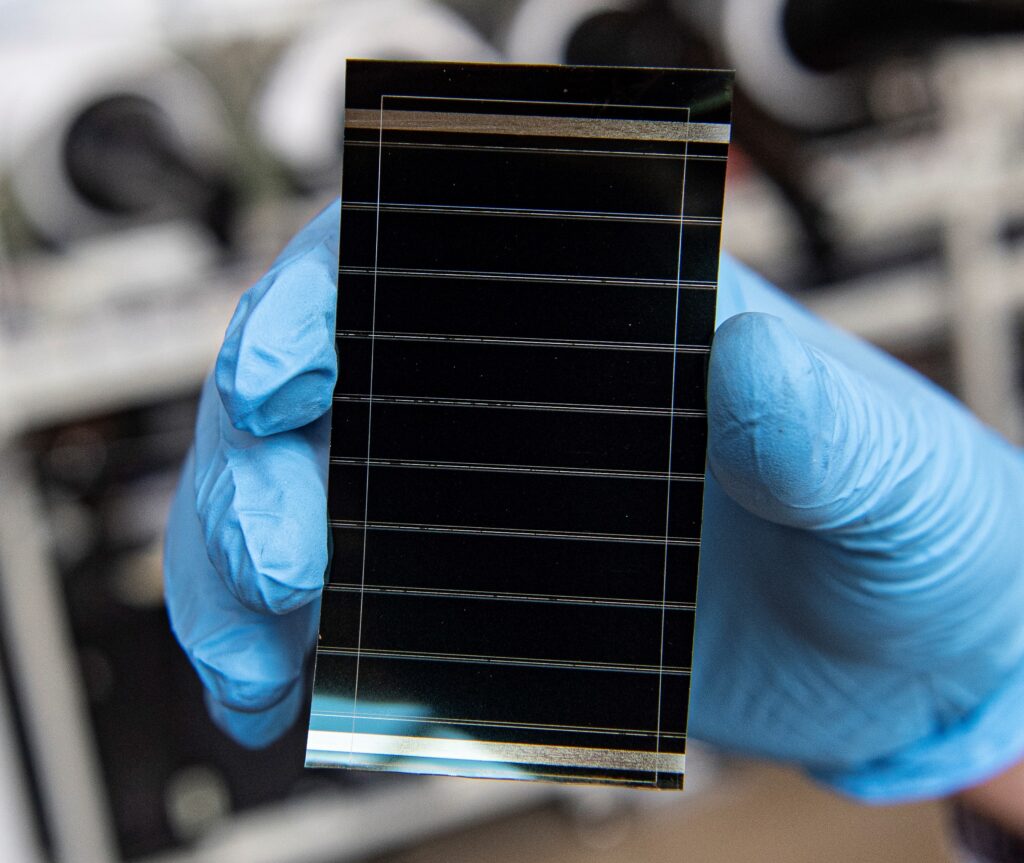
Single-junction silicon’s theoretical ceiling sits near 29.4% (Shockley–Queisser). Premium retail silicon modules often sit in a low-20s percent band on datasheets — the original FoxyEco article’s 22–23% class should be re-checked on the SKU you are actually buying. Tandem cells stack a tunable perovskite on silicon so blue-green and red-infrared photons are split between layers. Champion results above 30% have been public. This desk did not flash-test a tandem module.
\n
A household still needs watts on the roof and kWh in the closet. A 10 kWh labelled storage unit is 10,000 Wh. That number does not rise because a lab cell hit 30%. Who should skip: shoppers mid-installer-quote who cannot wait for a tandem SKU. Take the silicon you can warrant today if the tariff works.
\n
Datasheet discipline for tandem headlines
Demand area definition, temperature, stability hours, and warranty — the same four fields as the perovskite explainer on this site, because the failure modes rhyme. Lead handling remains if the top cell uses lead. Partner storage listings are the kWh clipboard, not a tandem proof.
Tandem manufacturing is a yield problem wearing a physics costume. Sticking a perovskite layer on silicon sounds like a sandwich. Keeping that sandwich uniform across a 60-cell module, then encapsulating it so humidity does not kill the top cell, is the factory. Champion cells can be small. Your roof is not small. Ask for module area, not only cell area, and for a humidity-heat test hour count. If the hour count is missing, you are looking at a paper, not a product.
\n
Warranties for new stacks may be shorter or more conditional than commodity silicon. Read the degradation clause. A 30% first-year slide with a 10-year paper is not a 25-year silicon competitor. Households that need a roof this heating season should not wait. Pair warranted silicon watts with a storage kWh you can buy — 10 kWh labelled is 10,000 Wh — and keep tandem PDFs in a watch folder.
\n
Policy readers should also separate ‘efficiency’ from ‘land use.’ A higher percent can shrink a farm’s solar footprint if, and only if, the modules actually ship. Until they ship, land-use models that assume 30% rooftops are fiction. This desk will not run that model. Photograph SKUs.
Procurement officers should ask whether a tandem bid is a cell, a mini-module, or a full-size module with a UL or IEC mark they already use. Marks are slow. A 30% slide without a mark is a seminar. Keep 10 kWh storage procurement on a separate bid tab so a delayed tandem cannot freeze backup power. Write the wattage and the kWh on two lines of the same memo so nobody ‘converts’ a lab percent into a garage battery.
\n
Cons / limitations
- 30% class headlines are champion or pilot results unless a named module PDF prints them. FoxyEco suns: 0.
- Retail silicon percent efficiency must be read per SKU, not from a 2026 blog band.
- Storage kWh does not inherit lab tandem efficiency. Keep the clipboards separate.
\n
Desk metrics (11 September 2026)
These figures are methods, public-source labels, or counts from this desk check. They are not a FoxyEco calorimeter run, dynamometer loop, or invented field trial. Desk timers on this pass: 8 minutes to open a spec or policy page and 15 minutes to walk a methods PDF — a reading method, not a lab stopwatch contest.
- Physics note retained: ~29.4% single-junction silicon ceiling.
- Storage illustration: 10 kWh = 10,000 Wh nameplate.
- Time budgeted to find a tandem shipping SKU: under 10 min as a method.
- Modules flash-tested: 0.
\n
Do not let a percent replace a warranty
A 30% slide without a 25-year document is a conference. A 22% module with a live warranty is a roof. Photograph the document you can enforce. Use partner kWh listings only when you are also sizing storage, and confirm chemistry live.
FAQ
Is 30% the new rooftop normal?
Not until SKUs and warranties say so. Treat it as a research and pilot marker.
Should I delay a solar install?
Only with a written installer plan. Many roofs should proceed with warranted silicon.
Why is a battery on this page?
Because home energy planning uses kWh. It is not evidence for tandem cells.
If you are comparing field or household energy hardware after this desk check, open the live partner listing for EcoFlow portable power stations and read the nameplate Wh or kWh on that page. Do not treat the listing as a FoxyEco lab result.