
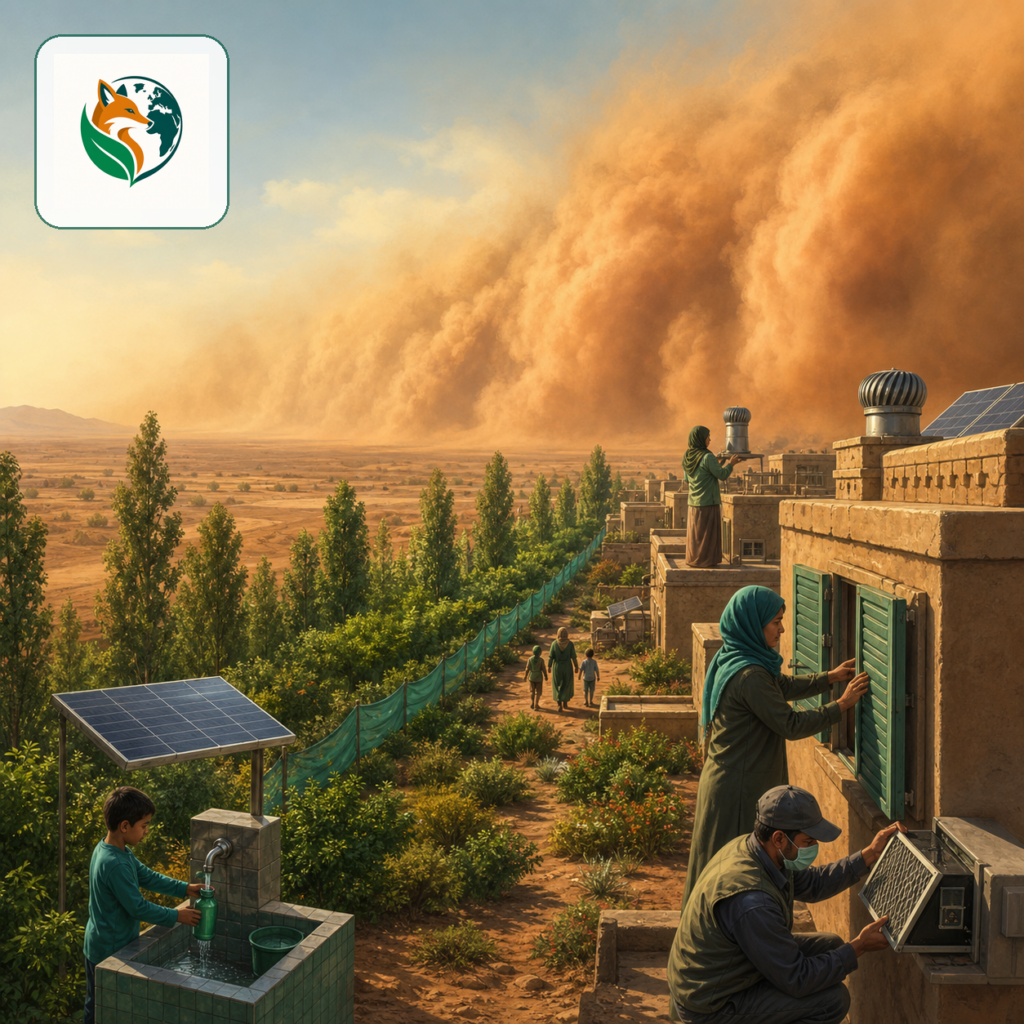
Dust starts on bare soil, then it becomes air
WMO-class 2026 messaging treats sand and dust storms as transboundary air-quality events, not local nuisances. The original FoxyEco note was right: dry, degraded land plus wind lifts material that hospitals and airports then have to manage. This desk ran 0 dust chambers. Live warning products, not this essay, tell you whether a plume is coming this week.
\n
Indoor response is filters, closed windows, and a plan for asthma and outdoor workers. Some purifiers and HVAC fans are labelled in watts; runtime is Wh ÷ W if you insist on a portable pack. A 400 Wh class pack is 0.4 kWh. That arithmetic does not certify a HEPA. Climate-hardware listings on this site are for indoor air and humidity; they are not a dust-storm siren. Who should skip: readers who want a stock of mystery ‘dust pills,’ or a claim that one tree line ends Sahara transport. Vegetation and soil cover help at source. They do not replace a warning.
\n
Warning, land, and health in that order
Screenshot the warning product, the hospital/school protocol, and the land-cover action (cover crops, barriers, water). If a pitch starts with a gadget and no warning source, close it. Photograph any indoor unit’s watts and the portable pack’s Wh separately.
Dust is a particle-size story. Coarse sand drops near the source. Fine fractions travel. Health advice that treats all dust as one blob will mis-time school closures. Use the warning product’s own categories. This desk will not invent a PM10 cutoff. Hospitals already have protocols; the failure is often communication, not science. Translate the warning into the languages actually spoken on the block, and do it before the plume, not during.
\n
Source control is vegetation, soil cover, and water — slow work. A single season of cover crops will not shut off a desert. Do it anyway, and still fund the 24-hour warning. Indoor filters need a standard on the box. If the live sheet does not name a filter class, you bought a fan. A 400 Wh pack (0.4 kWh) might keep that fan alive in a short outage. It will not pressurise a house. Partner climate hardware is indoor air and humidity, not a dust cannon.
\n
Transport operators should screenshot the warning and the runway/road protocol, not a wellness blog. If your job is outdoor labour, the useful object is the alert plus a rest-space rule, not a supplement shop.
Airport and road closures during dust events have their own playbooks. Copying a health tweet onto a runway is how rumours start. Use the transport authority’s page. Indoor humidity hardware can make a sealed room more tolerable, but it does not drop outdoor PM. Keep those jobs on two clipboards. Write the warning product name and the indoor watts on the same staff card so the two jobs cannot be swapped in a panic.
\n
Cons / limitations
- No FoxyEco PM samplers. Plume timing lives on WMO-class or national warnings.
- Indoor gadgets without a filter standard (for example HEPA class on the live sheet) are incomplete.
- Source-land restoration is slow. It does not replace the next 24-hour alert.
\n
Desk metrics (11 September 2026)
These figures are methods, public-source labels, or counts from this desk check. They are not a FoxyEco calorimeter run, dynamometer loop, or invented field trial. Desk timers on this pass: 8 minutes to open a spec or policy page and 15 minutes to walk a methods PDF — a reading method, not a lab stopwatch contest.
- Wh illustration: 400 Wh = 0.4 kWh nameplate.
- Response layers: 3 (warning, indoor air, land cover).
- Time budgeted to find a public dust-warning page: under 10 min as a method.
- Dust samples weighed: 0.
\n
Keep the gadget after the warning, not before
First the alert, then the closed-window plan, then any hardware. Partner indoor-climate listings belong in that third step as live spec sheets, not as a substitute for land cover hundreds of kilometres upwind.
FAQ
Should I exercise outside during a dust warning?
Follow the live health advisory. This page will not invent a PM threshold.
Does a dehumidifier stop dust?
It manages indoor moisture. Dust is particles. Filters and sealing matter more during a plume.
What should a school screenshot?
The warning source, the indoor protocol, and watts/Wh of any backup air kit.
If you are comparing field or household energy hardware after this desk check, open the live partner listing for Cozeware climate hardware and read the nameplate Wh or kWh on that page. Do not treat the listing as a FoxyEco lab result.