
Section 1
Section 1 Introduction For Decades, silicon has been the undisputed king of solar energy, dominant in over 95 percent of the global photovoltaic market. However, silicon solar technology is approaching its theoretical efficiency limit of approximately 29. 4 percent. To sustain the global energy transition, researchers are turning to a revolutionary class of materials: perovskites. Named after their unique crystal structure, perovskite solar cells have shown an unprecedented increase in conversion efficiency, rising from just 3. 8 percent in 2009 to over 26 percent in laboratory settings today.
Section 2
Section 2 This article examines the material science of perovskites, their potential to reshape the energy market, and the technical hurdles that must be overcome for commercial scaling. The Crystalline Science of Perovskites Perovskites are not a specific chemical compound, but rather a family of materials sharing a specific crystal structure with the formula ABX3. In a typical organic-inorganic halide perovskite solar cell, ‘A’ represents an organic cation (such as methylammonium), ‘B’ is a metal divalent cation (usually lead or tin), and ‘X’ is a halide anion (such as iodide or bromide). This unique crystal arrangement possesses exceptional optoelectronic properties. Perovskites have a high absorption coefficient, allowing thin layers of just a few hundred nanometers to absorb as much sunlight as thick silicon wafers. They also feature a tunable bandgap, meaning their chemical composition can be altered to absorb different wavelengths of the solar spectrum.
Section 3
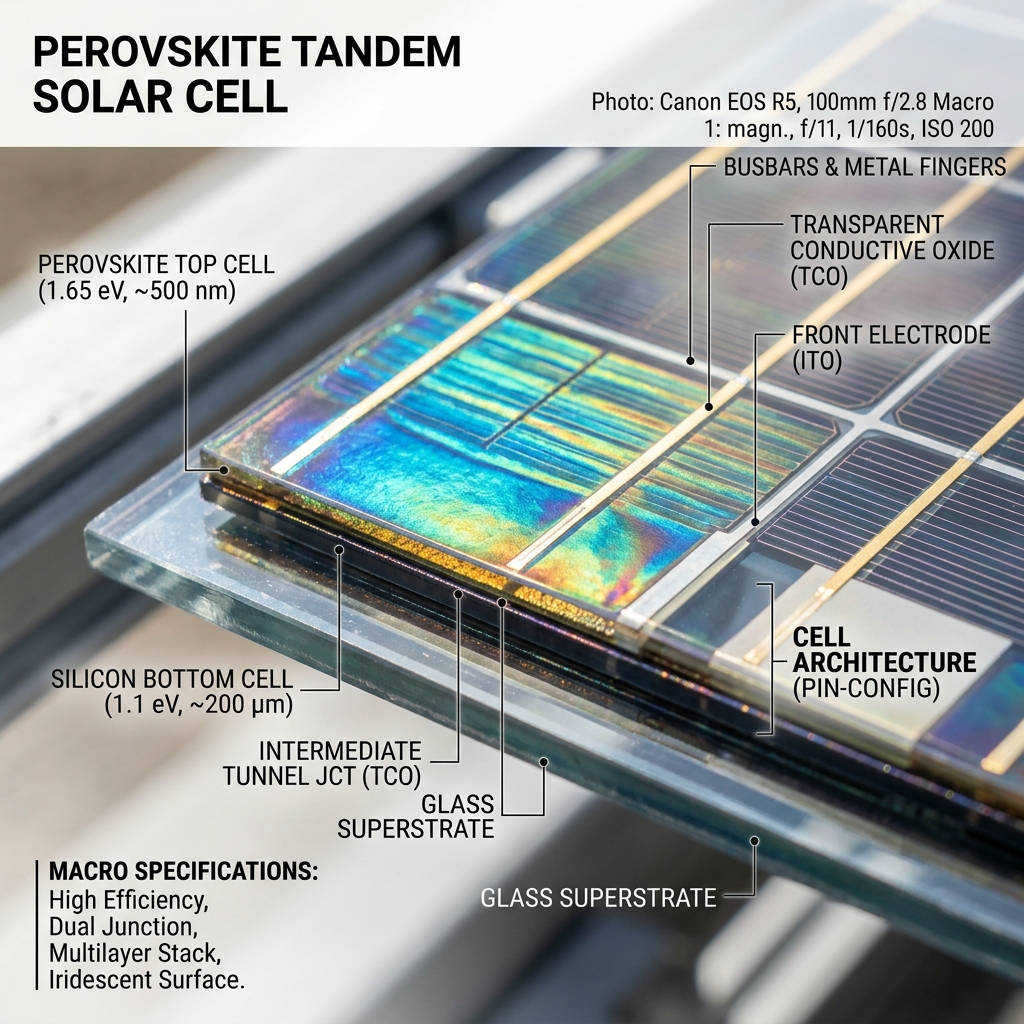
Section 3 Tandem Cells: Exceeding Silicon’s Limits The most immediate commercial application for perovskites is not in replacing silicon, but in upgrading it through tandem solar cells. By stacking a perovskite layer on top of a traditional silicon base, manufacturers can create a dual-junction solar cell. Silicon has a narrow bandgap that efficiently converts low-energy infrared light into electricity. Perovskites can be engineered with a wider bandgap to capture high-energy blue and green light. This combination allows a single tandem cell to harvest a wider range of solar radiation. Silicon-perovskite tandem cells have already achieved lab efficiencies exceeding 33 percent, offering a clear path to generating significantly more power from the same surface area.
Section 4
Section 4 Low-Cost, Low-Carbon Manufacturing Silicon Manufacturing is energy-intensive, requiring raw quartz to be melted in electric arc furnaces at temperatures exceeding 1,900 degrees Celsius, followed by expensive crystallization processes. In contrast, perovskite solar cells can be manufactured at low temperatures using solution-based processing. Perovskite inks can be printed or sprayed onto flexible substrates using roll-to-roll manufacturing methods, similar to printing newspapers. This low-temperature process dramatically reduces the energy and carbon footprint of manufacturing solar cells. Furthermore, because perovskite layers are extremely thin and flexible, they can be integrated into buildings, windows, and vehicle roofs, expanding the reach of solar power. The Dual Challenges: Stability and Toxicity Before perovskite solar cells can achieve widespread market adoption, they must resolve two critical vulnerabilities: stability and environmental toxicity.
Section 5
Section 5 Unlike durable silicon cells, which are guaranteed for 25 to 30 years, perovskites are highly sensitive to moisture, oxygen, ultraviolet light, and heat. Exposure to these factors causes the crystal structure to degrade rapidly, destroying its electrical properties. Researchers are developing advanced encapsulants and chemical additives to stabilize the material. The second concern is the presence of lead in the crystalline structure. While the amount of lead is small, its water-soluble nature poses potential environmental risks if the cells are damaged, forcing researchers to explore lead-free alternatives using tin or bismuth. Conclusion Perovskite solar cells represent the most exciting development in photovoltaic technology in a generation. With their high efficiency, tunable properties, and low-cost manufacturing, they have the potential to democratize clean energy worldwide. Although major engineering challenges in durability and chemical stabilization remain, the development of silicon-perovskite tandem cells is paving the way for commercial deployment. Overcoming these final hurdles will unlock the next era of solar energy, driving down costs and accelerating the global transition away from fossil fuels.