
Section 1
Section 1 Introduction The Oceans have absorbed approximately 30 percent of the carbon dioxide emitted by human activities since the beginning of the Industrial Revolution. While this massive absorption has buffered the atmosphere and slowed atmospheric warming, it has caused a fundamental shift in marine chemistry known as ocean acidification. Seawater pH has dropped from 8. 2 to 8. 1, representing a 30 percent increase in hydrogen ion concentration. This chemical shift reduces the availability of carbonate ions, which are the essential building blocks used by marine calcifiers—such as corals, shellfish, and pteropods—to construct their shells and skeletons. This article analyzes the chemical kinetics of ocean acidification and its cascading impacts on marine ecosystems.
Section 2
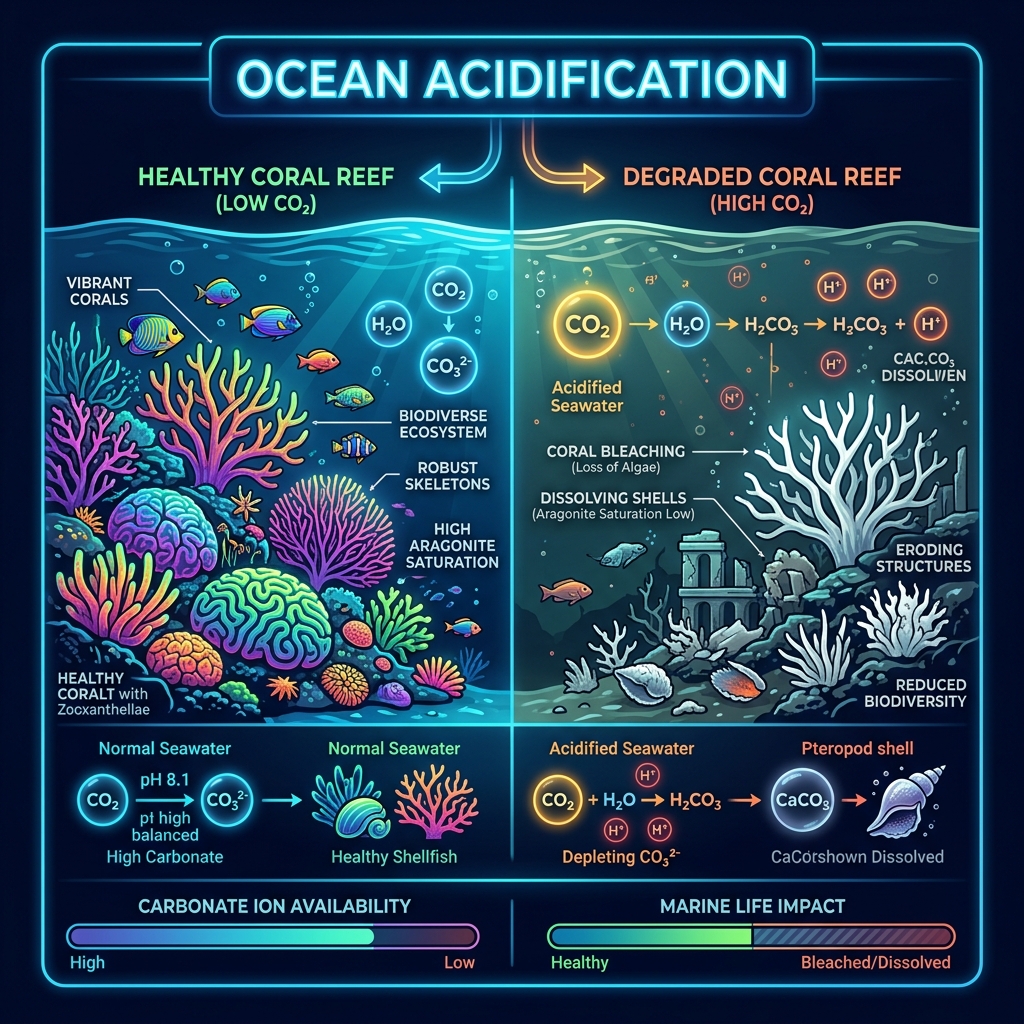
Section 2 The Chemical Reactions of Acidification The dissolution of carbon dioxide in seawater triggers a series of chemical equilibria that alter the ionic balance of the ocean. When gaseous CO2 dissolves in water (H2O), it forms carbonic acid (H2CO3): CO2 + H2O <-> H2CO3. Carbonic acid is unstable and rapidly dissociates into hydrogen ions (H+) and bicarbonate ions (HCO3-): H2CO3 <-> H+ + HCO3-. The release of hydrogen ions is what lowers the pH of the water. These excess hydrogen ions then react with carbonate ions (CO3 2-) already present in the water, converting them into additional bicarbonate: H+ + CO3 2- <-> HCO3-. This reaction consumes carbonate ions, reducing their availability for calcifying organisms. The Carbonate Saturation State The biological impact of acidification is measured by the carbonate saturation state, denoted by omega (Ω).
Section 3
Section 3 This state is the ratio of the product of calcium and carbonate ion concentrations to the apparent solubility product of calcium carbonate: Ω = ([Ca2+] * [CO3 2-]) / Ksp. When Ω is greater than 1. 0, the water is supersaturated, and calcium carbonate structures are stable. When Ω drops below 1. 0, the water is undersaturated, and calcium carbonate begins to dissolve. Marine calcifiers construct their shells using two primary forms of calcium carbonate: aragonite (used by corals and pteropods) and calcite (used by coccolithophores). Aragonite is highly soluble, making aragonite-based organisms the first to face shell dissolution as saturation states drop.
Section 4
Section 4 Impacts on Marine Calcifiers and Food Webs The reduction in carbonate availability forces calcifying organisms to expend significantly more energy to build and maintain their shells, leaving less energy for growth, reproduction, and defense. The ecological consequences are profound: Pteropods: These tiny marine snails, known as ‘sea butterflies,’ serve as the primary food source for salmon, herring, and baleen whales in polar oceans. Under current acidification projections, their shells can dissolve within 45 days, threatening the foundation of high-latitude marine food webs. Coral Reefs: Acidification slows coral calcification, weakening the structural integrity of reefs. Weakened reefs are more vulnerable to storm damage and bioerosion, threatening the habitats of 25% of all marine life. Shellfish: Oyster and mussel larvae experience high mortality rates in acidified waters, as they struggle to build their initial shells during their critical early life stages. Cascading Ecological and Economic Effects The loss of marine calcifiers will trigger cascading effects throughout global ecosystems and human economies.
Section 5
Section 5 Coral reef degradation threatens coastal tourism, commercial fisheries, and storm protection for millions of people living in coastal zones. The decline of key species like pteropods could desabilize commercial fisheries in the Pacific Northwest and North Atlantic, impacting food security and leading to significant job losses in the seafood industry. Furthermore, because calcifying organisms play a key role in the biological pump—transporting carbon to the deep ocean when they die—acidification could weaken the ocean’s capacity to absorb future carbon emissions. Conclusion Ocean acidification is often called the ‘other carbon dioxide problem,’ but its impacts are just as severe as warming temperatures. By altering the fundamental chemistry of seawater, human carbon emissions are dissolving the skeletal structures of the organisms that anchor marine food webs. Addressing this crisis requires a rapid, global reduction in carbon emissions. Protecting marine ecosystems from chemical collapse is not only a conservation duty, but a necessity for securing global food security and preserving the chemical balance of our planet’s largest habitat.