
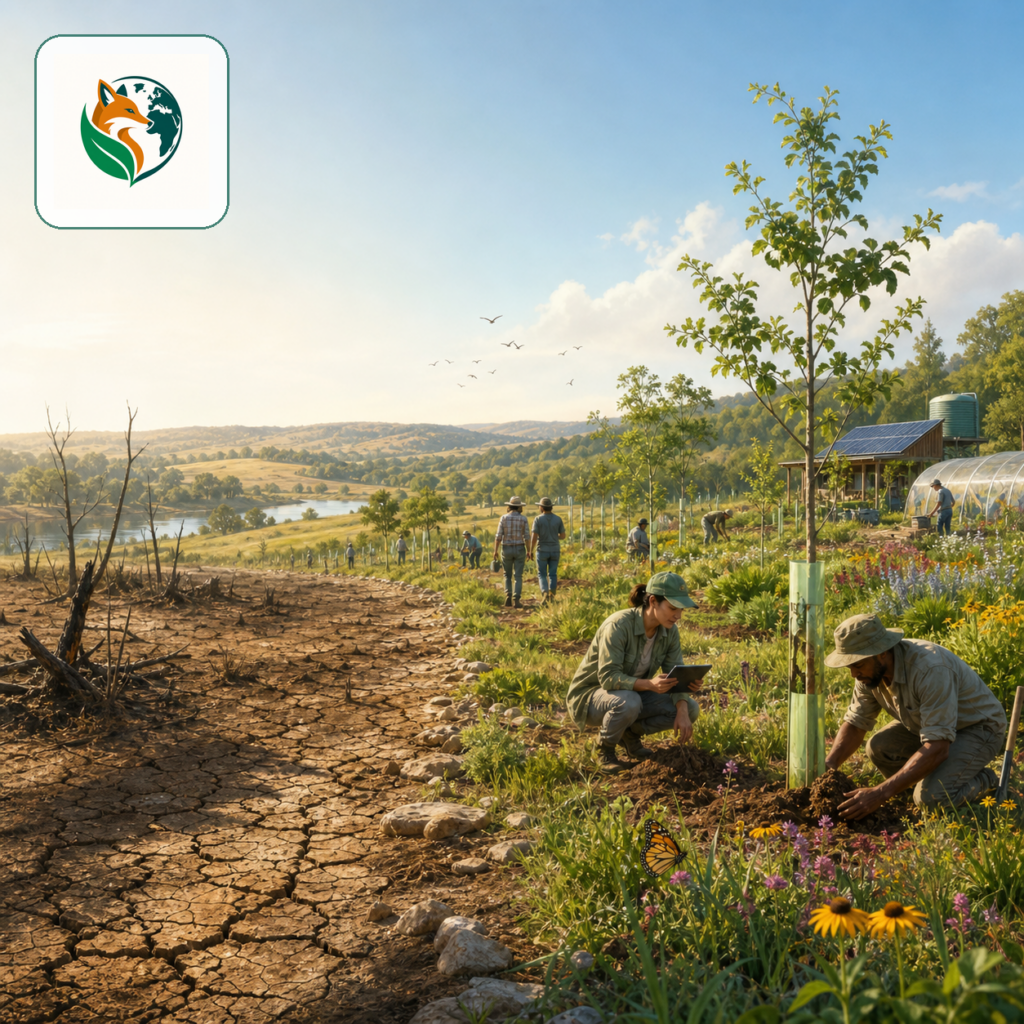
Restoration is infrastructure you can put a spade into
UNEP-class land-degradation warnings tie soil, drought, food, and biodiversity together. The original FoxyEco 2026 note was right: the point is not a museum landscape. Cover, roots, wetlands, and fewer destructive inputs rebuild function. This desk did not survey a catchment and will not invent hectares restored. The method is a map of erosion, water stress, and habitat gaps, then actions that survive a budget year.
\n
Pumps, fences, and loggers need energy. A 3,000 Wh class portable station is 3 kWh on the nameplate. A drip-filter pump may be listed in continuous watts, not Wh; you still convert runtime with Wh ÷ W if you must plan a day. That is arithmetic on two stickers, not a well-yield test. Who should skip: readers who want a tree-planting ranker or a carbon-credit checkout. Start with soil cover and water, not a selfie seedling.
\n
Local plans beat global slogans
Farmers and councils need shared maps. A national tree target that ignores grazing pressure and water rights fails in year two. Photograph the baseline: photos with dates, simple infiltration notes, and the logger’s Wh so the dry-season gap is not a dead battery. Partner power listings are for that logger and radio budget, not a land-use permit.
Degraded land is often a water-rights story wearing a tree costume. Planting into a catchment that already over-allocates irrigation is how restoration becomes a second drought. Ask who has the water, in writing. This desk did not adjudicate a basin. You can still demand the document. Grazing pressure is the other silent variable. A fence without a grazing agreement is a rumour.
\n
Simple field metrics beat satellite vanity: infiltration time on a standardised test, percent bare soil on a repeat photo point, and seedling survival. Satellites can help at scale if someone still walks the photo points. Loggers that measure soil moisture need Wh. A 3,000 Wh pack (3 kWh) that cannot be locked will vanish. Budget the lock. Partner power listings are the nameplate for that lock-and-pack kit, not a land-use approval.
\n
Carbon in soil is real and slow. Lead with erosion and water if you want farmers to stay in the programme after the grant year. A tonne certificate that pays before survival is a leak. Do not let this URL become a credit shop.
Photo points need a nail, a compass bearing, and a date stamp. Three photos without those are a holiday. Soil moisture loggers need the 3 kWh-class pack locked and shaded. If the grant buys drones but not locks, expect missing data. Partner power listings are the lock-and-pack nameplate, not a drone programme. Write the bearing on the nail so the next intern can find it without a legend that lived only in someone’s head.
\n
Cons / limitations
- Hectare totals on this page are not FoxyEco surveys. Use the jurisdiction’s own ledger.
- Seedling counts without survival and water rights overstate restoration.
- Pump kWh and logger Wh are labels. This desk did not certify a well.
\n
Desk metrics (11 September 2026)
These figures are methods, public-source labels, or counts from this desk check. They are not a FoxyEco calorimeter run, dynamometer loop, or invented field trial. Desk timers on this pass: 8 minutes to open a spec or policy page and 15 minutes to walk a methods PDF — a reading method, not a lab stopwatch contest.
- Wh illustration: 3,000 Wh = 3 kWh nameplate.
- Map layers to request: 3 (erosion, water stress, habitat gaps).
- Time budgeted to find a local restoration progress page: under 15 min as a method.
- Hectares walked by this desk for this URL: 0.
\n
Touch soil, then talk carbon
Carbon in restored soil is a slow co-benefit. Lead with erosion and water. If a pitch leads with a tonne certificate and no infiltration note, walk away. Confirm Wh on any kit you actually buy.
FAQ
Is planting trees always restoration?
Only if they belong there and survive. Grassland and wetland sites can be harmed by the wrong trees.
Can a home battery restore land?
No. It can run a logger or a small pump if the watt sheet fits. The land work is still soil and water.
What should a donor screenshot?
Baseline maps, survival rates, water rights, and the energy labels of any kit in the budget.
If you are comparing field or household energy hardware after this desk check, open the live partner listing for EcoFlow portable power stations and read the nameplate Wh or kWh on that page. Do not treat the listing as a FoxyEco lab result.