
Section 1
Section 1 Introduction As Wind and solar power expand to dominate global electricity grids, they introduce a fundamental challenge: intermittency. Solar energy disappears at night, and wind can die down for days at a time. While lithium-ion batteries are excellent for short-term energy storage (typically 2 to 4 hours), they are far too expensive to scale for multi-day or seasonal grid storage. To build a fully decarbonized energy grid, we need low-cost, long-duration energy storage (LDES) technologies. Iron-air batteries, which store energy through the controlled rusting and unrusting of iron, have emerged as a leading contender. Offering a storage duration of 100 hours at a fraction of the cost of lithium-ion, this technology could unlock the next phase of the renewable energy revolution.
Section 2
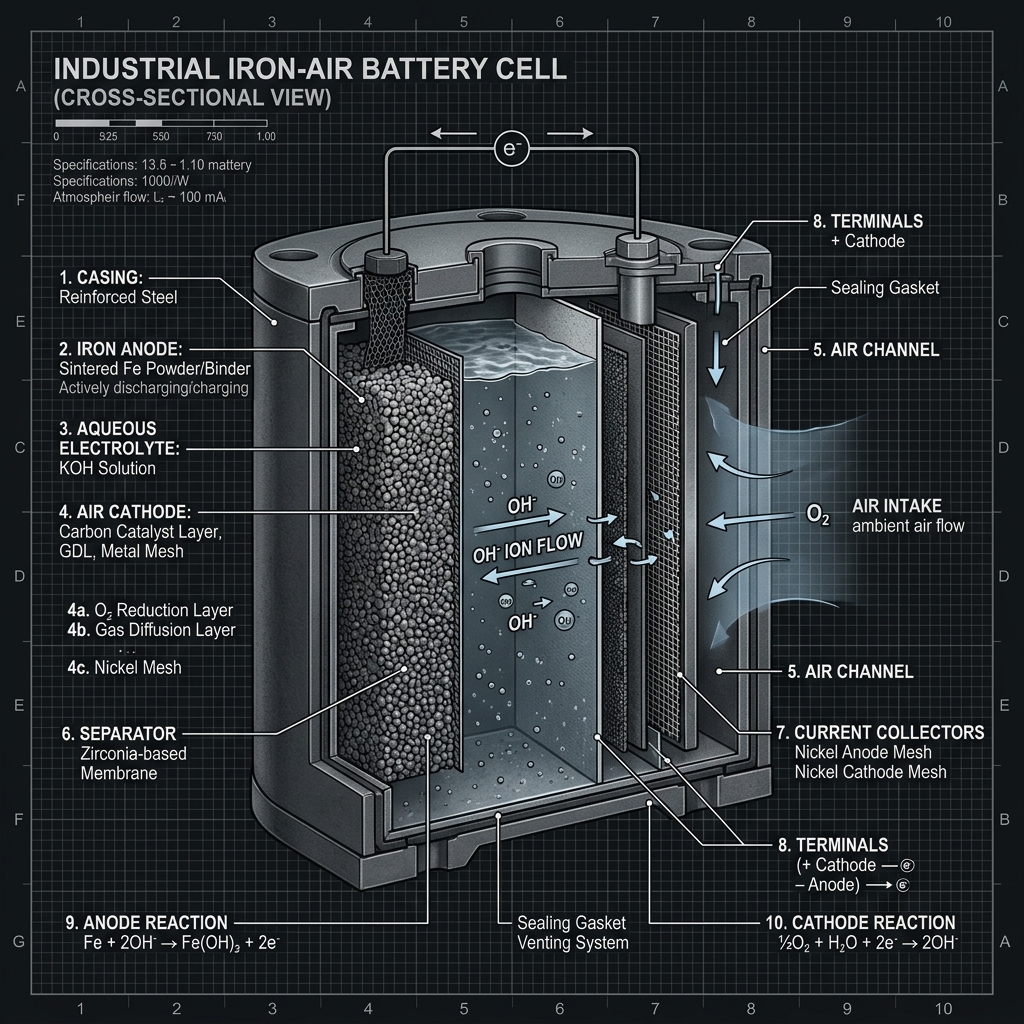
Section 2 This article analyzes the chemical mechanisms, cost physics, and grid potential of iron-air batteries. The Chemistry of Rusting as Energy Storage The operational chemistry of an iron-air battery is elegant in its simplicity, utilizing the natural process of iron oxidation, commonly known as rusting. The battery consists of an anode made of abundant, porous iron metal, a liquid alkaline electrolyte (typically potassium hydroxide), and an air-breathing cathode. During discharge, the battery breathes in oxygen from the air. The oxygen molecules react at the cathode, forming hydroxyl ions that travel through the electrolyte to the iron anode, where they oxidize the iron into iron oxide (rust). This oxidation reaction releases electrons, generating electrical current: Fe + 2OH- -> Fe(OH)2 + 2e-.
Section 3
Section 3 To charge the battery, an electrical current is applied in reverse, converting the iron oxide back into metallic iron and releasing oxygen, a process equivalent to ‘unrusting’ the battery. Unmatched Material Abundance and Low Cost The primary advantage of iron-air batteries over lithium-ion systems lies in raw material costs and supply chain stability. Lithium-ion batteries rely on expensive, geopolitically sensitive materials such as cobalt, nickel, and lithium, which are prone to supply bottlenecks. In contrast, the active materials of an iron-air battery are iron, water, and air. Iron is the most refined metal on Earth, with vast global supply chains and massive production capacities. Consequently, the material cost of an iron-air battery is estimated to be below $20 per kilowatt-hour of capacity, compared to over $100 to $130 per kilowatt-hour for lithium-ion systems.
Section 4
Section 4 This ultra-low cost makes long-duration, multi-day grid-scale installations economically viable. Low Energy Density: The Land Footprint Trade-off While iron-air chemistry is ideal for grid storage, it has a significant limitation: low energy density. Iron-air batteries are heavy and bulky, making them entirely unsuitable for electric vehicles or portable electronics where weight and space are critical constraints. For grid installations, however, physical size is a secondary concern. An iron-air battery station requires more land area than a lithium-ion equivalent, but it can be housed in modular, warehouse-like structures situated near wind farms, solar fields, or retired coal power plants, repurposing existing grid connections and infrastructure without requiring excessive land clearing. Slow Charge and Discharge Cycle Mechanics Iron-air batteries operate on a slow cycle mechanism, designed to discharge continuously for up to 100 hours (about 4 days).
Section 5
Section 5 They have a lower round-trip efficiency (RTE) than lithium-ion batteries. While lithium-ion systems boast an RTE of 85% to 90%, iron-air batteries typically operate at an efficiency of 40% to 50% due to the energy required to drive the electrochemical rust reduction process. However, this lower efficiency is offset by the extremely low cost of capital and the fact that they are designed to store cheap, surplus renewable energy that would otherwise be wasted (curtailed) during peak production periods. Conclusion Iron-air batteries represent a vital, missing link in the global renewable energy infrastructure. By utilizing the simple chemistry of iron rust, this technology provides an ultra-low-cost, environmentally friendly solution to the multi-day grid intermittency of wind and solar power. Free from the supply chain constraints and fire risks of lithium-ion, iron-air storage systems can be deployed globally using existing industrial infrastructure. As commercial production scales up, these batteries will play a central role in stabilizing future energy grids, facilitating the permanent retirement of fossil-fuel-powered peaking plants.