
Section 1
Section 1 Introduction For Billions of years, life on Earth evolved under a reliable cycle of light and dark. This circadian rhythm regulated the behaviors, migrations, and physiological processes of almost every living organism. However, the rapid expansion of urbanization has filled the night sky with artificial light at night (ALAN). Today, over 80 percent of the world’s population lives under light-polluted skies, and nocturnal species—which represent more than half of all terrestrial wildlife—are facing an unprecedented ecological crisis. Light pollution acts as a sensory pollutant, fragmenting habitats, altering predator-prey dynamics, and disrupting critical reproductive behaviors. This article analyzes the biological mechanisms of this disruption and its broader impacts on global biodiversity. Disruption of Circadian Rhythms and Hormonal Cycles At the physiological level, light pollution disrupts the internal biological clocks of animals by suppressing the production of melatonin, a hormone critical for regulating sleep-wake cycles, thermoregulation, and immune function.
Section 2
Section 2 In vertebrates, melatonin is synthesized in response to darkness. Even low levels of artificial light can inhibit this synthesis. For birds, exposure to ALAN causes premature breeding behavior, disrupts sleep, and causes singing to begin hours before dawn, depleting their energy reserves. In mammals, chronic melatonin suppression has been linked to weakened immune responses and reproductive failures, reducing the long-term viability of urban wildlife populations. Navigation and Migration Hazards Many migrating species rely on celestial cues, such as the stars and the moon, to navigate during their long journeys. Artificial light sources disorient these animals, causing them to drift off course. The most well-documented example is sea turtle hatchlings.
Section 3
Section 3 Emerging from nests on sandy beaches at night, hatchlings naturally crawl toward the brightest horizon, which historically was the ocean reflecting starlight. Today, bright coastal developments draw hatchlings inland toward roads and predators, resulting in millions of deaths annually. Similarly, migrating birds are attracted to illuminated skyscrapers, circling them until they collapse from exhaustion or die from collisions, causing hundreds of millions of avian fatalities each year. Predator-Prey Dynamics and Foraging Shifts ALAN alters the balance between predators and their prey by removing the cover of darkness. Diurnal predators, such as hawks and kestrels, extend their hunting hours into the night, exploiting illuminated areas. For prey species, like rodents and bats, the increased visibility makes foraging extremely dangerous. To avoid predators, these animals reduce their feeding times, leading to chronic stress and nutritional deficits.
Section 4
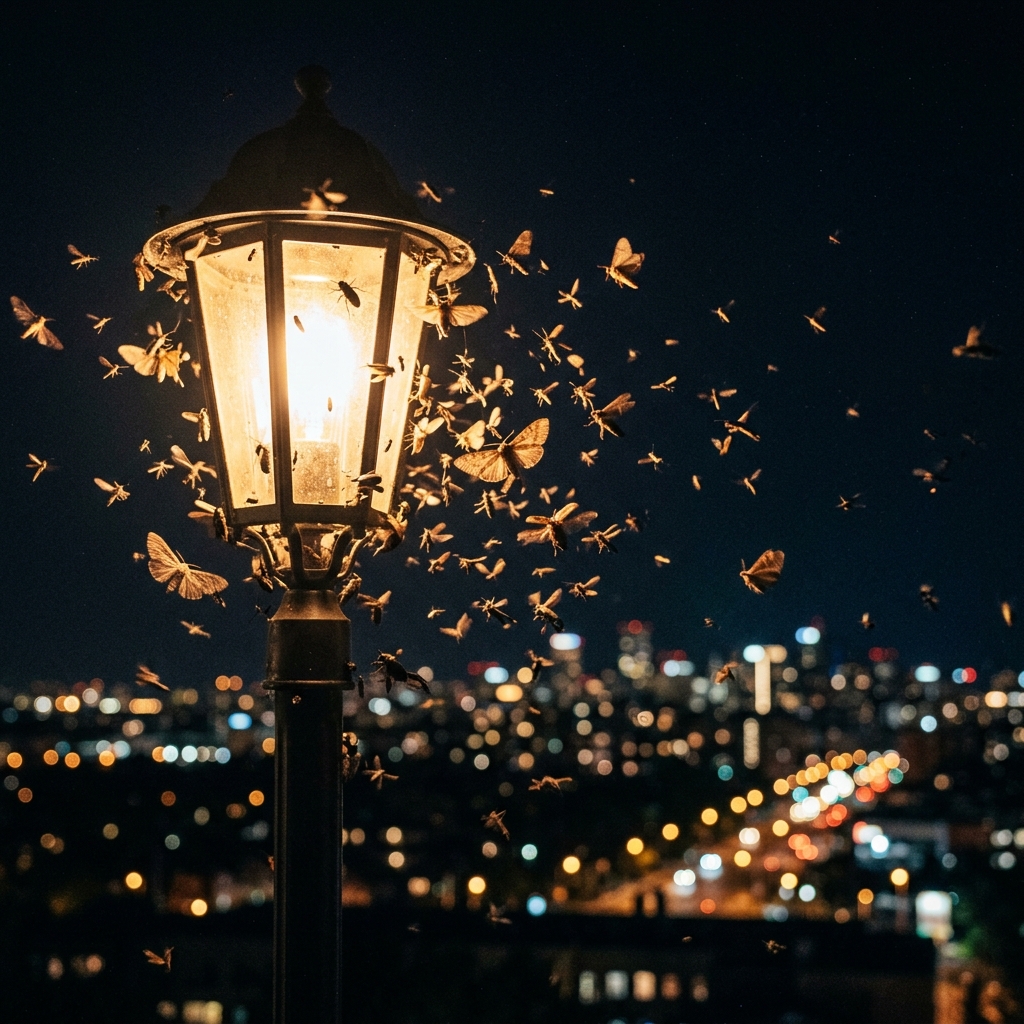
Section 4 Conversely, some opportunistic predators, like certain bat species, gather around streetlights to feed on disoriented insects, creating artificial advantages that disrupt local ecological balances and outcompete other sensitive species. The Insect Apocalypse and Plant Pollination Insects are the foundation of terrestrial food webs, and their populations are declining globally at alarming rates. Light pollution is a primary, yet often overlooked, driver of this decline. Millions of nocturnal insects are attracted to artificial lights, entering a state of exhaustion or falling prey to predators. Furthermore, ALAN disrupts nocturnal plant-pollinator interactions. Studies show that artificial lighting reduces nocturnal pollination visits by over 60 percent. Because many plants rely on nocturnal moths and beetles for reproduction, this disruption leads to reduced seed output, affecting plant diversity and the herbivorous species that depend on them.
Section 5
Section 5 Mitigation Strategies: Designing Ecological Lighting Unlike chemical pollution, light pollution can be mitigated immediately by changing how we design and deploy lighting. Effective strategies include: Shielding and Directionality: Using fully shielded fixtures that direct light downward, preventing skyglow and light trespass into natural habitats. Spectral Management: Transitioning from blue-rich white LEDs to warm-amber lighting (less than 2200 Kelvin), which has a minimal impact on wildlife physiology. Smart Control Systems: Implementing motion sensors, timers, and dimming controls to ensure light is only present when and where it is needed. Conclusion Light pollution is a major threat to global biodiversity, disrupting the fundamental rhythm of night and day. By disorienting migratory animals, altering predator-prey dynamics, and decimating insect populations, artificial light is silently degrading ecosystems worldwide. However, this is a highly solvable environmental crisis. Through smart lighting design, policy regulation, and community action, we can easily reclaim the dark skies, restoring natural habitats and protecting nocturnal wildlife without compromising human safety or urban functionality.